
Zona de identificação
Código de referência
Título
Data(s)
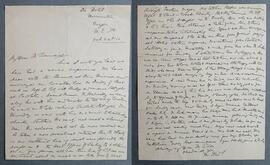
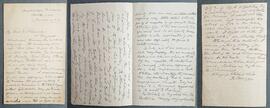
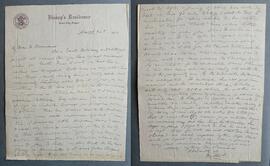
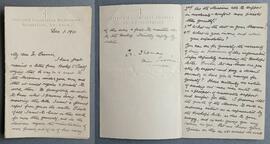
- 1890-2015 (Produção)
Nível de descrição
Dimensão e suporte
10 boxes, comprising 120 files and 116 items
Zona do contexto
Nome do produtor
Entidade detentora
História do arquivo
Fonte imediata de aquisição ou transferência
Zona do conteúdo e estrutura
Âmbito e conteúdo
The Irish Capuchin Franciscans founded the Western American Province of the Order, establishing missions throughout the Western United States (firstly in Oregon and later in California), beginning in the early 1900s.
Origins and Early Timeline in Oregon
In 1910 the Irish Capuchins were requested by Charles Joseph O’Reilly, the Bishop of Baker City in Oregon, to minister to the pastoral needs of newly arrived immigrants and local Native Americans. The mission was explicitly driven by the need to provide religious services to growing immigrant populations in the Western United States in the early part of the twentieth century.
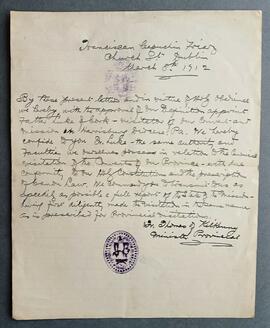
The Irish friars responded to this call and in early 1910 Fr. Luke Sheehan OFM Cap. and Fr. Thomas Dowling OFM Cap. travelled to Oregon, to a region bordering the Columbia River, between Bend and Hermiston, an area roughly the size of Ireland itself. They established their first residence at Our Lady of the Angels in Hermiston. The Capuchins celebrated their first Mass in Hermiston on 20 February 1910.
Other Irish Capuchin houses and churches were established in Oregon at Bend and in Roseburg. The historic St. Francis of Assisi Catholic church in downtown Bend was built in 1920 by Fr. Luke Sheehan OFM Cap. and was staffed by Irish Capuchin Franciscans for sixty-six years. Fr. Camillus Killian OFM Cap. and Fr. Edward Walsh OFM Cap. were the first Irish Capuchins assigned to St. Joseph’s Parish in Roseburg in 1912.
The Irish Capuchin leadership was willing to send more friars, but it was a long and difficult journey from Ireland to the West Coast of America, so parishes were accepted in Abbottstown, Pennsylvania, and later in Lincoln, Nebraska. This allowed the long journey, across one of America’s first cross-country passages, to be broken up into segments.
Mendocino County, California
In 1920, English Capuchin friars (who had established a parish ministry in Mendocino, California) were called to serve in missions on the Indian subcontinent. The Irish Capuchins were asked to take their place. As a consequence, Archbishop Edward Joseph Hanna of San Francisco transferred the administration of the whole of Mendocino County to the Irish Capuchin friars.
The Irish friars quickly expanded their ministry from Oregon into Northern California, building several churches and friaries, again mainly serving immigrant communities. Within Mendocino, there were several centres, notably in Ukiah, Fort Bragg, Elk, Mendocino Town, Willits, and Hopland. In each of these locations churches and schools were constructed serving as centres for parochial ministry and Capuchin missionary work. In the late 1960s, the Capuchin Order ended its pastoral services throughout the majority of Mendocino County.
Missions and Foundations
Serving as Archbishop of San Francisco from 1915 to 1935, Edward Joseph Hanna gave encouragement to the Irish Capuchins as the they expanded from their initial mission in Oregon into California.
In 1924 Fr. Albert Bibby OFM Cap. was sent to the United States and appointed Pastor of the Capuchin Mission at Santa Inés in Santa Barbara County, one of the twenty-one historic Spanish Franciscan missions established in Alta California.
A critical focus for the Irish friars was restoring the historic, early-nineteenth century Santa Inés Mission, located north of Los Angeles. Fr. Albert Bibby, alongside Brothers Reginald O’Hanlon and Colmcille Cregan, installed modern plumbing and electricity to revitalize the mission’s physical structure.
Father Albert Bibby was ardent Irish nationalist and fluent Irish speaker who was prominent in the 1916 Rising. He was sent to California in 1924 to lead the Santa Inés mission but died only three months after his arrival. He was initially buried outside the mission’s chapel, but his remains were repatriated to Ireland in 1958.
Santa Inés remains an active Catholic parish while the mission itself has been designated a National Historic Landmark.
Elsewhere in California, Archbishop Hanna blessed and opened St. Mary’s Church in Ukiah on 25 March 1924, which served as major foundation for the Irish Capuchin friars in the West.
Watts, Los Angeles
A few years after they had taken charge of Mendocino County, the Irish Capuchin friars moved further south in California to Los Angeles at the request of the Limerick-born Bishop John Joseph Cantwell (later the Archbishop of Los Angeles). In 1922 he asked the friars to take charge of the parish of Watts, a parish of mixed ethnic backgrounds, now home to a large population of Hispanic Americans and African Americans. The friars dedicated this parish to the Capuchin saint, Lawrence of Brindisi.
Burlingame, San Mateo County, California
Having impressed with their work in the Mendocino County, in 1926 Archbishop Hanna invited the Irish Capuchin friars to take up a ministry in his Diocese of San Francisco. He entrusted the new parish of Burlingame to their care which was dedicated to Our Lady of the Angels with Fr. Thomas Dowling OFM Cap. appointed the first pastor and Fr. Berchmans Cantillon OFM Cap. as his assistant.
Further Development
By 1936 the Irish Capuchins were present in four states and six dioceses with a total of fifteen foundations. With the opening of a new novitiate in Wilmington, Delaware (1937-1963), the Irish friars’ presence in Pennsylvania and Nebraska ended.
From 1937, the Irish Capuchin mission in the United States was officially termed the Custody of St. Patrick and local vocations were increasingly deemed a priority.
St. Francis High School, La Cañada Flintridge, California
Up to 1945, the foundations established by the Irish friars in the United States had been directed almost exclusively towards parochial ministry. For several years the question of founding a high school had engaged the attention of superiors.
In 1945, Fr. Stephen Murtagh OFM Cap., the Irish Capuchin superior in California, secured property in the Flintridge (now known as La Cañada) district of Los Angeles with the intention of establishing a high school.
St. Francis High School opened on 16 September 1946. Many of the school’s early administrators and teachers were Irish-born friars, notably Fr. Valerian O’Leary OFM Cap., Fr. Emilian Meade OFM Cap., and Fr. Cyril Kelleher OFM Cap.
St. Francis High School now has a total student population of approximately 620 boys and is consistently ranked among the best of its class in California. It continues to be sponsored and operated by the Capuchin Franciscan Order of the Western America Province (known as the Province of Our Lady of Angels).
San Lorenzo Novitiate, Santa Ynez Valley, California
By 1963, the friars decided they no longer needed the Wilmington (Delaware) foundation on the East Coast as a new novitiate, San Lorenzo, was established in the Santa Ynez Valley in California, near the Santa Inés Mission. The Capuchin novices at San Lorenzo engage in a life of prayer and service, participating in community activities and ministries, such as preparing food for the homeless, as part of their formation and training. Today, San Lorenzo serves as the inter-provincial novitiate for the North American Capuchin Conference.
Establishment of the Western American Capuchin Province
The Custody of St. Patrick in the Western United States was elevated to a Vice-Province in 1970. Following nearly seventy years of governance under Irish friars, the Western American Capuchin territory achieved full independence on 18 April 1979, becoming the Province of Our Lady of the Angels.
At the time the province gained its administrative independence, the Irish friars maintained thirteen houses in California and one in Oregon.
In 1985, the friars established their own mission in Northern Mexico, beginning at Yécora, in the state of Sonora. Friars from other American Capuchin provinces assist this mission, which is now the Custody of San Juan Diego.
The Capuchin friars in California remain focused on serving a diverse population, including Hispanic, Native American, and African American communities, following the Franciscan charism of aiding the poor and marginalized.
Current Presence
A very small number of Irish-born friars still minister in the United States. Today, the Western American Province continues its mission, serving communities across six states (California, Oregon, Washington, Idaho, Nevada, and Arizona) and in Northern Mexico.
Their varied work includes:
• Parish ministry
• Hospital and prison chaplaincy
• Community outreach, including serving the homeless and marginalized
• Campus and school ministry and evangelization
Legacy
The legacy of the Irish Capuchin friars in the Western United States forms an important part of California’s Catholic history, a testament to their dedication to serving poor immigrants and establishing vibrant faith communities.
Avaliação, seleção e eliminação
Incorporações
Sistema de arranjo
Zona de condições de acesso e utilização
Condições de acesso
Access is open to bona fide researchers. Records containing personal information such as minutes and correspondence are subject to access restrictions.
Condiçoes de reprodução
Idioma do material
- inglês
- latim
Sistema de escrita do material
Notas ao idioma e script
Características físicas e requisitos técnicos
The papers are generally in good condition
Instrumentos de descrição
Descriptive catalogue
Zona de documentação associada
Existência e localização de originais
Existência e localização de cópias
Unidades de descrição relacionadas
Nota de publicação
Fr. Conrad O’Donovan OFM Cap., ‘The Irish Capuchins in the United States of America’, ‘The Capuchin Annual’ (1973), pp 249-89 can be viewed at https://designrr.page/?id=315961&token=3957567399&type=FP&h=8418
Zona das notas
Identificador(es) alternativo(s)
Pontos de acesso
Pontos de acesso - Assuntos
Pontos de acesso - Locais
Pontos de acesso - Nomes
Pontos de acesso de género
Zona do controlo da descrição
Identificador da descrição
Identificador da instituição
Regras ou convenções utilizadas
Estatuto
Nível de detalhe
Datas de criação, revisão, eliminação
Línguas e escritas
- inglês