
Identificatie
referentie code
Titel
Datum(s)
- 1913-1969 (Vervaardig)
Beschrijvingsniveau
Omvang en medium
38 items; manuscript and typescript
Context
Naam van de archiefvormer
Biografie
Michael Joseph Dowling, the son of Michael and Catherine Dowling (née Byrne), was born in Kilkenny on 13 March 1874. John Dowling, an older brother, joined the Capuchins in 1888 and took Laurence as his religious name. Michael followed in his brother’s footsteps and joined the Order in Kilkenny a year later in September 1889. He took Thomas as his religious name and he was solemnly professed as a friar in October 1894. He was ordained a priest in Kilkenny on 21 December 1896. Fr. Thomas was a professor at Rochestown Capuchin College in Cork, and later served as guardian (local superior) of the Capuchin Friary in Dublin. He visited Oregon in the United States in 1910 to select a suitable mission parish for the Irish Capuchins in Baker City. In this period, he held several senior administrative positions in the Order and served as definitor (councillor) from 1907-10 and was Provincial Minister of the Irish Capuchins from 1910-3. He was also guardian of Holy Trinity Friary in Cork in 1920.
He emerged as a prominent public figure in Cork because of his high-profile campaigning on social and political issues. He was active in the Anti-Conscription campaign in the city in 1918 and was elected Honorary President of the Cork and District Trades and Labour Council. During the First World War, there was widespread economic distress in Cork as wages failed to keep pace with rising prices. The result was numerous strikes and general worker unrest. Dowling had studied social reform and he threw himself wholeheartedly into the task of industrial dispute mediation. His interventions were accepted by employers and trades unions alike. He presided over negotiations between tramway workers and their employers in a crucial wage dispute and was instrumental in securing a settlement between the two sides in 1919. He was awarded the freedom of Cork in 1920 in recognition of his invaluable services in preserving the peace of the city and for his role in successfully resolving industrial disputes. He also received an honorary degree (an LL.D. or a Doctor of Laws) from Professor P.J. Merriman (1877-1943), President of University College Cork. The award was given on account of his ‘invaluable services’ in ensuring peaceful and harmonious social relations in the city. The Cork Trades’ Council later donated a stained-glass window to Holy Trinity Church to mark his contribution in securing workers’ rights.
His ministries as a Capuchin friar centred on preaching missions and retreats and he was also an enthusiastic promoter of the temperance cause (he was instrumental in organising the Father Theobald Mathew Pavilion at the Cork International Exhibition in 1902). In 1926 Fr. Thomas offered to travel to the United States to work as a missionary friar. The Irish Capuchins had established a mission custody on the American Pacific Coast in 1910. His first appointment was in Our Lady of the Angels Church and Capuchin Friary in Burlingame near San Francisco. He was appointed Pastor of St. Lawrence of Brindisi Church situated in Watts in South Los Angeles in 1937. In the following years he succeeded in paying off the considerable debt on both the church and the adjoining school. He served as Custos (Superior) of the Western American Capuchin Mission from 1940-6. He died on 7 January 1951 and was buried in Calvary Cemetery in Los Angeles.
Naam van de archiefvormer
Biografie
William Patrick Travers was born into a prominent Cork family on 20 March 1870. The family were devoutly Catholic. John, his elder brother, was also a Capuchin friar and took Anthony as his religious name. Another brother was an Augustinian friar while a sister became an Ursuline nun. William joined the Capuchin Franciscans in 1887, took the religious name of Aloysius, and was ordained to the priesthood in 1894. From his earliest years, Aloysius took a keen interest in promoting the work of the temperance movement. He was appointed President of the Father Mathew Hall in Dublin, and held this position from 1904-13. During his years as President, he used the Hall for the promotion of temperance and as a recreational venue for the members of the Sacred Heart Sodality. To further support the ideals of temperance and to revitalise interest in Irish culture, he founded 'The Father Mathew Record' which began publication in January 1908. The year before, he had inaugurated the Féis Maitiu which promoted Gaelic cultural revivalist activities such as storytelling and festivals of native song and dance. Fr. Aloysius also used the pages of the 'Record' to strongly promote a ‘Buy Irish Campaign’. About this time, he also established the League of Young Irish Crusaders. Like many of the Capuchin friars of the Dublin community, Fr. Aloysius was involved in ministering to the Rising leaders during their imprisonment and was present at the execution of James Connolly in Kilmainham Jail on 12 May 1916. He later championed the cause of various labour leaders in Dublin. It has also been speculated that Fr. Aloysius undertook a secret mission to Pope Benedict XV in connection with the Irish struggle. He was elected seven times to the office of Provincial Definitor (Councillor) and was Provincial Minister of the Irish Capuchins from 1913-6. In his later years, he became an enthusiastic member of the Legion of Mary and published numerous devotional tracts including a popular prayer book, 'The Voice of the Church', 'The Seraphic Standard' and 'ĺosa Mo Mhian'. He died on 2 May 1957 at the Capuchin Friary, Church Street, Dublin. He was 89 years old and was a Capuchin friar for almost 69 of these years. He was buried in Glasnevin Cemetery.
Naam van de archiefvormer
Biografie
Baptismal name: Edward Bowe
Religious name: Fr. Peter Bowe OFM Cap.
Date of birth: 19 Sept. 1856
Place of birth: Tullaroan, County Kilkenny
Name of father: Thomas Bowe (b. 3 Nov. 1816)
Name of mother: Ellen Bowe (née Maher) (b. 1815)
Date of reception into the Capuchin Order: 8 Apr. 1877
Date of first profession: 21 Apr. 1878
Date of final profession: 8 Sept. 1881
Date of ordination (as priest): 27 Aug. 1882
Leadership positions: Provincial Minister: 1901-4, 1907-10, 1916-9, 1922-5; Provincial Definitor (Councillor): 1887-90, 1890-3, 1893-6, 1895-8, 1898-1901, 1913-6; Custos: 1904, 1910, 1919, 1925
Date of death: 25 Nov. 1926
Place of death: Church Street Friary, Dublin
Place of burial: Glasnevin Cemetery, Dublin
Naam van de archiefvormer
Biografie
Thomas Fitzgibbon was born in 1874 to a large Irish-speaking family in Ballynona near Castlemartyr in County Cork. He was educated at the Capuchin College in Rochestown, County Cork, and joined the Order in March 1893 taking Edwin as his religious name. He was solemnly professed as a Capuchin friar in December 1897 and continued his studies in the University of Louvain where he obtained a PhD. He was ordained in St. Mary of the Angels, Church Street, Dublin, by Archbishop William Walsh in February 1902. In 1906 Fr. Edwin was appointed Rector of the Capuchin College in Rochestown and he became an enthusiastic supporter of the school’s Gaelic sports’ teams. In December 1908, Queen’s College, Cork, became one of the constituent colleges of the new National University of Ireland (NUI). Fitzgibbon was one of the first appointees to the new college becoming Professor of Philosophy in 1909. In 1912 he was elected president of the university’s hurling club. Almost immediately, he donated his annual salary (reckoned to be about £80) for the purchase of a trophy to be contested by the hurling teams of various colleges within the NUI. The Fitzgibbon Cup was the last national Gaelic trophy to be named after a living person, and the donor remained a regular fixture at the presentation ceremonies for the next twenty-five years. Fr. Edwin was elected Provincial Minister of the Irish Capuchins on four occasions, holding this office from 1919-22, 1926-9, 1931-4 and 1934-7. He undertook several visitations to the newly established Irish Capuchin mission custody in the Western United States while Provincial Minister. Ill-health forced his resignation from the Chair of Philosophy in UCC in 1937. He died at the Bon Secours Home in Cork on 24 June 1938 and was buried in the cemetery adjoining the Capuchin Friary in Rochestown, County Cork.
Baptismal name: Thomas Fitzgibbon
Religious name: Fr. Edwin Fitzgibbon OFM Cap.
Date of birth: 26 Jan. 1874
Place of birth: Castlemartyr, County Cork (Diocese of Cloyne)
Name of father: John Fitzgibbon
Name of mother: Elizabeth Fitzgibbon (née Desmond)
Date of reception into the Capuchin Order: 23 Mar. 1893
Date of first profession: 24 April 1894
Date of final profession: 25 Dec. 1897
Date of ordination (as priest): 23 Feb. 1902
Leadership positions: Provincial Minister: 1919-22; 1926-9; 1931-4; 1934-7; Provincial Definitor: 1907-10; 1910-3; 1916-9.
Date of death: 24 June 1938
Place of death: Bon Secours Home, Cork
Place of burial, Cemetery, Capuchin Friary, Rochestown, County Cork
Naam van de archiefvormer
Biografie
Thomas Griffin was born in the town of Doneraile in County Cork on 16 January 1886. He joined the Capuchin Franciscans in February 1903 and took Colman as his religious name. Having took his solemn vows in July 1908, he was ordained to the priesthood in May 1910. He subsequently pursued further theological studies at the International Capuchin College in Rome and received a Doctorate in Divinity (DD) from the Pontifical Gregorian University in the Italian capital. On his return to Ireland in 1914, he taught as a professor in theology in the Seraphic College in Rochestown, County Cork. He spent the greater part of his life teaching friars dogmatic theology both as a professor and as a director of students and master of novices. He held many senior leadership positions in the Order in Ireland and was several times guardian and vicar of various Capuchin communities. He was chosen as the first guardian (local superior) of the new Ard Mhuire foundation which was established in County Donegal in 1930. He was appointed superior of the newly established Raheny Hostel in Dublin in 1946. Fr. Colman was elected five times as a Provincial Definitor (Councillor) and served four terms as Provincial Minister (1937-40, 1940-3, 1949-51, 1952-5). He died in Raheny on 24 August 1971 and was buried in Glasnevin Cemetery in Dublin.
Baptismal name: Thomas Griffin
Religious name: Fr. Colman Griffin OFM Cap.
Date of birth: 16 Jan. 1886
Place of birth: Doneraile, County Cork (Diocese of Cloyne)
Name of father: Humphrey Griffin (Farmer)
Name of mother: Anne Griffin (née Carmody)
Date of reception into Capuchin Order: 19 Feb. 1903
Date of first profession: 19 Mar. 1904
Date of final profession: 31 July 1908
Date of ordination (as priest): 29 May 1910
Education attainments: BA (Royal University of Ireland, Cork, 1908); Doctorate in Divinity (Pontifical Gregorian University, Rome, 1914)
Leadership positions: Provincial Definitor (Councillor): 1925-8, 1928-31, 1931-4, 1934-7, 1946-9; Provincial Minister: 1937-40, 1940-3, 1949-51, 1952-5; Custos General: 1943-6, 1955-8.
Date of death: 24 Aug. 1971
Place of death: Raheny, Dublin
Place of burial: Glasnevin Cemetery, Dublin
Naam van de archiefvormer
Biografie
Edward O’Mahony was born in Mitchelstown in County Cork on 4 April 1897. He attended the Seraphic College in Rochestown in County Cork and joined the Capuchin Order in October 1913 taking James as his religious name. He graduated with a first-class honours BA from University College Cork and was awarded the Pierce Malone scholarship in 1918. He later obtained an MA and was awarded a travelling scholarship in 1920. He attended the Catholic University of Louvain (Leuven) in Belgium and was awarded a highly acclaimed Licentiate in Philosophy in 1925 and a Doctorate in the following year. In 1928 he was awarded the title of Professor Agrégé from Louvain, the first Irishman to achieve such a distinction. On his return to Ireland, he was appointed superior of St. Bonaventure’s Hostel in Cork and was reappointed on several occasions thereafter. In 1931 the National University of Ireland conferred on him a Doctorate of Letters (D.Litt.) for his thesis ‘The Desire of God in the Philosophy of St. Thomas’. In the same year he was appointed a lecturer in religion in UCC. In 1933 he was appointed Assistant Professor of Philosophy, eventually succeeding Fr. Edwin Fitzgibbon OFM Cap. as Professor and head of the university’s philosophy department in 1937. He was first elected Provincial Definitor (Councillor) in 1934 and was elected Provincial Minister of the Irish Capuchins in at the Chapter held in 1943. He was re-elected for a further three years from 1946 to 1949 and held the position again from 1955 to 1961. He was appointed a member of the senate of the National University of Ireland in 1946 and was briefly Acting-President of UCC in 1954. An accomplished lecturer, preacher, and writer, he published over twenty books and contributed numerous articles to various journals on a variety of philosophical and religious subjects. His published works included ‘The Franciscans’ (1930), ‘Where dwellest thou? / An essay on the inner life’ (1936), ‘The Person of Jesus’ (1942), and ‘The Music of Life’ (1944). He died in Cork on 31 July 1962 and was buried in the cemetery attached to Rochestown Capuchin Friary.
Baptismal name: Edward O’Mahony
Religious name: Fr. James O’Mahony OFM Cap.
Date of birth: 6 Apr. 1897
Place of birth: Mitchelstown, County Cork
Name of father: James O’Mahony
Name of mother: Ellen O’Mahony (née O’Callaghan)
Date of reception into the Capuchin Order: 23 Oct. 1913
Date of first profession: 29 Oct. 1914
Date of final profession: 22 Dec. 1917
Date of ordination (as priest): 15 Mar. 1924 (at the Archbasilica of St. John Lateran, Rome)
Education attainments: BA (1918); MA (1919); Studentship (1920); PhD (Louvain) 1926; D. Litt (NUI) 1931; Agrégé en Philosophie de l’Universite Catholique de Louvain (1928); Appointed Professor of Philosophy in UCC (1937).
Leadership roles: Provincial Definitor: 1934-7; 1937-40; 1940-3; 1952-5; Provincial Minister (Superior): 1943-6; 1946-9; 1955-8; 1958-61.
Date of death: 31 July 1962
Place of death: Cork
Place of burial: Cemetery, Capuchin Friary, Rochestown, County Cork
Naam van de archiefvormer
Biografie
Baptismal name: Patrick Creed
Religious name: Fr. Berard Creed OFM Cap.
Date of birth: 17 Aug. 1923
Place of birth: Kilmurry, County Cork
Name of father: John Creed
Name of mother: Mary Creed (née Anglin)
Date of reception into the Capuchin Order: 3 Oct. 1942
Date of first profession: 4 Oct. 1943
Date of final profession: 4 Oct. 1946
Date of ordination (as priest): 24 May 1951
Educational attainments: BA, 1st class hons. (1946); MA, 1st class hons. (1947); Higher Diploma in Education (1956)
Leadership positions: Provincial Definitor (Councillor), 1961-4, 1964-7; Provincial Minister, 1967-73; Director of Postulants, 1973-5; Vicar Provincial, 1976-9; Provincial Definitor and Novice Master, 1979-82.
Missionary activities: Travelled to Auckland, New Zealand, on 30 June 1975. He returned to Ireland on 30 July 1976; Travelled to South Korea in 1990 and returned to Ireland in 1994.
Date of death: 1 Feb. 2004
Place of death: Kilkenny
Place of burial: Foulkestown Cemetery, County Kilkenny
archiefbewaarplaats
Geschiedenis van het archief
Directe bron van verwerving of overbrenging
Inhoud en structuur
Bereik en inhoud
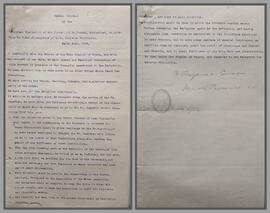
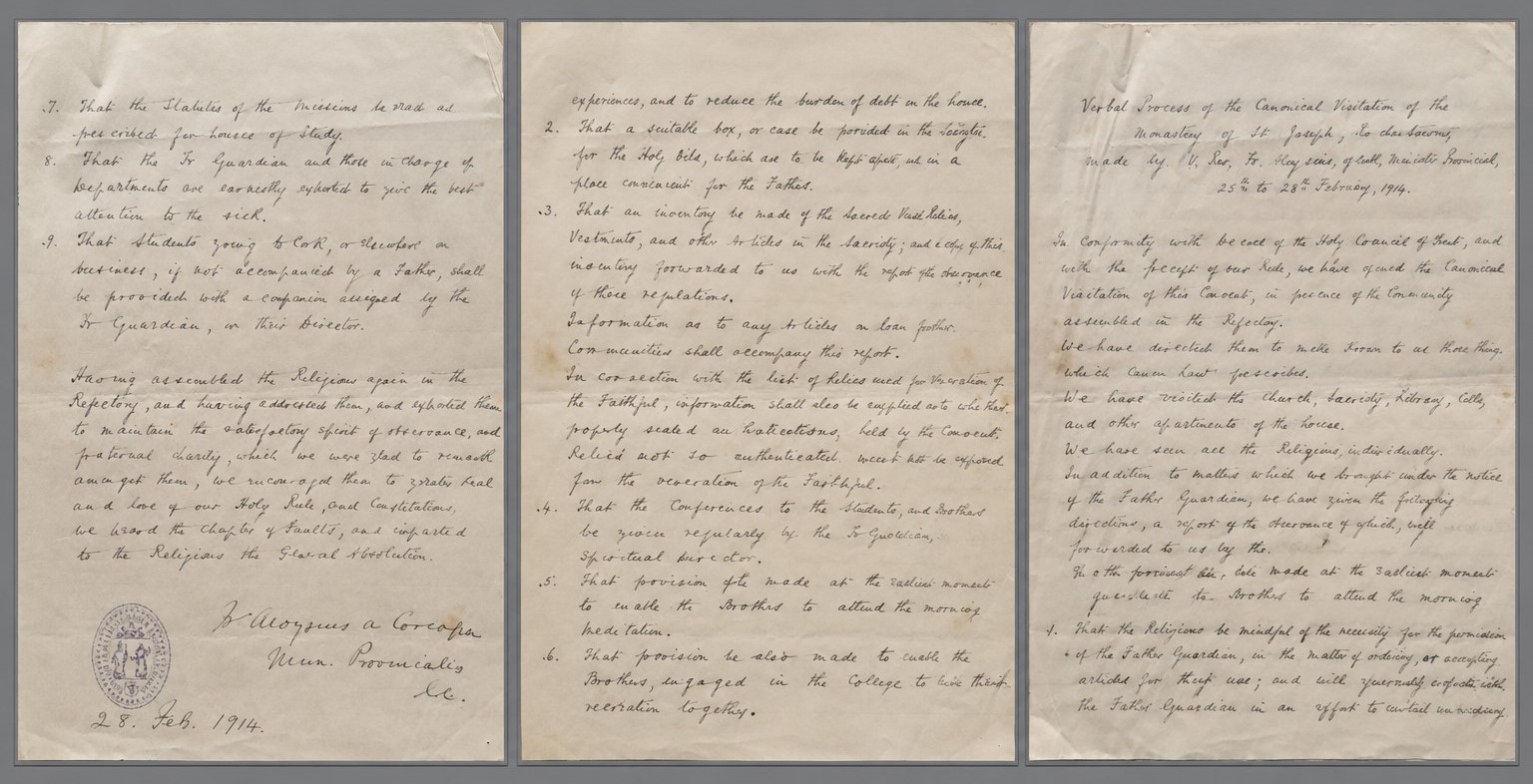
The file contains formal legal accounts (traditionally titled ‘Verbal Process’) detailing statutory inspections and administrative mandates left behind for local superiors (Guardians) in Rochestown to implement. Matters addressed include religious observance, communal discipline, fraternal charity, the provision of spiritual conferences, the management of the library, care of the sick, the maintenance and cleanliness of convent buildings, and the responsibilities of the Father Guardian and other community officials.
The chronological composition of the file includes:
May 24, 1913 (Fr. Thomas Dowling OFM Cap.): Entirely handwritten record confirming standard canonical inspections, community assembly in the refectory, and individual friar interviews.
February 25–28, 1914 & Feb 2, 1915 (Fr. Aloysius Travers OFM Cap.): A three-page handwritten decree outlining financial reductions to curb the debt burden of the Rochestown house. Mandates strict protocols prohibiting unauthorized communication between standard community religious and novices without explicit permission from the Novice Master. Includes rules governing student travel from Cork or Whitehall.
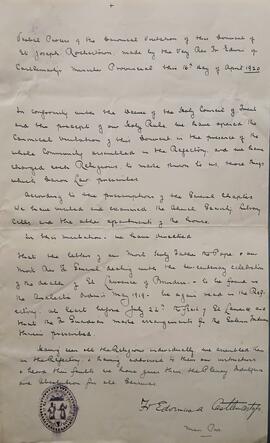
April 16, 1920 (Fr. Edwin Fitzgibbon OFM Cap.): Handwritten record referencing modern spiritual briefs, notably the Centenary Celebration of the Death of St. Veronica of Milan (issued May 1919) read aloud in the refectory.
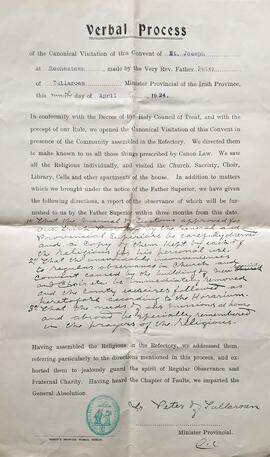
April 1924 & April 13, 1925 (Fr. Peter Bowe OFM Cap.): Partially printed formal legal templates with custom handwritten addenda. Outlines responsibilities for students preparing for Holy Orders and mandates the reading of statutory provisions inside the refectory.
March 28, 1940 (Fr. Colman Griffin OFM Cap.): Form template containing a prominent handwritten restriction enforcing rules relating to unpermitted communication between standard community friars and novitiate students.
April 9-10, 1969 (Fr. Berard Creed OFM Cap.): A contemporary typed memorandum documenting inspections of account books, mass registers, friary infrastructure, and communal fraternal discussions.