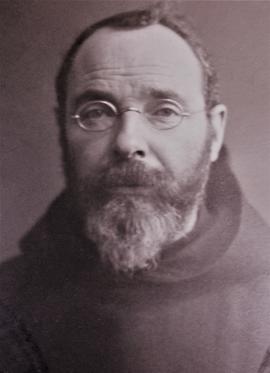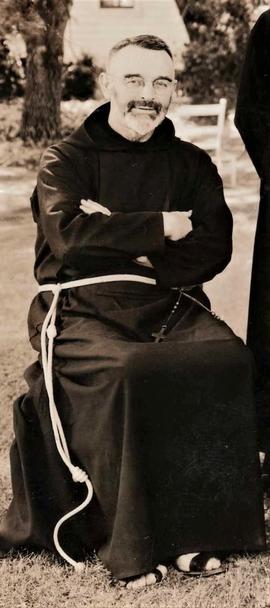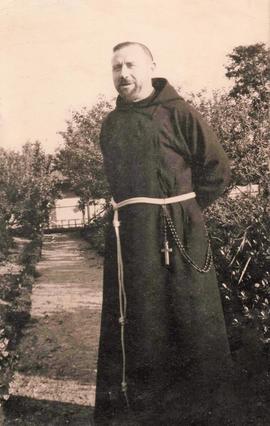
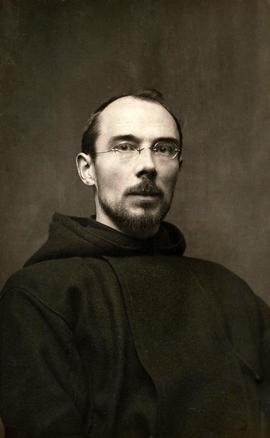
Thomas Bibby was born on 24 October 1877 in Bagenalstown, County Carlow. He was baptised on 28 October 1877. His family were proprietors of a woollen mill at Greensbridge and operated two drapery establishments in Kilkenny City, one in Parliament Street and another on High Street. He entered the Capuchin novitiate at Rochestown on 7 July 1894 and took the religious name of Albert. He was solemnly professed on 8 May 1900 and was ordained a priest at St. Mary of the Angels, Church Street, Dublin, on 23 February 1902. A gifted scholar, Fr. Albert was among the first batch of Capuchin students to receive a BA degree from the Royal University. He later became a professor of philosophy and theology and taught these subjects to Capuchin students for some years after his ordination. One of his first students was Fr. Dominic O’Connor OFM Cap. Fr. Albert was active in the Gaelic revival movement and became a fluent speaker of Irish. He was also engaged in temperance advocacy and gave missions sometimes solely in Irish in Gaeltacht areas. He was also involved in the Columcille branch of Conradh na Gaelige in its early years. Briefly a part of the community of friars in Kilkenny, he moved to Church Street, Dublin, in the early 1900s. In the aftermath of the Easter Rising, Fr. Albert ministered to a number of rebel prisoners in Kilmainham Jail and in other locations. He was present at the execution of Seán Heuston on 8 May 1916 and wrote an account of his final hours. He was later a regular correspondent with prominent republicans and their relations. On 16 December 1920 both Fr. Albert and Fr. Dominic O’Connor OFM Cap. were arrested by British forces during a raid on the friary on Church Street. Fr. Albert was detained for some hours in Dublin Castle but was afterwards released whilst Fr. Dominic was sentence to five years’ penal servitude. When the Four Courts was attacked on 27 June 1922 in the opening engagement of the Civil War, Fr. Albert was present in the building alongside Fr. Dominic. Both priests remained with the Anti-Treaty irregulars until the Four Courts was evacuated. They then proceeded to administer to Cathal Brugha and other IRA men occupying the Hamman Hotel on O’Connell Street. In June 1924, Fr. Albert was sent to the United States and was eventually appointed Pastor of the Capuchin Mission at Santa Inez in California. He immediately set about restoring both the parish and the structures of the old Franciscan Mission. Modern plumbing and electricity systems were installed at Santa Inez and Fr. Albert was joined by Friars Reginald O’Hanlon and Colmcille Cregan. However, Albert’s health deteriorated and he was soon admitted to St. Francis Hospital in Santa Barbara County. He died on 14 February 1925, a mere three months after his arrival in Santa Inez. He was buried just outside the mission’s chapel. His remains (along with those of his former pupil Fr. Dominic O’Connor OFM Cap.) were later repatriated to Ireland and he was buried in the cemetery of Rochestown Capuchin Friary, Cork, on 14 June 1958.
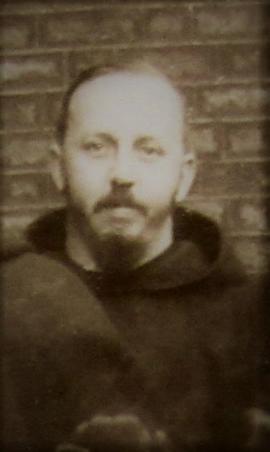
Daniel Murphy was born on 17 June 1881 in Cork. He was baptised in St. Finbarr’s Church on 19 June 1881. His parents were James and Sarah Murphy (née Flynn) of Ethelville, Western Road, Cork. He was a student of Presentation College and later Rochestown College in Cork. He applied for entrance to the Capuchin novitiate in August 1898 taking the religious name of Columbus. He was ordained a priest in 1906. He subsequently studied at the Catholic University of Louvain and obtained a Bachelor of Divinity in 1909. His life as a friar was mostly devoted to missionary and retreat work. At the outbreak of the 1916 Rising Fr. Columbus was a member of the Church Street community in Dublin. He would go on to play an important role in bringing about a cessation of hostilities. The day after the surrender of the Four Courts garrison on 29 April there was still confusion in North King Street and in other locations as to whether this was a truce or a complete surrender. To clarify, Fr. Columbus went to the Four Courts to retrieve Patrick Pearse’s note which had led to the surrender of Commandant Edward Daly. He later negotiated with the British military to arrange a personal meeting with Pearse in Arbour Hill and brought a copy of his surrender order to Commandant Patrick Holohan at North Brunswick Street. Between 30 April and 4 May Fr. Columbus was called upon to minister to prisoners in Kilmainham Jail prior to their executions. He later compiled a memoir recording his experiences of ministering to various rebel leaders awaiting their court martials and sentencing (IE CA IR-1-2-6). Fr. Columbus later acted as President of Father Mathew Hall, Church Street, Dublin, from 1925-8. He died on 20 February 1962.
John Moynihan, the son of Thomas and Mary Moynihan, was born on 24 November 1900 in Castlegregory, County Kerry. He was educated at Aughacasla National School (eight years) and at St. Brendan’s Seminary, Killarney (four years) and he matriculated in June 1918. He studied at All Hallows College in Dublin from October 1918 to March 1919. He joined the Irish Capuchin Franciscans in September 1920 taking the religious name of Senan. He took his final vows in 1925 and he was ordained a priest in 1928. Shortly after his ordination in 1928 he was appointed editor of ‘The Father Mathew Record’, a popular monthly publication of the Irish Capuchins which promoted the Order’s overseas’ missions (particularly in Africa) and carried articles supporting the cause of total abstinence. Fr. Senan strove to create a higher grade, more literary publication. He was acquainted with many well-known Irish writers and artists and he secured permission from the Order’s leadership to publish an ‘Annual’ in 1930. ‘The Capuchin Annual’ was published from 1930 to 1977. The publication was very much the work of Fr. Senan and he remained its editor until 1954. In 1955 a decision was made at the Capuchin Provincial Chapter to remove Fr. Senan from the editorship of the ‘Annual’. Soon afterwards he travelled to Perth at the invitation of Archbishop Redmond Prendiville (1900-1968), a fellow Kerry man. Fr. Francis Moynihan, a brother of Fr. Senan, had also been resident in Australia and was parish priest of St. John’s, Clifton Hill, in Melbourne. Fr. Francis was also the editor of ‘The Advocate’, a leading Catholic newspaper in Australia. Fr. Senan arrived in Perth in 1959. He was incardinated into the Perth Archdiocese on 1 April 1959 (as a diocesan priest having left the Capuchin Order). On arrival he took up a position as chaplain to religious sisters at St Anne’s Hospital, Mt Lawley (now Mercy Hospital). He did not, however, act as a chaplain to the patients. Archbishop Redmond Prendiville appointed him the first archivist of the Archdiocese of Perth in July 1962. Fr. Senan died in Perth on 26 July 1970. He is buried in Karrakatta Cemetery, Perth.
John Kavanagh was born in Mountmellick in Queen’s County (later County Laois) on 12 June 1876. Having spent some years in the Seraphic College in Rochestown, County Cork, he was received into the Capuchin Order in March 1893. He was ordained a priest in Dublin on 23 February 1902. Soon after his ordination he was stationed in Kilkenny as a Professor of Philosophy, but most of his life as a priest was spent in Dublin and in Cork. An accomplished scholar, Kavanagh spent many years in libraries and archives in England, France, Italy, Spain and Belgium, transcribing thousands of documents in a very clear hand, recording everything relating to the Irish Capuchins which could be discovered overseas. His work in transcribing the seventeenth-century Latin text, the ‘Commentarius Rinuccinianus’, published by the Irish Manuscripts Commission in six volumes between 1932 and 1949, is well known. His extremely important corpus of manuscripts, surrogate copies and transcribed materials for early Capuchin history are now extant in the Irish Capuchin Archives. He served as Provincial Archivist for the Capuchin Order in Ireland from 1919 to 1958. In 1918 he was appointed to investigate the cause of two seventeenth century Irish Capuchin martyrs, Fr. Fiacre Tobin OSFC (d. 1656) and Fr. John Baptist Dowdall OSFC (d. 1710). Kavanagh also had a life-long interest in Fr. Theobald Mathew OSFC (1790-1856) and amassed a huge quantity of research and documentary material relating to his life and nineteenth-century temperance campaign. In recognition of his contribution to Irish historical scholarship, the National University of Ireland awarded him an honorary Doctorate of Literature (D. Litt.) in 1947. Outside of academia, Kavanagh was a well-known preacher, missionary, and retreat-giver. In 1924 he was asked to travel to the United States where he spent several months assisting Irish Capuchin friars in missionary and preaching work. He was also a long-time incumbent of the position of Secretary of the Irish Capuchin Province (1922-31; 1937-55) and was elected Provincial Deifintor (Councillor) in 1931. His later years were blighted by dementia and he died on 16 May 1965 in the Bon Secours Hospital in Dublin. He was buried in Glasnevin Cemetery.
Baptismal name: John Kavanagh
Religious name: Fr. Stanislaus Kavanagh OFM Cap.
Date of birth: 12 June 1876
Place of birth: Mountmellick, Queen’s County (County Laois), Diocese of Kildare & Leighlin
Name of father: Edward Kavanagh
Name of mother: Joanna Kavanagh (née Costello)
Date of reception into the Capuchin Order: 20 Mar. 1893
Date of first profession: 2 July 1894
Date of final profession: 25 Dec. 1897
Date of ordination (as priest): 23 Feb. 1902
Educational attainments: Doctor of Literature (D. Litt.), 1947
Leadership positions: Provincial Definitor, 1931-4; Provincial Secretary, 1922-31, 1937-55; Provincial Archivist, 1919-1958
Date of death: 16 May 1965
Place of death: Bon Secours Hospital, Glasnevin, Dublin
Place of burial: Glasnevin Cemetery, Dublin
Michael Cronin was born in Cork in January 1849. He was received into the Capuchin Order at Rochestown in County Cork on 30 July 1882. He took Leo as his religious name upon joining the Order. He was solemnly professed as a Capuchin friar in August 1887. For the following sixty-seven years he fulfilled the ordinary duties of a lay brother in most of the houses of the Irish Capuchin Province. He was particularly known as a Brother Questor in Dublin, seeking alms and donations for the poor. Following several years of ill-health, he died in the Capuchin Friary on Church Street in Dublin on 23 October 1949. He was buried in Glasnevin Cemetery.
Baptismal name: Michael Cronin
Religious name: Br. Leo Cronin OFM Cap.
Date of birth: 30 Jan. 1859
Place of birth: Cork
Name of father: Michael Cronin
Name of mother: Mary Cronin (née Foley)
Date of reception into the Capuchin Order: 30 July 1882
Date of first profession: 8 Aug. 1883
Date of final profession: 2 Aug. 1887
Date of death: 23 Oct. 1949
Place of death: Capuchin Friary, Church Street, Dublin
Place of burial: Glasnevin Cemetery, Dublin
John Fenelon was born in the village of Ballinakill, Queen’s County (Laois), on 31 May 1875. He joined the Capuchin Order in February 1892 and took Joseph as his religious name. He was ordained to the priesthood in Dublin on 21 September 1901. Soon after his ordination he begun his ministry in Cork and was made guardian (local superior) of Holy Trinity Church and Friary in 1907. During his term as guardian the extension of the Church as a memorial to the late Fr. Bernard Jennings OFM Cap. was completed and formally opened. In 1913 he was made President of Father Mathew Hall in Cork, and at the subsequent Provincial Chapter in 1916 he was elected guardian of the Capuchin Friary in Kilkenny. In 1919 he moved to Dublin and was appointed President of Father Mathew Hall on Church Street. In 1922 he was appointed superior of the Irish Capuchin mission in the United States. Soon after his arrival he took charge of the parish of the Most Holy Redeemer in Watts, Los Angeles. One of his first acts was to have the name of the church changed to St. Lawrence of Brindisi (a Capuchin Franciscan saint). Fenelon constructed a parochial school and began to conduct novenas and parish missions in Watts and further afield (including in Bakersfield and in Sacramento). On 15 November 1924 he preached at the installation of Fr. Albert Bibby OFM Cap. as the first Capuchin pastor of Santa Inés Mission in Santa Barbara County, north of Los Angeles. In 1930 Fenelon was appointed the first Capuchin pastor of St. Francis parish in Los Angeles. Five years later he moved to the Irish Capuchin foundation at Wilmington in Delaware and as vicar supervised the building of the first novitiate of the Irish Capuchins in the United States. The novitiate wing at St. Patrick’s Friary in Wilmington became a centre for the education and training of friars until the foundation was transferred to the care of New Jersey Capuchins in 1963. Fr. Stephen Murtagh OFM Cap. replaced Fenelon as superior of the Irish Capuchin mission in 1937. Fenelon returned to Ireland in 1948 and took up residence in Holy Trinity Friary in Cork. He remained active in ministry and mission work until his death on 20 April 1963. He was laid to rest in the cemetery adjoining the Capuchin Friary in Rochestown, County Cork.
Baptismal name: John Fenelon
Religious name: Fr. Joseph Fenelon OFM Cap.
Date of birth: 31 May 1875
Place of birth: Ballinakill, County Laois (Diocese of Kildare & Leighlin)
Name of father: Thomas Fenelon (Farmer)
Name of mother: Johanna Fenelon (née Redmond)
Date of reception into the Capuchin Order: 7 Feb. 1892
Date of first profession: 20 Mar. 1893
Date of final profession: 25 Dec. 1897
Date of ordination (as priest): 21 Sept. 1901
Missionary assignments: Travelled to California in Nov. 1922; Returned to Ireland in July 1948;
Date of death: 20 Apr. 1963
Place of death: Bon Secours Hospital, Cork
Place of burial: Cemetery, Rochestown Capuchin Friary, County Cork
Nicholas Brophy was born in Sandymount in Dublin on 13 October 1895. He entered the Capuchin novitiate in Kilkenny in 1917 and took Charles as his religious name. He later attended the Capuchin College in Rochestown in County Cork and obtained a Bachelor of Arts degree from University College Cork in 1921. He was ordained to the priesthood in June 1925. The entirety of his priestly ministry was spent in Dublin. He was President of Father Mathew Temperance Hall in the capital from 1928 to 1934 and was guardian (local superior) of the Church Street Capuchin community from 1934 to 1940 and from 1946 to 1949. He also served as Provincial Definitor from 1937-40 and from 1946-9. He founded the Retreat House in Raheny in Dublin and became its first director in 1957. He was well-known for his enclosed retreats in Raheny and for his missionary and preaching work particularly in his native Dublin which continued until his health deteriorated in his later years. He died in Jervis Street Hospital on 13 May 1976 and was buried in Glasnevin Cemetery in Dublin.
Baptismal name: Nicholas Brophy
Religious name: Fr. Charles Brophy OFM Cap.
Date of birth: 13 Oct. 1895
Place of birth: Sandymount, Dublin
Name of father: Peter Brophy
Name of mother: Catherine Byrne (née Byrne)
Date of parents’ marriage: 15 Nov. 1894
Date of reception into the Capuchin Order: 17 Sept. 1917
Date of first profession: 29 Sept. 1918
Date of final profession: 29 Sept. 1921
Date of ordination (as priest): 29 June 1925
Educational attainments: BA, 1921
Leadership positions: Provincial Definitor (Councillor), 1937-40, 1946-9; Custos General, 1940-3, 1943-6
Date of death: 13 May 1976
Place of death: Jervis Street Hospital, Dublin
Place of burial: Glasnevin Cemetery, Dublin
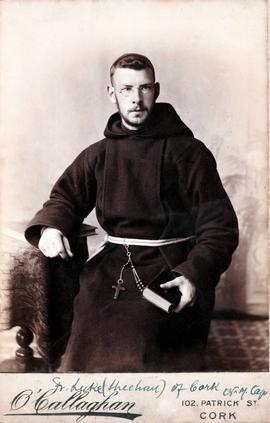
Francis Bernard Sheehan was born in Cork on 31 March 1873. His early studies were in Saints Peter and Paul school, the Christian Brothers’ school, the Presentations Brothers’ school, and finally at the Seraphic College in Rochestown in County Cork. He was received into the Capuchin Order on 2 February 1889. After the usual philosophical and theological studies, he was ordained in Holy Trinity Church, Cork, in July 1896. Shortly afterwards, he was transferred to the Kilkenny Friary where acted as a lector in philosophy. In November 1902 Fr. Luke volunteered for missionary work as a chaplain in Arabia where the Capuchin friars had established a Vicariate. He was soon appointed Pro-vicar Apostolic. He was charged with chaplaincy duties at British military and naval stations in Aden and did much visitation work in the interior of the country. While stationed in Aden he was taken ill with fever and was forced to return to Ireland to recuperate. Before he had fully recovered the priest who replaced him succumbed to the harsh climatic conditions prevailing in that part of the world. Fr. Luke immediately offered to return to Arabia, and he remained there until 1908. As Aden was then governed as part of British India, Fr. Luke also frequently visited India to conduct missions for troops, chiefly around Bombay (now Mumbai). He returned to Ireland in 1908. In 1910 he accompanied Fr. Thomas Dowling OFM Cap. on a journey to eastern Oregon to establish a new Capuchin mission in this territory. Fr. Dowling was appointed a Provincial Definitor (councillor) later in 1910 leaving Fr. Luke to work alone in Oregon until the arrival of Fr. Casimir Butler OFM Cap. He worked diligently in establishing parish communities in Hermiston and later in Bend on the Deschutes River in Oregon.
The first church Bend was an old schoolhouse purchased in 1912 for $75. Fr. Luke later invited a group of nuns of the Order of St. Joseph to establish a hospital in the locality. With a growing population, a larger church was needed in Bend, and the foundation stone for the present-day St. Francis of Assisi Church was laid on 25 January 1920. It was built by E. P. Brosterhous at the cost of $55,000 and was officially opened and dedicated in the same year. St. Francis Catholic School in Bend (with an initial enrolment of 140) was opened in 1936. Fr. Luke served as a priest in Bend for twenty-seven years. He died in Hood River, Oregon, on 11 February 1937. His obituary in the ‘Bend Bulletin’ noted that ‘women cried and men who had known Father Sheehan since he came here in the early days were unable to control their sobs as the requiem mass was celebrated. Every available bit of space in the huge church, erected years ago through the efforts of Father Sheehan, was occupied as parishioners, churchmen and close friends of other faiths came to pay their respects to the priest who played such an important part in the religious and civic life of Bend. Occupying a pew in the crowded church were six members of the Protestant clergy of Bend’. Father Luke was buried beneath a Celtic Cross gravestone in Bend’s Pilot Butte Cemetery. For images of his memorial in Pilot Pilot Butte Cemetery in Bend, Oregon, see https://www.findagrave.com/memorial/12540403/luke-sheehan
Baptismal name: Francis Bernard Sheehan
Religious name: Fr. Luke Sheehan OFM Cap.
Date of birth: 31 Mar. 1873
Place of birth: Cork
Name of father: John Sheehan
Name of mother: Catherine Sheehan (née Sullivan)
Date of reception into the Capuchin Order: 2 Feb. 1889
Date of first profession: 4 Feb. 1890
Date of final profession: 18 Oct. 1894
Date of ordination (as priest): 2 July 1896
Missionary assignments: Ministered in Aden from 1902-08; Travelled to Oregan, United States, in 1910
Leadership positions: Custos, 1913-6; 1919-22
Date of death: 11 Feb. 1937
Place of death: Hood River, Oregon (while on supply from Bend, Oregon)
Place of burial: Bend, Oregon
Francis Cantillon was born near the village of Glounthaune in County Cork on 20 June 1880. He attended the local diocesan seminary for several years, but after some discernment entered the Capuchin novitiate in September 1899. Having completed his philosophical and theological studies, he was ordained on 16 March 1907. In 1910 he was appointed guardian (local superior) of the Capuchin friary in Kilkenny. Following the completion of his term as guardian, he engaged in the ministry of preaching missions and retreats throughout Ireland. He was transferred to the United States in 1926 and took up residence in Mendocino County in California. Later that year he assisted Fr. Thomas Dowling OFM Cap. in ministering in Visitation Valley near San Francisco. This assignment was a temporary one as within a few months the Irish friars were given the administration of the new parish of Our Lady of Angels in Burlingame, California. They resided there in a small house on Cortez Avenue. In 1931 Fr. Berchmans was appointed Pastor of Our Lady of Angels parish in Ukiah, a position he filled until 1937 when he took up the position of pastor of the church of St. Francis of Assisi in Bend, Oregon. His health began to decline in subsequent years, and he retired from active ministry in 1940. He moved to Los Angeles and died there on 12 March 1942. He was laid to rest in the Capuchin plot in Calvary Cemetery in Los Angeles.
Baptismal name: Francis Cantillon
Religious name: Fr. Berchmans Cantillon OFM Cap.
Date of birth: 20 June 1880
Place of birth: Rockfarm, Glounthaune, County Cork
Name of father: Denis Cantillon
Name of mother: Mary Ellen Cantillon (née Mahony)
Date of reception into the Capuchin Order: 8 Sept. 1899
Date of first profession: 8 Sept. 1900
Date of final profession: 25 Sept. 1904
Date of ordination (as priest): 16 Mar. 1907
Educational attainments: BA (RUI)
Missionary assignments: Travelled to Los Angeles, California, in 1926
Date of Death: 12 March 1942
Place of death: Queen of Angels Hospital, Los Angeles, California, United States
Place of burial: Calvary Cemetery, Los Angeles, California, United States
A native of Tarbert in County Kerry, Thomas O’Connor was born on 16 July 1859. At the age of seventeen, he joined the Capuchin Franciscans and took Matthew as his religious name. He was ordained a priest on 27 August 1882. He held several senior leadership positions in the Order in Ireland and was twice elected Provincial Minister (1893-6 and 1898-1901). He served as President of Father Mathew Memorial Hall on Church Street in Dublin from 1894 to 1895. Much of his later life in ministry was spent in Kilkenny and he died in the Capuchin Friary in the city on Sunday, 27 April 1930. He was buried in Foulkstown Cemetery just outside Kilkenny city.
Baptismal name: Thomas O’Connor
Religious name: Fr. Matthew O’Connor OFM Cap.
Date of birth: 16 July 1859
Place of birth: Tarbert, County Kerry
Name of father: John O’Connor
Name of mother: Ellen O’Connor (née Heagerty)
Date of reception into the Capuchin Order: 16 July 1876
Date of first profession: July 1877
Date of final profession: 4 Oct. 1880
Date of ordination (as priest): 27 Aug. 1882
Leadership positions: Provincial Minister: 1893-6, 1898-1901; Provincial Definitor (Councillor): 1885-8, 1887-90, 1890-3, 1905-8, 1910-3; Custos: 1887, 1890, 1895, 1901, 1907.
Date of death: 27 Apr. 1930
Place of death: Capuchin Friary, Kilkenny
Place of burial: Foulkstown Cemetery, County Kilkenny