
Identificatie
referentie code
Titel
Datum(s)
- 1852-2018 (Vervaardig)
Beschrijvingsniveau
Omvang en medium
15 boxes
Context
Naam van de archiefvormer
archiefbewaarplaats
Geschiedenis van het archief
Directe bron van verwerving of overbrenging
Inhoud en structuur
Bereik en inhoud
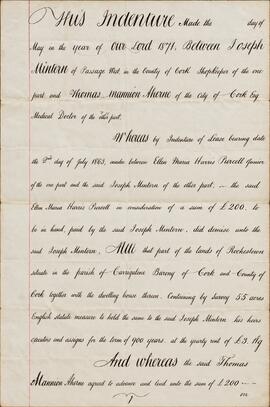
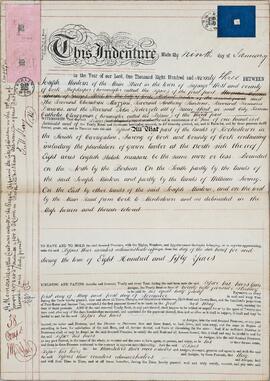
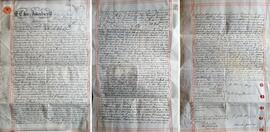
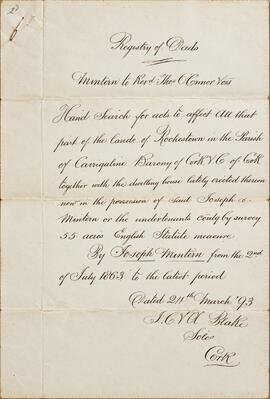
The founding of the Capuchin Franciscan community at Rochestown, County Cork, stands as a milestone in the modern evolution and institutional footprint of the Irish Capuchin Province. On 9 January 1873, the Italian-born Capuchin Superior, Fr. Cherubin Mazzini OFM Cap. (also known as Father Cherubini), initiated the foundation by acquiring an eight-acre leasehold on the Rochestown to Monkstown Road. Despite initial material privations and reliance on the sparse local populace, the community rapidly institutionalized regular Capuchin life, constructing its first permanent refectory and a continental-style monastic church, which was dedicated on 4 November 1878. The site briefly served as the Order’s novitiate following the arrival of Fr. Simeon Gaudillot OFM Cap. and a cohort of novices from Kilkenny in February 1877, though shifting institutional requirements soon altered the property’s primary function.
Throughout the late nineteenth and early twentieth centuries, the friary functioned an important socio-religious anchor for the surrounding locality. The integration of the friars into the local community manifested in several distinct developments, notably the establishment of the Third Order of St. Francis, a lay confraternity which attracted over three hundred members by the turn of the century. Under the direction of Fr. Sylvester Mulligan OFM Cap., the community established a local Temperance Hall in 1913, which served as a vital civic and social center. This was followed in 1914 by the construction of a Marian Grotto, funded by an anonymous benefactor, which became a focal point for regional pilgrimage and liturgical devotion, presided over by prominent ecclesiastical figures such as the Bishop of Cork, Daniel Cohalan.
The institutional focus of Rochestown shifted permanently with the relocation of the Seraphic School from Kilkenny in November 1886. Founded originally in December 1884 by Fr. Seraphin Van Damme OFM Cap. to foster vocations following directives from the General Capuchin Chapter in Rome, the school initially operated as a strict semi-monastic juniorate. When Fr. Paul Neary OFM Cap. took over as administrator and expanded the facilities in 1887, the institution professionalized its academic framework. The college introduced external assessments and matriculation preparation by 1893, balancing its primary purpose of vocational cultivation with a rigorous secular curriculum. The early twentieth century marked a period of significant academic expansion and cultural alignment. Under the rectorship of Fr. Edwin Fitzgibbon OFM Cap., the college actively engaged with the contemporary Gaelic revival, participating in the inaugural meeting of the Munster Colleges Gaelic Athletic Association (GAA) in 1907. Physical expansion continued under Fr. Bonaventure Murphy OFM Cap. with the construction of a dedicated study hall and residential wing in 1926. The mid-century rectorship (1934-1955) of Fr. Eugene O’Carroll OFM Cap. further modernized the college, overseeing full capacity enrolments, advanced pedagogical standards, and the formation of the Past Pupils’ Union in 1950, which actively supported foreign missionary initiatives in Africa.
The latter half of the twentieth century brought substantial administrative and systemic challenges. A 1952 provincial decree restricting senior enrolment strictly to prospective postulants caused a severe reduction in student numbers, a trend exacerbated by a broader, country-wide decline in religious vocations during the 1960s. Furthermore, the 1970 proposal by the Department of Education to replace private secondary institutions with state-managed community schools forced a critical transition. The administration opted to maintain institutional independence, reorganizing as St. Francis College. This structural pivot necessitated an amalgamation of the monastery and college spaces, resulting in the closure of the friary church in 1974. By the mid-1980s, the transition to a predominantly co-educational day-pupil model was complete, supported by modernized scientific laboratories and expanded athletic facilities, ensuring the survival of the institution within a rapidly secularizing educational landscape. Today, St. Francis College, Rochestown, maintains its legacy as a Capuchin-trusteed voluntary secondary school for boys, currently educating an enrolment of nearly eight hundred students.
Waardering, vernietiging en slectie
Aanvullingen
Ordeningstelsel
Voorwaarden voor toegang en gebruik
Voorwaarden voor raadpleging
Access is open to bona fide researchers. Records containing personal information are subject to access restrictions.
Voorwaarden voor reproductie
Taal van het materiaal
- Engels
- Iers
- Latijn
Schrift van het materiaal
Taal en schrift aantekeningen
Fysieke eigenschappen en technische eisen
The papers are generally in good condition
Toegangen
Descriptive catalogue
Verwante materialen
Bestaan en verblifplaats van originelen
Bestaan en verblijfplaats van kopieën
Related units of description
Aantekeningen
Alternative identifier(s)
Trefwoorden
Onderwerp trefwoord
Geografische trefwoorden
Naam ontsluitingsterm
Genre access points
Beschrijvingsbeheer
Identificatie van de beschrijving
Identificatiecode van de instelling
Toegepaste regels en/of conventies
Status
Niveau van detaillering
Verwijdering van datering archiefvorming
Taal (talen)
- Engels