
Identificatie
referentie code
Titel
Datum(s)
- 1721-1968 (Vervaardig)
Beschrijvingsniveau
Omvang en medium
64 boxes; Bound volume, manuscript, typescript, printed, photographic print and newspaper
Context
Naam van de archiefvormer
Biografie
John Moynihan, the son of Thomas and Mary Moynihan, was born on 24 November 1900 in Castlegregory, County Kerry. He was educated at Aughacasla National School (eight years) and at St. Brendan’s Seminary, Killarney (four years) and he matriculated in June 1918. He studied at All Hallows College in Dublin from October 1918 to March 1919. He joined the Irish Capuchin Franciscans in September 1920 taking the religious name of Senan. He took his final vows in 1925 and he was ordained a priest in 1928. Shortly after his ordination in 1928 he was appointed editor of ‘The Father Mathew Record’, a popular monthly publication of the Irish Capuchins which promoted the Order’s overseas’ missions (particularly in Africa) and carried articles supporting the cause of total abstinence. Fr. Senan strove to create a higher grade, more literary publication. He was acquainted with many well-known Irish writers and artists and he secured permission from the Order’s leadership to publish an ‘Annual’ in 1930. ‘The Capuchin Annual’ was published from 1930 to 1977. The publication was very much the work of Fr. Senan and he remained its editor until 1954. In 1955 a decision was made at the Capuchin Provincial Chapter to remove Fr. Senan from the editorship of the ‘Annual’. Soon afterwards he travelled to Perth at the invitation of Archbishop Redmond Prendiville (1900-1968), a fellow Kerry man. Fr. Francis Moynihan, a brother of Fr. Senan, had also been resident in Australia and was parish priest of St. John’s, Clifton Hill, in Melbourne. Fr. Francis was also the editor of ‘The Advocate’, a leading Catholic newspaper in Australia. Fr. Senan arrived in Perth in 1959. He was incardinated into the Perth Archdiocese on 1 April 1959 (as a diocesan priest having left the Capuchin Order). On arrival he took up a position as chaplain to religious sisters at St Anne’s Hospital, Mt Lawley (now Mercy Hospital). He did not, however, act as a chaplain to the patients. Archbishop Redmond Prendiville appointed him the first archivist of the Archdiocese of Perth in July 1962. Fr. Senan died in Perth on 26 July 1970. He is buried in Karrakatta Cemetery, Perth.
archiefbewaarplaats
Geschiedenis van het archief
Directe bron van verwerving of overbrenging
Inhoud en structuur
Bereik en inhoud
The series comprises a large collection of archival material compiled by Fr. Senan Moynihan OFM Cap., the founding editor of ‘The Capuchin Annual’. The historical material spans from the mid-eighteenth century to the mid-twentieth century, with a strong focus on Irish history, politics, religion, literature, and culture. Notably, this collection offers a comprehensive, multi-faceted view of the Irish revolutionary period, combining official documents, personal correspondence, propaganda, press coverage, and visual material. It provides invaluable primary sources for understanding the political, social, and cultural dynamics of early twentieth century Ireland, as well as chronicling the personal stories of those involved in the struggle for independence.
Types of Material
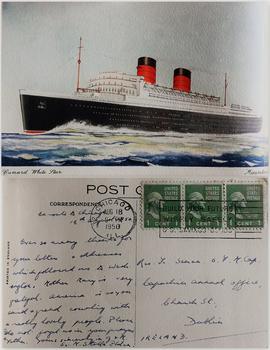
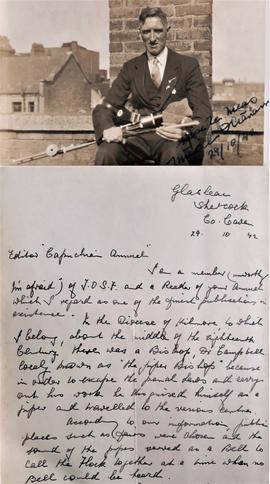
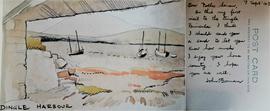
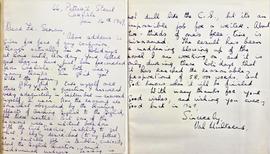
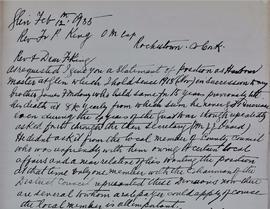
The collection includes original letters, manuscripts, typescripts, printed pamphlets and books, periodicals, newspaper clippings, photographs, postcards, musical scores, and ephemera.
Historical and Political Content
The collection contains a wealth of original documents, letters, pamphlets, periodicals, and photographs directly relating to the Irish revolutionary period, including the 1916 Rising, the War of Independence, and the Civil War.
The collection includes extensive runs of various revolutionary newspapers, bulletins, and propaganda, such as ‘Irish War News’, ‘Irish Bulletin’, ‘Sinn Féin’, ‘An Phoblacht’, ‘Éire: The Irish Nation’, and ‘Republic of Ireland (Poblacht na hÉireann)’.
Key Figures and Correspondence
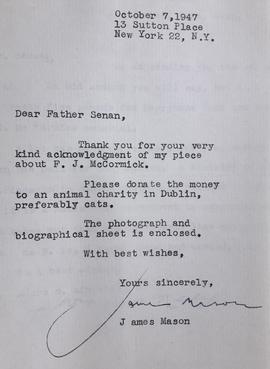
The archive includes correspondence and memorabilia from or about major Irish revolutionary figures such as Patrick Pearse, Éamon de Valera, Michael Collins, Tom Clarke, Terence MacSwiney, Roger Casement, Thomas MacDonagh, Constance Markievicz, Liam Mellows, Frank Fahy, and others. There are also memorial cards, photographs, and original letters from and about these individuals, providing insight into their roles and personal experiences during the revolutionary years.
Political and Military Documentation
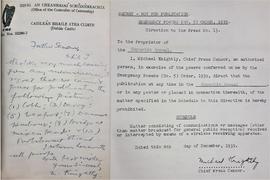
The collection features election fliers, anti-treaty pamphlets, Sinn Féin circulars, and communiqués from the Four Courts during the Civil War.
Minute books and attendance records from the Irish Volunteers, including signatures of key participants in the 1916 Rising.
Affidavits, pension certificates, and reports on Dáil proceedings document the administrative and legal aftermath of the revolutionary period.
Visual and Ephemeral Material
Numerous photographs, postcards, and prints depict revolutionary leaders, events, funerals, commemorations, and the destruction in Dublin during and after the 1916 Rising and Civil War. There are also original memorial cards for executed leaders and commemorative materials for significant anniversaries of the Rising.
Press and Public Opinion
The series includes many contemporary newspaper clippings, both Irish and international, covering the 1916 Rising, the War of Independence, the Civil War, and subsequent commemorations. These clippings provide context on public sentiment, propaganda, and the international response to events in Ireland.
Notable Thematic Volumes
Several bound volumes are specifically dedicated to the Irish Revolution, containing original photographs, fliers, ephemera, and pasted-in content from 1916 to 1923. Other volumes focus on partition, anti-conscription campaigns, and the experiences of republican prisoners in Northern Ireland.
Literary and Cultural Material
Includes periodicals and journals such as ‘The Irish Review’, ‘The Nation’, ‘An t-Óglách’, ‘The Capuchin Annual’, and others.
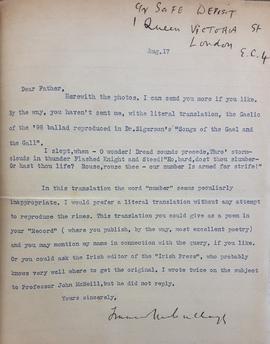
Original manuscripts and correspondence from Irish writers, poets, and scholars, including William Frederick Paul Stockley, Patrick Stephen Dinneen, Daniel Corkery, Thomas Moore, Oscar Wilde, George Bernard Shaw and many others.
Religious and Ecclesiastical Content
Letters and documents from and about Capuchin friars, bishops, and other diocesan clergy, including missionary work and religious ceremonies.
Printed devotional texts, sermons, pamphlets, and literature reflecting Catholic doctrine and practice.
Music and Art
Music manuscripts and sheet music, notably by Carl Hardebeck and other Irish musicians.
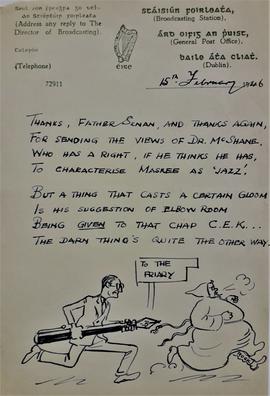
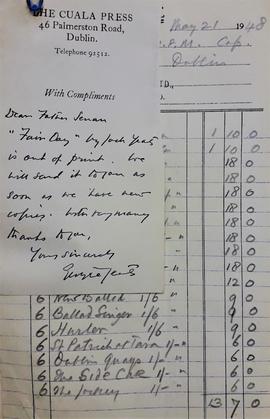
Exhibition catalogues, photographs, and correspondence relating to Irish artists and sculptors such as Jack B. Yeats, Mary Redmond, Laurence Campbell, and Richard King.
Biographical and Genealogical Material
Biographical notes, memorial cards, and correspondence relating to prominent Irish figures, families, and contributors to ‘The Capuchin Annual’.
Genealogical records, account books, and business documents, including material on the Pearse family.
Irish Language and Folklore
Manuscripts, letters, and publications in Irish, including works by Tadhg Ó Murchadha, Peadar Ua Laoghaire, Tadhg Ó Donnchadha, Risteard De Hindeberg (Richard Henebry), and other notable Irish language writers.
Folklore collector notes and texts, with references to the Irish Folklore Commission.
International Connections
Correspondence and material relating to the Irish diaspora, international religious missions, and global events (the collection includes letters from the United States, Argentina, France, Germany, Italy, and Israel).
Waardering, vernietiging en slectie
Aanvullingen
Ordeningstelsel
Voorwaarden voor toegang en gebruik
Voorwaarden voor raadpleging
Voorwaarden voor reproductie
Taal van het materiaal
- Engels
- Frans
- Duits
- Iers
- Italiaans
- Latijn
- Spaans
Schrift van het materiaal
Taal en schrift aantekeningen
Fysieke eigenschappen en technische eisen
Some of the items are noted as fragile, damaged, or in poor condition, with specific instructions for careful manual handling and conservation priority.