
Zone d'identification
Cote
Titre
Date(s)
- 1910-1928 (Création/Production)
Niveau de description
Étendue matérielle et support
84 items; manuscript and typescript
Zone du contexte
Nom du producteur
Notice biographique
Francis Bernard Sheehan was born in Cork on 31 March 1873. His early studies were in Saints Peter and Paul school, the Christian Brothers’ school, the Presentations Brothers’ school, and finally at the Seraphic College in Rochestown in County Cork. He was received into the Capuchin Order on 2 February 1889. After the usual philosophical and theological studies, he was ordained in Holy Trinity Church, Cork, in July 1896. Shortly afterwards, he was transferred to the Kilkenny Friary where acted as a lector in philosophy. In November 1902 Fr. Luke volunteered for missionary work as a chaplain in Arabia where the Capuchin friars had established a Vicariate. He was soon appointed Pro-vicar Apostolic. He was charged with chaplaincy duties at British military and naval stations in Aden and did much visitation work in the interior of the country. While stationed in Aden he was taken ill with fever and was forced to return to Ireland to recuperate. Before he had fully recovered the priest who replaced him succumbed to the harsh climatic conditions prevailing in that part of the world. Fr. Luke immediately offered to return to Arabia, and he remained there until 1908. As Aden was then governed as part of British India, Fr. Luke also frequently visited India to conduct missions for troops, chiefly around Bombay (now Mumbai). He returned to Ireland in 1908. In 1910 he accompanied Fr. Thomas Dowling OFM Cap. on a journey to eastern Oregon to establish a new Capuchin mission in this territory. Fr. Dowling was appointed a Provincial Definitor (councillor) later in 1910 leaving Fr. Luke to work alone in Oregon until the arrival of Fr. Casimir Butler OFM Cap. He worked diligently in establishing parish communities in Hermiston and later in Bend on the Deschutes River in Oregon.
The first church Bend was an old schoolhouse purchased in 1912 for $75. Fr. Luke later invited a group of nuns of the Order of St. Joseph to establish a hospital in the locality. With a growing population, a larger church was needed in Bend, and the foundation stone for the present-day St. Francis of Assisi Church was laid on 25 January 1920. It was built by E. P. Brosterhous at the cost of $55,000 and was officially opened and dedicated in the same year. St. Francis Catholic School in Bend (with an initial enrolment of 140) was opened in 1936. Fr. Luke served as a priest in Bend for twenty-seven years. He died in Hood River, Oregon, on 11 February 1937. His obituary in the ‘Bend Bulletin’ noted that ‘women cried and men who had known Father Sheehan since he came here in the early days were unable to control their sobs as the requiem mass was celebrated. Every available bit of space in the huge church, erected years ago through the efforts of Father Sheehan, was occupied as parishioners, churchmen and close friends of other faiths came to pay their respects to the priest who played such an important part in the religious and civic life of Bend. Occupying a pew in the crowded church were six members of the Protestant clergy of Bend’. Father Luke was buried beneath a Celtic Cross gravestone in Bend’s Pilot Butte Cemetery. For images of his memorial in Pilot Pilot Butte Cemetery in Bend, Oregon, see https://www.findagrave.com/memorial/12540403/luke-sheehan
Baptismal name: Francis Bernard Sheehan
Religious name: Fr. Luke Sheehan OFM Cap.
Date of birth: 31 Mar. 1873
Place of birth: Cork
Name of father: John Sheehan
Name of mother: Catherine Sheehan (née Sullivan)
Date of reception into the Capuchin Order: 2 Feb. 1889
Date of first profession: 4 Feb. 1890
Date of final profession: 18 Oct. 1894
Date of ordination (as priest): 2 July 1896
Missionary assignments: Ministered in Aden from 1902-08; Travelled to Oregan, United States, in 1910
Leadership positions: Custos, 1913-6; 1919-22
Date of death: 11 Feb. 1937
Place of death: Hood River, Oregon (while on supply from Bend, Oregon)
Place of burial: Bend, Oregon
Histoire archivistique
Source immédiate d'acquisition ou de transfert
Zone du contenu et de la structure
Portée et contenu
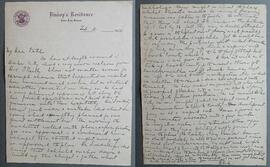
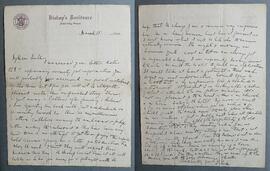
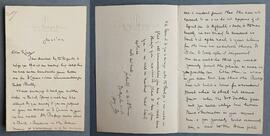
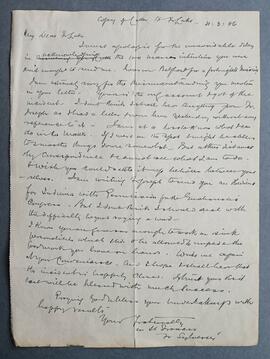
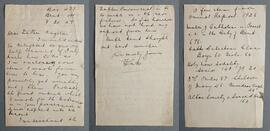
The subseries includes letters chronicling the activities of Fr. Luke Sheehan OFM Cap., an Irish Capuchin missionary working primarily in Oregon and later in California between 1910 and 1928. The files include correspondence, legal documents, and administrative reports that illuminate the early development of the Capuchin mission in the American West.
Early Mission Work in Oregon (1910–1912)
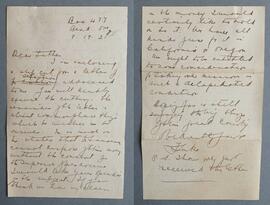
Sheehan reports on initial meetings with Bishop Charles Joseph O’Reilly, including misunderstandings about the Capuchins’ role and expectations for rapid construction of a combined chapel and residence. He describes challenging living conditions in Baker City and the frontier atmosphere. Documents also include the incorporation of the Capuchin Order in the Diocese of Baker City and discussions about staffing the Warm Springs Indian mission, which the Capuchins considered unsuitable.
Property and Mission Administration
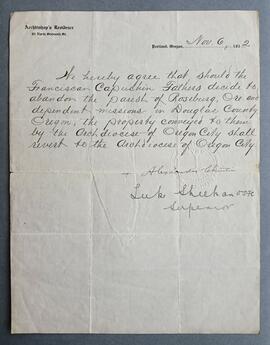
Sheehan issues a formal declaration ensuring that Capuchin-held property in Roseburg, Oregon would revert to the archdiocese if the Order departed, reflecting the insecure and developing nature of the mission.
Work with English Capuchins (1920–1921)
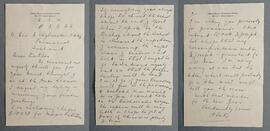
Letters address coordination with English Capuchin friars working in Mendocino County, California, including disagreements over insurance arrangements and the transfer of responsibility for struggling rural missions.
Development of Bend, Oregon (1925–1926)
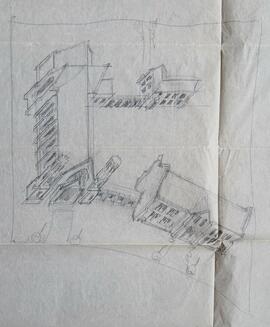
Sheehan spearheads plans for a new school in Bend, providing sketches and updates on construction. He seeks permission to travel to Ireland to recruit suitable teaching sisters and proposes aligning the trip with attendance at the Eucharistic Congress.
Later Administration (1927–1928)
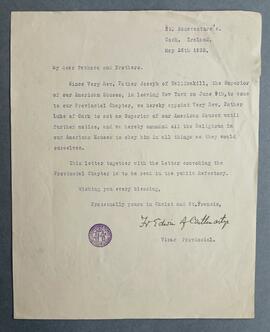
He reports local parish statistics (376 Catholics in Bend, Oregon) and is formally appointed temporary superior of the American houses in 1928 during the temporary absence of Fr. Joseph Fenelon.