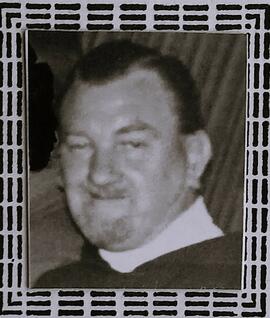
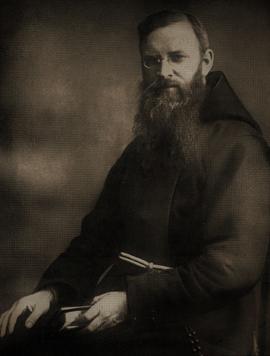
Religious name: Fr. Fridolin Desmond OFM Cap.
Baptismal name: David Desmond
Date of birth: 25 Feb. 1922
Place of birth: Midleton, County Cork
Name of father: Edmond Desmond
Name of mother: Margaret Desmond (née Tobin)
Date of reception into the Capuchin Order: 3 Oct. 1941
Date of first profession: 4 Oct. 1942
Date of final (solemn) profession: 4 Oct. 1945
Date of ordination (as priest): 16 June 1949
Educational attainments: BA (1945)
Missionary activities: Travelled to Cape Town, South Africa, on 13 June 1957. He returned to Ireland on 22 Apr. 1959.
Date of death: 28 Dec. 1978
Place of death: Church Street, Dublin
Place of burial: Glasnevin Cemetery, Dublin
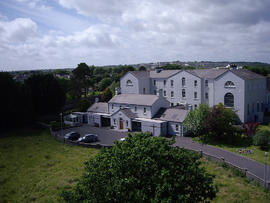
In the early 17th century, as a result of continued persecution of Catholics, it was illegal for women to train in Ireland as religious so many opted to travel to Spanish Flanders, France or Spain in order to fulfill their calling. This was the case with the foremothers of our community. They travelled to the Poor Clare monastery in Gravelines, then in the territory of Spanish Flanders, modern-day Northern France. Some of them had brothers who were already Franciscans in the Irish Franciscan College in Louvain. That college had been founded in 1607.
The Poor Clare monastery of Gravelines was founded in 1609 to provide a house for English women who wished to become Poor Clares.As the Irish friars were already established in Louvain they provided spiritual assistance to this monastery before their Irish sisters arrived. Our foremothers joined this community in the early 1620s and by 1626, they numbered five sisters. In that same year on the 20th of May they left the Gravelines community and set out to found a separate house specifically for Irish women in the neighbouring town of Dunkirk. As circumstances changed they eventually decided to return to Ireland in 1629 now numbering seven. After a short period in Dublin they eventually settled in a rural part of Co. Westmeath not far from Athlone. The monastery was appropriately called 'Bethlehem' to emphasise the central focus of Franciscan spirituality, namely the poverty and humility of the Son of God in taking on our human flesh and becoming one with us in the Incarnation.
As the number of women joining the community grew daughter houses were established in Galway, Drogheda, Athlone and Wexford.
We thank God for the life and witness of our sisters and for their faith, courage and dedication to Christ and His holy Mother after the example of St. Francis and St. Clare. We pray that whatever our state in life, we may be faithful to God as they were and that our lives may bear great fruit as theirs did.
This year, 2022, marks the 400th anniversary of the solemn profession of blood sisters Cecily and Eleanor Dillon on the 8th of September 1622. . Sr. Cecily was the Abbess of Bethlehem monastery, the motherhouse of our Galway monastery at the time that the foundation was made in 1642.
History of Accumulator
The Congregation of Our Lady of Apostles (OLA) was founded in Lyon in 1876 by Father Augustine Planque and immediately began to recruit girls in Ireland. The Irish Sisters would eventually settle in Ardfoyle Convent in Ballintemple, Cork from 1913 onward and became their own OLA Province on the 25th of November 1930. The Irish Province was initially comprised the OLA houses in Ireland, the Vicariate of Benin, and the Vicariate of Niger, with the latter of these two now being present day Nigeria. Sometime between 1930 and 1938 the OLA communities in the Gold Coast, now modern day Ghana, were included in the Irish Province. In 1950 the Irish Province began assuming responsibility of the French Generalate’s convents and foundations in England starting with their house in London, followed soon after by their property in Lancaster in 1953. For three years from 1949-1952 the Irish OLA had a foundation in Niger where they were involved in primary school education, and in 1957 the Irish Sisters began a new foundation in the United States.
In addition to setting up their own foundations, the Irish Province also assisted in the work of other OLA communities abroad in Egypt, Algeria, France and Argentina. And in 1974 the Irish Province sent their own sisters to help staff hospitals in Kenya and Zambia. In the 1990’s the original foundations in Nigeria and Ghana became self-sufficient and independent OLA provinces of their own, and so, the Irish Province opened a new frontier in Tanzania in 1991, and also sent Sisters to South Sudan to aid refugees where they remained until 1997. In 2024 the Irish Province became an OLA District alongside Tanzania with both Districts being independent.
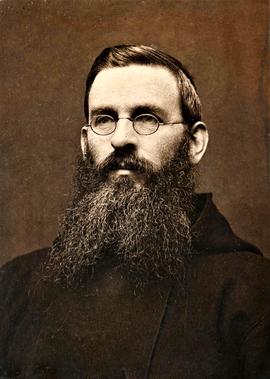
John Hayden was born in Gowran, County Kilkenny, on 7 November 1870. His parents were William Hayden, a railway station master, and Mary Hayden (née Morrissey). On 8 December 1884, he was among the first five pupils to be admitted to the recently opened Seraphic School at Rochestown in County Cork. He took Augustine as his religious name upon entering the Capuchin Order in November 1885. Towards the end of his clerical studies his health deteriorated and he was forced to spend two years in Switzerland. He was ordained a priest in the Augustinian Church on Thomas Street in Dublin in November 1893. On 3 August 1896, Fr. Augustine was appointed rector of Rochestown College, replacing Fr. Francis Hayes OFM Cap. He held this position from 1896 to 1907. He later returned to Dublin and was guardian (local superior) of the Church Street Friary from 1913-6. He cultivated a strong interest in the Gaelic Revival and in particular preserving the Irish language. He was associated with Shán Ó Cuív (1875-1940) in establishing the Irish Language College at Ballingeary, County Cork in 1904, the first college of its kind. He was also a regular correspondent with Fr. Peadar Ua Laoghaire (1839-1920), a noted figure in Conradh na Gaelige, and for many years conducted missions in Gaeltacht areas of Counties Kerry and Donegal. In the immediate aftermath of the 1916 Rising, Fr. Augustine accompanied Fr. Aloysius Travers OFM Cap. in visiting Patrick Pearse and James Connolly. He was instrumental in securing the surrender of Thomas MacDonagh at the Jacob’s Factory and was present at Ėamonn Ceannt’s surrender at the South Dublin Union. He also ministered to Ceannt in the hours before his execution. Like the other Capuchin friars of the Dublin community, Fr. Augustine later committed his memories of Easter Week to writing (CA IR-1-4-1). In 1917, he was the celebrant at the wedding of Terence MacSwiney to Muriel Murphy and he was also the celebrant at the marriage of McSwiney’s daughter in Cork in 1940. He authored a number of devotional texts including 'Ireland’s Loyalty to the Mass' (1933) and 'Ireland’s Loyalty to Mary' (1952). Fr. Augustine died on 6 February 1954 in the Bon Secours Hospital in Cork, and was laid to rest in the cemetery adjoining the Capuchin Friary in Rochestown in County Cork.
John Francis O’Connor was born on 13 Feb. 1883 in County Cork. He was born into a devoutly Catholic family. His father, John O’Connor, a teacher, and his mother, Mary Ann Sheehan, were both tertiaries of the Third Order of St. Francis attached to Holy Trinity Capuchin Church, Cork. A brother of Many Ann Sheehan had already joined the Capuchin Franciscan Order. Fr. Luke Sheehan OFM Cap. was one of the first Catholic missionaries to minister in the American state of Oregon. A good number of John’s siblings also entered religious life. John entered Rochestown College, Cork, in the Autumn of 1897. Having successfully completed his secondary education, he entered the Capuchin novitiate on 1 Oct. 1899 and received the religious name of Dominic. A year later he took his simple vows and in the Autumn of the same year began studying for a philosophy degree in the Royal University, Cork. He was ordained a priest on 17 Mar. 1906 in the Capuchin Friary in Kilkenny. He later enrolled in the Catholic University in Louvain where he obtained a Sacrae Theologiae Baccalaureus (Bachelor of Sacred Theology). In response to a call from Cardinal Michael Logue, Archbishop of Armagh, Fr. Dominic volunteered for chaplaincy work with the British armed forces during the First World War. After spending two months with a Scottish brigade in England, he transferred to a hospital unit bound for Salonika, Greece. After approximately two years of service, Fr. Dominic resigned his post in 1917, returned to Ireland and was appointed to the Capuchin community in Holy Trinity Friary, Cork. Fr. Dominic soon attained notoriety in nationalist circles and was appointed chaplain to the Cork Brigade of IRA Volunteers by Tomas MacCurtain. As chaplain, Fr. Dominic was the first to appear at the MacCurtain home in Blackpool, Cork, on the morning the Sinn Féin Lord Mayor was killed by British forces (20 Mar. 1920). He also served as chaplain to MacCurtain’s successor as Lord Mayor of Cork, Terence MacSwiney, who was arrested on 12 Aug. 1920. Fr. Dominic ministered to MacSwiney throughout his hunger strike in Brixton Prison and was present for his death on 25 Oct. 1920. Soon after his return to Ireland, Fr. Dominic was arrested at the Capuchin Friary on Church Street, Dublin. He was taken to Dublin Castle and in January 1921 was court martialled and sentenced to five years’ imprisonment. During his confinement, he became acquainted with two notable republican detainees, Ernie O’Malley and Pádraig Ó Caoimh. Fr. Dominic served about a year of his imprisonment in Parkhurst Prison. Following the Anglo-Irish Treaty in December 1921, there was a general amnesty for prisoners and Fr. Dominic was released in January 1922. On 25 February 1922, he was granted the freedom of Cork ‘as a mark of respect for his valuable services rendered to the first two Republican Lord Mayors of Cork’. With the onset of the Civil War the Capuchins in Church Street were once more involved in ministering to besieged republicans. In June 1922 the Four Courts, located only a couple of hundred meters from the Church Street Friary, was attacked by Free State forces. Fr. Dominic (assisted by Fr. Albert Bibby OFM Cap.) provided spiritual comfort, assisted in the evacuation of the wounded, and later facilitated the surrender of the defeated garrison. Soon afterwards, Fr. Dominic returned to Holy Trinity Friary, Cork. On 26 Nov. 1922 a decision was made by the Provincial Definitory of the Irish Capuchins to have Fr. Dominic transferred to the Province’s Mission in Bend, Oregon, United States. This was the location of Fr. Luke Sheehan’s (Fr. Dominic’s uncle) pioneering missionary work some years before. For the remainder of his life Fr. Dominic performed routine duties associated with the missionary apostolate of a Capuchin friar. He was appointed temporary rector of St. Francis de Sales Cathedral and published the first of a two-volume history of the Diocese of Baker in 1930. In August 1935 he sustained serious injuries in a car accident from which he never fully recovered. He died on 17 Oct. 1935 and was buried in Bend, Oregon. His remains (along with those of Fr. Albert Bibby OFM Cap.) were later repatriated to Ireland and he was buried in the cemetery of Rochestown Capuchin Friary, Cork, on 14 June 1958