
Identity area
Reference code
Title
Date(s)
- 1904 (Creation)
Level of description
Extent and medium
15 pp; manuscript
Context area
Name of creator
Biographical history
Baptismal name: Patrick B. Brennan
Religious name: Fr. Benignus Brennan OFM Cap.
Date of birth: 14 July 1875
Place of birth: Paulstown, County Kilkenny (Diocese of Kildare & Leighlin)
Name of father: James Brennan
Name of mother: Mary Anne (Margaret) Brennan (née Byrne)
Date of reception into the Capuchin Order: 1 Jan. 1891
Date of first profession: 2 Feb. 1892
Date of final profession: 11 Oct. 1896
Date of ordination (as priest): 8 Jan. 1899
Missionary activities: Travelled to Harrisburg, Pennsylvania, United States, in 1911
Date of death: 15 Apr. 1950
Place of death: Wilmington, Delaware, United States
Place of burial: St. Patrick’s Capuchin Friary, Wilmington, Delaware, United States
From the ‘Necrology of the Western American Province’ (2005):
Patrick Brennan was born in Paulstown in County Kilkenny on 14 July 1875. He was given the name Benignus upon joining the Capuchin Order in 1891. Benignus was remembered as an outstanding preacher and retreat master. This was his principal ministry. He also wrote articles for the ‘Homiletic and Pastoral Review’ and other publications. Most of his life was spent as a member of the community at St. Patrick’s Friary in Wilmington, Delaware, from the 1920s until his death in 1950. In the 1930s he was an associate pastor for a short time in the friary in Lincoln, Nebraska. He was there when fire destroyed the friary on 8 January 1933 severely injuring Fr. Raphael Quinn OFM Cap., the pastor. Benignus was a great community friar and a helper to all those in the community. He died in the Wilmington Friary on 15 April 1950 and was buried in the cemetery attached to the house.
Repository
Archival history
Immediate source of acquisition or transfer
Content and structure area
Scope and content
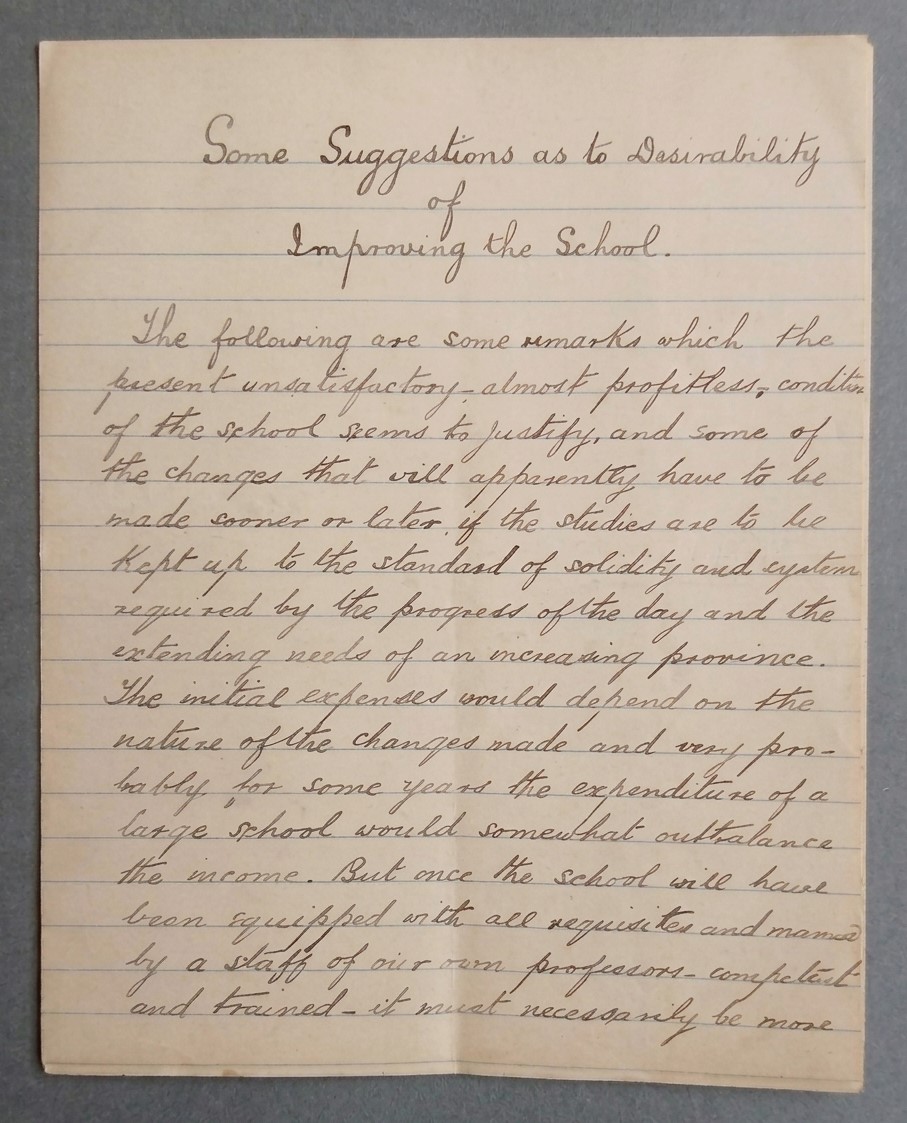
A memorandum, prefaced by the Latin motto ‘Paulo speroque meliora’, outlining a series of structural, curricular, and administrative recommendations aimed at reforming the Seraphic School at Rochestown College. The memorandum was seemingly authored by Fr. Benignus Brennan OFM Cap. Addressing the school’s then-unsatisfactory condition, the report presents an itemized blueprint to the Capuchin Definition to align the institution with modernizing national standards, specifically referencing the reorganization of the Intermediate Board and the anticipated establishment of a national Catholic University.
The memorandum proposes a rigorous, standardized five-year course of studies mapping student progression through the Intermediate Preparatory, Junior, Middle, and Senior grades, alongside the Royal University of Ireland (R.U.I.) Matriculation and First Arts examinations. The proposed curriculum is categorized into essential disciplines (including Latin, French, Mathematics, Experimental Science, and Irish language and history), optional subjects (such as Greek, Italian, music, book-keeping, and drill), and core religious topics.
To implement this successfully, the report suggests securing the services of French and Italian Capuchin priests for language instruction. Finally, the memorandum advocates for a selective admissions policy, mandating that entry be restricted to boys of proven intelligence and refinement, verified either through existing certificates or a formal entry examination overseen by a Definition-appointed examiner.