
Identificatie
referentie code
Titel
Datum(s)
- 1922-1937 (Vervaardig)
Beschrijvingsniveau
Omvang en medium
76 items; manuscript, typescript, and clipping
Context
Naam van de archiefvormer
Biografie
John Fenelon was born in the village of Ballinakill, Queen’s County (Laois), on 31 May 1875. He joined the Capuchin Order in February 1892 and took Joseph as his religious name. He was ordained to the priesthood in Dublin on 21 September 1901. Soon after his ordination he begun his ministry in Cork and was made guardian (local superior) of Holy Trinity Church and Friary in 1907. During his term as guardian the extension of the Church as a memorial to the late Fr. Bernard Jennings OFM Cap. was completed and formally opened. In 1913 he was made President of Father Mathew Hall in Cork, and at the subsequent Provincial Chapter in 1916 he was elected guardian of the Capuchin Friary in Kilkenny. In 1919 he moved to Dublin and was appointed President of Father Mathew Hall on Church Street. In 1922 he was appointed superior of the Irish Capuchin mission in the United States. Soon after his arrival he took charge of the parish of the Most Holy Redeemer in Watts, Los Angeles. One of his first acts was to have the name of the church changed to St. Lawrence of Brindisi (a Capuchin Franciscan saint). Fenelon constructed a parochial school and began to conduct novenas and parish missions in Watts and further afield (including in Bakersfield and in Sacramento). On 15 November 1924 he preached at the installation of Fr. Albert Bibby OFM Cap. as the first Capuchin pastor of Santa Inés Mission in Santa Barbara County, north of Los Angeles. In 1930 Fenelon was appointed the first Capuchin pastor of St. Francis parish in Los Angeles. Five years later he moved to the Irish Capuchin foundation at Wilmington in Delaware and as vicar supervised the building of the first novitiate of the Irish Capuchins in the United States. The novitiate wing at St. Patrick’s Friary in Wilmington became a centre for the education and training of friars until the foundation was transferred to the care of New Jersey Capuchins in 1963. Fr. Stephen Murtagh OFM Cap. replaced Fenelon as superior of the Irish Capuchin mission in 1937. Fenelon returned to Ireland in 1948 and took up residence in Holy Trinity Friary in Cork. He remained active in ministry and mission work until his death on 20 April 1963. He was laid to rest in the cemetery adjoining the Capuchin Friary in Rochestown, County Cork.
Baptismal name: John Fenelon
Religious name: Fr. Joseph Fenelon OFM Cap.
Date of birth: 31 May 1875
Place of birth: Ballinakill, County Laois (Diocese of Kildare & Leighlin)
Name of father: Thomas Fenelon (Farmer)
Name of mother: Johanna Fenelon (née Redmond)
Date of reception into the Capuchin Order: 7 Feb. 1892
Date of first profession: 20 Mar. 1893
Date of final profession: 25 Dec. 1897
Date of ordination (as priest): 21 Sept. 1901
Missionary assignments: Travelled to California in Nov. 1922; Returned to Ireland in July 1948;
Date of death: 20 Apr. 1963
Place of death: Bon Secours Hospital, Cork
Place of burial: Cemetery, Rochestown Capuchin Friary, County Cork
archiefbewaarplaats
Geschiedenis van het archief
Directe bron van verwerving of overbrenging
Inhoud en structuur
Bereik en inhoud
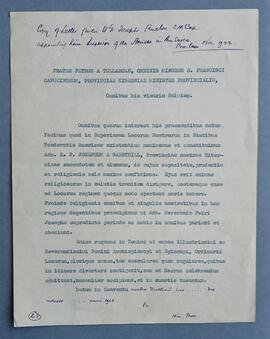
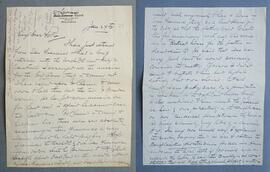
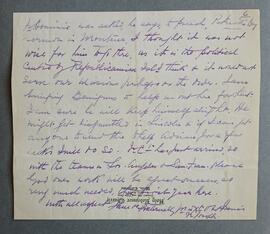
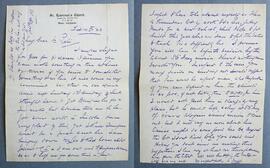
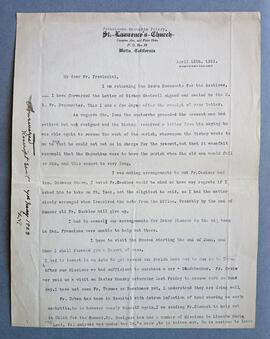
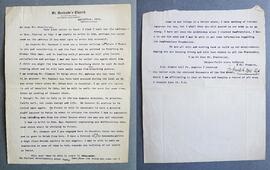
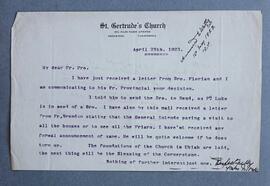
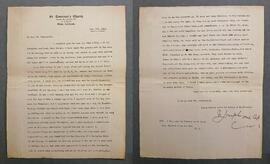
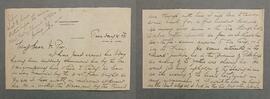
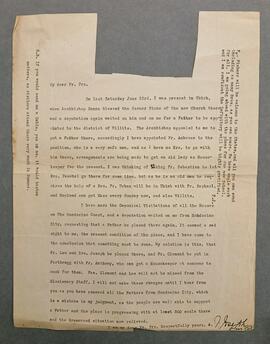
The subseries comprises the correspondence of Fr. Joseph Fenelon OFM Cap. (1875-1963), a leading figure in the expansion of the Irish Capuchin missions in the United States during the early-to-mid twentieth century. His letters provide administrative, personal, and historical insights into the order’s expansion and the challenges faced by friars on the ground.
Missionary Expansion: The letters track the establishment and administration of parishes and friaries in California (Mendocino, Los Angeles), Oregon (Roseburg, Bend, Hermiston), and Delaware (Wilmington).
Personnel Management: Fr. Joseph frequently corresponded with successive Provincial Ministers in Ireland regarding the health, discipline, and home leave requests of friars stationed in the United States.
Fr. Albert Bibby: Correspondence includes telegrams and letters regarding the death of this prominent Irish patriot in Los Angeles in 1925 and the request to return his body to Ireland.
Archbishop Edward Joseph Hanna: Letters from the Archbishop of San Francisco discuss the strategic relocation of priests and the development of educational facilities in Mendocino County.
Economic Impact: Many letters from the 1930s reflect the financial strain of the Great Depression, including the difficulty of supporting foreign missions in South Africa and managing heavy parish debts.
New Deal Era Ministry: Correspondence mentions the friars’ interactions with the Civilian Conservation Corps (CCC) and the struggle to provide enough chaplains for these camps.