
Identity area
Reference code
Title
Date(s)
- c.1985 (Creation)
Level of description
Extent and medium
3 pp; printed
Context area
Name of creator
Repository
Archival history
Immediate source of acquisition or transfer
Content and structure area
Scope and content
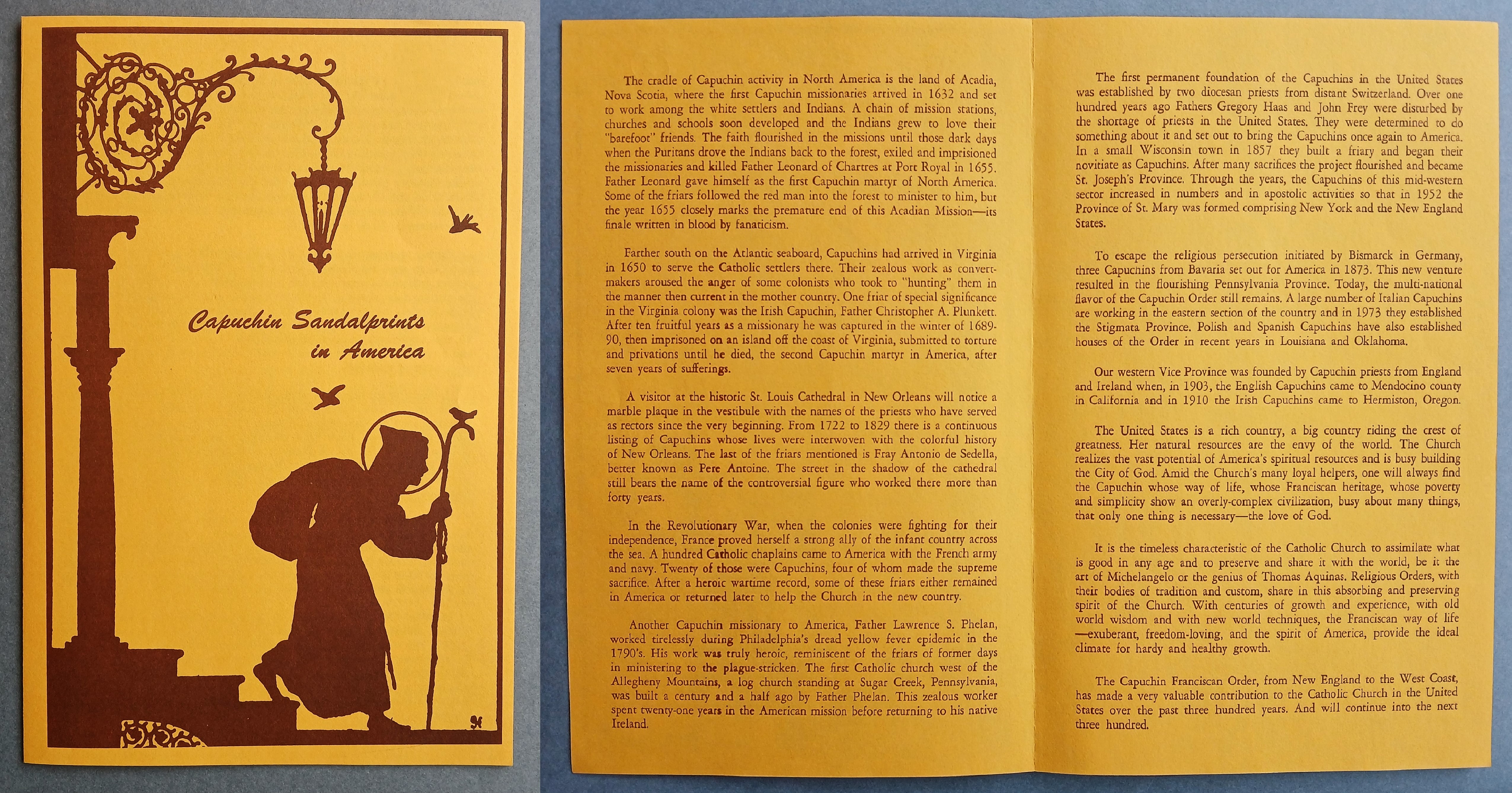
A promotional flier detailing the early presence and missionary work of the Capuchin Order in North America.
Early Acadian Mission: The text describes Acadia (Nova Scotia) as the ‘cradle of Capuchin activity in North America’, noting that the first missionaries arrived in 1632 to work among white settlers and Native Americans. It details early hardships, including the 1655 martyrdom of Father Leonard.
Virginia Mission: Mentions Capuchins arriving in Virginia around 1650, highlighting Irish Capuchin Father Christopher Plunkett, who was captured and imprisoned until his death in 1697.
New Orleans Presence: Notes that from 1722 to 1829, there was a continuous line of Capuchins in New Orleans, specifically highlighting Father Antonio de Sedella (Père Antoine) and a marble plaque dedicated to them at the St. Louis Cathedral.
Revolutionary War & Yellow Fever: Mentions that roughly 20 Capuchin chaplains served with the French army and navy during the Revolutionary War. It also praises Father Lawrence S. Phelan for his heroic ministry during Philadelphia’s yellow fever epidemic in the 1790s.
Midwestern & Later Foundations: Details the arrival of priests from Switzerland in 1857 who founded a friary in Wisconsin, paving the way for St. Joseph’s Province. It also touches on German Capuchins fleeing Bismarck’s persecution in 1875, and the later twentieth-century arrival of English and Irish friars in California and Oregon.