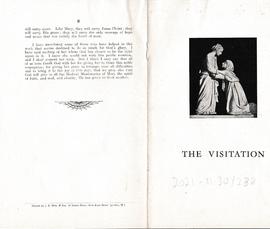
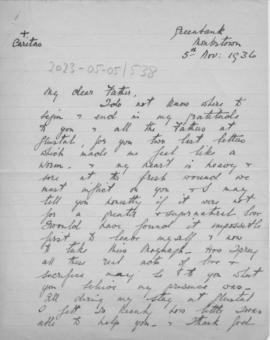
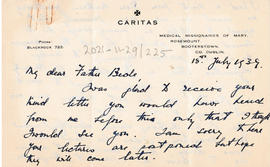
Introductory pamphlet to the Congregation. No date. Title is simply "The Visitation"
AI CLEANED TEXT
Sermon preached by Father Kelly, S.J., on the occasion of the opening of the Novitiate House of the Medical Missionaries of Mary, at Collon, Co. Louth, on 11th December, 1938. THE MYSTERY OF THE VISITATION "And Mary rising up in those days went into the hill country with haste into a city of Judah." (St. Luke 1:39) In these words, St. Luke begins his narration of the Mystery of the Visitation, which was the first action of Mary after the overwhelming message of the angel. The first movement of grace in this new stage of life and holiness, the first movement of Christ whom she carried within her, was this long journey to her cousin, whose son, miraculously given to her in her old age, was to be so closely connected with the Saviour that Mary herself was carrying. She went with haste on her gracious message of charity. She leaves her home, the retirement she needed to enable her to understand her secret, to realize her blessing. She goes into the world, she climbs into the hill country. This first journey was symbolic. It typified the role of Our Lady in the whole history of the world. Not merely does she give Jesus Christ human nature from her most holy flesh and blood, not merely is He born of her, but she brings Him herself to the world. "Caritas Christi urget nos," St. Paul could cry. How incomparably stronger the urge and desire of Mary, driven by the infinite zeal of the unborn Saviour of the world. See the double aspect of that mystery: the gracious act of womanly charity to a friend in her trial of maternity, see the spiritual aspect, that she comes not alone but with One at whose approach the infant leaps in the prison of the womb and the mother is filled with the Holy Spirit. I have called the Medical Missionaries of Mary the latest manifestation of that spirit, and it is certainly not the least original and bold. It is the response to the appeal of the Holy Father for a new effort to meet new needs. It is a true religious congregation, whose members will have public vows, and the rights, responsibilities, and privileges of religious. Its distinctive work will be to help the missions not merely in Africa, but wherever the Church will call it in medical work. It will be oriented to that work in a very special manner, and its constitutions, rules, and way of life will be framed so as to give the fullest and freest scope for that work. In accordance with the instruction of the Holy See, it will procure the most modern equipment and training, and it will put the newest inventions of science and discovery at the service of religion and charity. Rooted in Charity Skilled, professional, and unwearied service—it will give. But it will give more because it will be more than a professional body. It will be a religious order. Its motto is St. Paul's "Fundati et radicati in caritate" (founded and rooted in charity). Its external activity is but the manifestation of an intense interior life—not doctors and nurses merely, but nuns. Their lives will be bound by the vows of poverty, chastity, and obedience, those holy bonds that do not depress but elevate, that do not shackle but set free. They will tend sick pagans because they love them, and they will love them because God has already loved them and given His Son for them. They will spend their professional skill and care on sick, fever-wracked, diseased bodies, but they will have a tender care, a deeper solicitude for the soul that is in darkness and the shadow of death. Let me end with the gracious picture with which I began. The Visitation came after the Annunciation when Our Lady had conceived Christ within her, then she went abroad to carry Him to the world. The Medical Missionaries of Mary will have their Annunciation; they will have St. Paul's ideal: "I live, now not I, but Christ lives in me." Their spiritual training will fashion them to an intense interior life. And then will come their Visitation. They will go forth in haste to the hill country, they will go into the ways of the mission fields. The jungle, the lonely hut, the hospital ward will be for them the city of Judah. To those wracked with fever, to lepers, to sick children, to suffering, mothering women; they will, as trained doctors and nurses, carry healing and comfort.
His Grace the Archbishop of Dublin to open a house, Rosemount, in Booterstown, where aspirants and those following medical courses in the hospitals or University might stay. And the permission given by His Eminence to open the Novitiate at Collon, which is the ceremony we celebrate today.
THREE BENEFACTORS.
In its short history the young Society has met with many friends, none of whom it will forget, but there are three especially whose service to it has been incalculable, and whom it is only just to mention on this occasion. His Excellency the Apostolic Nuncio who from the beginning has taken the deepest and most helpful interest in every step of the foundation and whose presence here to-day is deeply appreciated; His Grace Archbishop Riberi, Delegate Apostolic in Africa for the Missions, who approved enthusiastically of the idea, hastened the foundation and secured all the necessary permissions at Home; and Mgr. Moynagh, Vicar Apostolic of Calabar who received the Society in his vicariate, petitioned Rome for its being made a religious institute and gave it a hospital and noviceship. The Medical Missionaries of Mary will never forget these benefactors whom God raised up for them and whose services made their existence possible.
OUTBURST OF APOSTOLIC ENTERPRISE.
Today's ceremony is the latest manifestation of the unquenchable missionary spirit of our people. The last twenty years have witnessed an outburst of apostolic enterprise which can be paralleled only by the days of Columba and Columbanus and Gall. To all the pagan lands, to China, to Africa East and West, to India a stream of priests, brothers and nuns are going forth, but we must not forget that it is the zeal and generosity of our people at home which have made that effort possible. The spirit that made St. Paul cry out (Vae mihi si non evangelizavero—"Woe to me if I preach not the Gospel"), the spirit that made those early missionaries desire peregrinari pro Christo, to be exiles for Christ's sake, that spirit still burns clear and strong in our people through God's mercy.
At a moment when the whole world is filled with war, with the preparations for war, with racial hatred and injustice, it is consoling to think that our own country dreams of extending the kingdom of Christ, and subduing [nations to] Him, whose service [is] Life and freedom and justice.
Joy, see Our Lady's charity on the double plane, the natural and the supernatural, and you will understand the propriety with which the mystery of the Visitation has been chosen as the inspiration of the Medical Missionaries of Mary.
NOTABLE CEREMONY.
The ceremony which you have come to witness and in which you take a part is something very simple, but very unusual. The foundation of a new religious congregation is in itself not often seen, but there is another consideration that makes this ceremony still more notable.
It is the first response of Ireland, if not of the Catholic world, to the new call of the Holy Father, which marks by its nature and spirit and organisation and constitutions a new departure in the history of the missions, a new adaptation of the Church to the new needs of the missionary Apostolate.
The presence of this distinguished congregation shows that the significance of that event is fully understood, that all recognise that this quiet ceremony is the putting into the ground of a small seed which with God's grace will grow and develop and become a great tree and send its branches far and wide and will provide shelter and life and rest for great multitudes.
With this day's event the history of the Medical Missionaries of Mary may be said to begin officially, but the foundation of the Congregation has had its history, which may be briefly sketched here. The idea came eighteen or twenty years ago to one who worked in Nigeria under Dr. Shanahan; some years of experience as nurse and teacher among the pagans led to two convictions: one, the necessity of a professional medical service; the second, that such work needed a special organisation, that the spirit of sacrifice, the devotion, the constancy could be, as a rule, expected only from those who were freed from family ties and had special spiritual helps, that is, from a religious congregation. The idea persisted for years, though it seemed but a dream. Many things happened which seemed to make it impossible, among them continued bad health. But perhaps from the delay came fuller conviction and a clearer grasp. And after eight or nine years came the first faint steps towards realising the dream, and five or six others were found who had already vaguely thought and hoped for a kind of missionary work which they had not yet seen realised. In that first group there came a sifting and winnowing until there was left finally
a few who had that spirit of courage and confidence that qualified them to be pioneers in a new spiritual enterprise. Those were years of slow growth of hope and prayer when only desire and zeal were certain, and all means and ways uncertain.
DEEP AND FAR-REACHING ROOTS.
The decisive event of that first period, the event which really began the process towards the formation of a religious congregation, was the invitation of the Prior of the Benedictine Abbey of Glenstal given to the foundress to live close to the monastery and share as far as could be in its spiritual life. The two years spent at Glenstal were decisive; they constituted a kind of noviceship, in which the principles of the religious and spiritual life were given to the aspirants by instruction and by assistance at the Liturgical Life of the Monastery. The Medical Missionaries of Mary would wish this public record on this occasion, of their incalculable debt to the sons of St. Benedict, and it is a significant fact that this latest venture in religious life, under the most modern conditions, should go back to drink at the spring from which came the beginning of monastic life in Europe eleven hundred years ago. All new movements in the Church spring from deep and far-reaching roots.
While the idea was growing in clearness in the mind of the foundress and her companions a full sense of the difficulties was also growing. Like all the things of God the growing institute was fed on disappointments and trials; it was stamped with the cross, that truest guarantee of vitality and future success. There were practical difficulties of all kinds of ways and means, of permission: but perhaps the chief difficulty, which lay across the path like a great barrier, was the fact that the Church did not in general approve of unrestricted medical work for nuns. Certain fields of medical work, especially maternity work, had traditionally been considered as not suitable for religious. With such a restriction the [new] institute could scarcely exist. There were many who said that the restriction would never be removed. The work of preparation went on in hope and prayer and suddenly the great barrier which had seemed to block all advance was lifted.
In February, 1936, the Sacred Congregation of Propaganda issued an instruction of immense import, which will be regarded as marking a decisive point in the history of the missions and which will be considered as one of the Great decisions of the present Holy Father.
The Sacred Congregation said that its practise had always been to have the methods of apostolate conform to the varying needs of place and time, that the significance of medical work, especially for mothers and children, had been brought home to it by the reports of Bishops and Vicars Apostolic and missionaries all over the wide mission fields, and that after mature study it had decided that medical work, especially for women and children, would have better provision made for it in future. Consequently it expressed the desire for the foundation of new religious institutes of women who would dedicate themselves principally to that work, and the wish that already existing institutes might found special branches for this purpose also. It emphasised the necessity for the best and most modern professional equipment and training, it insisted that all that concerned the spiritual formation and security of such religious should be abundantly guaranteed.
In itself this instruction made mission history. For the nascent institute it was decisive, it seemed like a special answer to prayer, it was an immense incentive and encouragement, the way now lay open, the Church had spoken her mind decisively and had called for an institute which corresponded exactly to the secret hope that the foundress and her companions had been cherishing for years. Difficulties of a practical order remained in abundance, but the fundamental one had been removed. Preparation could now be made with the assurance that what was aimed at was what the Church was calling for.
I need not detail the different steps that led to the foundation of the society. The final step, the erection into a religious institute, was taken as was fitting on the mission field. At the end of 1936 the foundress and two companions left Dublin for Calabar in Nigeria, where a noviceship was canonically erected, in which the spiritual training was entrusted to a religious of the Society of the Holy Child Jesus. Here the Medical Missionaries of Mary were erected into a religious congregation by Mgr. Moynagh, Prefect Apostolic of Calabar, and on Low Sunday the foundress pronounced her vows of religion, and became first professed sister, taking the name of Mary of the Incarnation. She had been gravely ill with fever, had been anointed and had been taken to a Protestant Hospital because there was no Catholic one available. There seems to be a peculiar propriety in the fact that the ward of a fever hospital in Africa was the scene of the first profession in the Medical Missionaries of Mary. The two chief succeeding events worthy of mention here were the permission given by.
OCR ORIGINAL TEXT
Sermon preachedby'YathertKely,S.J., on the occasion
of the OpeningoftherNovitiate House of the Medical Mission.
Ames of Mary, at Colon,Go. Louth, on iith December, 1338.
THEMYSTERY OF THE YISITAMON.
LAnd Mary nong up in Chose days went imto (he
MiM coumiry AItA Hasteimo a qly o/Juda.
L1. Luke 1,30)
N these words St. Luke begins his narration of the Mystery
of the Visitation, which was the Arst action of Mary alter
Re
the overwhelming message of the angel. The Arst mnove.
ment of grace in this new stage of Mile and holincss, the Arst
movement of Chrst whomn she carried within her, was this
Long journey to her cousin, whose son, mniraculously given to
her in her old age, was to be so cioscly connccted with the
Saviour that Mary herself was carrying. She went with haste
on her gracious mnessage of charty. She leavcs her home, the
retirement she needed (to enable her to understand her
secret. to rcalise her blessing. she goes into the word. she
climbs into the hill country. This Arst journey was symabolic.
1t typikes the role of Our Lady in the whole history of the
word. Not merely does she give Jesus Chrst human nature
frorn her most holy Hcsh and blood, not merely is He born of
her. but she brings Himn herselt to the worid. "" Caritas
Christi urget nos'" St. Paul could cry. How incomnparably
stronger the urge the desire of Mary driven by the infnite
zeal of the unborn Saviour of the womd. See the double aspoct
of that mystery. the gracious act of womnanly charity to a
Iriend in her trial of maternity, see the spiritual aspect, that
she comes not alone but with One at whose approach the infant
Leaps in the puison of the womb and te mother is fled with
1 have called the Mcdical Missionaries of Mary the latest
mnanifcstation of that spirit, it is certainly not the least original
And bold. it is the rcsponse to the appeal of the Moly Father
4or a new cHort to mnect new needs. 1t is a true rcligious
Congrcgation, whose members will have public vows, and the
rights, responsibilitics and privileges of religious. Mts distinctive
work wil be to help the missions not mercly in Africa, but
wherever the Church wil cal it in mhedical work. It will be
orientatcd to that work in a vey special mnanner, consbitutions,
rules, way of 1ite, will be Mramned so as to give the fulest and
Ircest scope tor that work. In accordance with the instruction
of the Moly Sce it will procure the most modern cquipmnent
and taining it will put the newest inventions of science and
discovery at the serrice of religion and charity.
ROOTED IN CHARITY.
Skiled, professional, unwearied service, it will give but it
will give more, because it will be more than a proicssional
body. 1t will be a rcligious order. 1ls motto is St. Pauls
Pundali ef radicalt in carilate founded and rooted in charity.
Ms exteinal aclivity is but the mnanitestation of an intense
interior Lle, not doctors and nurses muercly but nuns. Their
Lives will be bound round by the vows of poverty, chastity and
obedience, those holy bands that do not dcpross but clevate
that do not shackle but set irce. They will tend sick pagans
because they love themn, they will love themn because
God has ahcady loved themn and given Mis Son (or
themn. They willspend their proicssional skill and care on sick.
fever-wrackcd, diseascd bodies, but they will have a tenderer
carc, a dccper solicitude for the soul that is in darkness and
the shadow of death.
Met me end on the gracious picture with which 1 began.
The visitation came after the Annunciation. when our Hady had
conceived Christ within her then she went abroad to Carry
Hirn to the word. The Medical Missionares ot Mary wIMhate
thcir Annunciation: they will have St. Pauls ideal" 1 Mve,
now not 1, but Christ Mves in me.' Their spirtual baining
will fashion themn to an intense interior Mke. And then will
come their Visitation. They will go forth in haste to the hil
country, they will go into the ways of the mission Helds. the
Junge, the lonely hut, the hospital ward will be for thern the
city of Juda, to those wracked with fever, to lepers, to sick
chidren, to sukering, mnothering women: they will, as trained
doctor and nurse, cany assuasement, healing. comiort. They
His Grace the Archbishop of Dublin to open a house, Rose.
mount, in Mooterstown, where aspirants and those following
medical courses in the hospitals or University might stay
And the perrnission given by His Mmninence to open the
Movibiate at Colon, which is the coremony we cclebrate today.
THREE BENEFAGTORS.
In its short history the young Society has met with many
Miends, none of whom it will forget. but there arc thrce
ospecialy whose service to it has been incalculable, and whorn
It is only just to mention on this occasion. Mis Mxccllency
the Apostolic Nuncio who irorn the beginning has taken the
Hcepcst and mnost helpful intercst in cvery step of the (ounda.
tion and whose prcsence herc to-day is deeply appreciated, Mis
Grace Archbishop Kiberi, Delegate Apostolic in Africa tor the
Missions who approved enthusiastically of the idea, hastencd
the foundation and secured all the necessary permnissions at
received the Society in his vicariate, petitioned Homne for its
being mnade a religious institute and gave it a hospital and
noviceship. The Medical Missionaries of Mary will never torget
these benclactors who God raised up for them and whose
serviccs made their existence possible.
OUTBURST OF APOSTOLIC ENTERPHISE.
Todays ceremony is the lalest manilcstabion of the
unquenchable mnissionary spirit of our people. The last twenty
ycars have witncssed an outburst of apostolic enterprise which
can be paralleled only by the days of Columuba and Colurnbanus
And Gall. To al the pagan lands, to China, to AHrica Hast and
West, to india a shcarn of pricsts, brothers and nuns arc
going forth, but we mnust not forget that it is the zeal and
Home, and Mgr. Moynagh. Vicar Apostolic of Calabar who
generosity of our pcople at homne which have mnade that cHort
possble. The spirit that made St. Paul cy out ( Vae mih.
si non cvangclisubero "' woe to mne if 1 prcach not the Gospel
the spirit that made those carly missionares dcsre percgrinam
pro Christo to be exiles tor Chuist's sake, that spirit shill burns
cear and sbrong in our people through Gods mnercy.
At a momnent when the whole womd is Hlled with war,
with the preparations for war, with racial hatred and
Injustice, it is consoling to think that our own country
dreams of extending the kingdomn of Chrst, and subduing
Mrsoncste Him. rhore servce LeMe and frecdom and
justice.
Joy, sce Our Lady's charity on the double plane the natural
and the supernatural and you will understand the proprety
with which the mystery of the Visitation has been chosen as
the inspiration of the Medical Missionaries of Mary.
NOTABLE CEREMONY.
The ceremony which you have comne to witness and in
which you take a part is something vey simple, but very
unusual. The foundation of a new religious congregabion is in
Mlselt not okten seen. but there is another consideration that
makes this ceremony still more notable
1t is the Arst response of Ireland, 1f'not of the Catholic
worid. to the new cal) of the,Holy. Wather. which marks
by its nature and spirit and organisation andlconstitutions
a new departure in the history of the missions a new
Adaptation of the Church to thenew needs of the missionary
Apostolate.
The prcsence of this distinguished congrcgation shows that the
signicance of that event is fully understood, that all recognise
that this quiet ceremnony is the putting into the ground of a
smnall secd which with Gods grace will grow and developr and
become a great trec and send its branches far and wide and
wil provide shelter and Mie and rest for great mnultitudes.
With this days event the history of the Medical Mission.
Arics ot Mary mnay be said to begin ofcially. but the founda.
Lion of the Congregation has had its history, which muay be
bnely sketched here. The idea came cighteen or twenty years
ago to one who worked in Migeria under Dr. Shanahan somne
years of cxperience as nurse and teacher amnong the paganslest
two convictions onc, the necessity of a professional medical ser.
vice, the second, that such work nceded a special organisation.
that the spirit of sacrihce, the devotion, the constancy could be,
As a rule, cxpected only Aromn those who were frced frorn farnily
Mcs and had special spiritual helps that is tromn a religous
congrcgation. The iden persisted for years, though it scemned
but a-dream. Many things happened which seemed to make it
imnpossible amnong thern continued badhealth. But perhaps
Mromn the delay camne (uller conviction and a clearer grasp.
And akter cight or nine years came the Arst faint steps towards
rcalising the dreamn. and Ave or six others were found who had
slrcady vaguely thought and hoped for a kind of missionary
work which they had not yet seen realised. In that Arst group
There came a sluns and winnorins unbl Chere was lelt fnaly
3
a few who had that spirit of courage and conadence that
qualiked themn to be pioncers in a new spiritual enterprise.
Mhose were years of slow growth of hope and prayer when
only desire and zeal were certain, and all means and ways
uncertain.
DEEP AND FAR.REACHING ROOTS.
The decisive event of that Arst perod the event which
really began the proccss towards the ormation of a religious
congrcgation, was the invitation of the Drior of the Bencdictine
Abbey of Glenstal given to the foundrcss to Mive close to the
monastery and share as lar as could be in its spiritual Mfe.
The two years spent at Glenstal were decisive, they constituted
A kind oi noviceship, in which the principles of the relgious
And spiribual life were given to the aspirants by instruction and
by assistance at the Mturgical Mite of the Monastery. The
Medical Missionaries of Mary would wish this public rccord on
this occasion, of their incaiculable debt to the sons of St.
Benedict. and it is a signhcant (act that this latcst venture in
religious lite, under the most mhodern conditions, ghould oo back
to drink at the spring kom which came the beginning of
monastic lile in Europe cleven hundred years ago. Al new
movements in the Church spring Momn decp and farreaching
1o0tS.
While the idea was growing in clearnessin the mind of the
foundress and her cornpanions a ful sense of the diMcultics
was also growing. Like al the things of God the growing
institute was fed on disappointments and bials it was stamnped
with the cross that truest guarantce of vitality and (uture
success. There were practical ditcultics of all kinds of wayS
and means, of permission: but perhaps the chies dimhculty,
which lay across the path Mke a grcat barrier, was the (act
that the Church did not in general appprove of unresbricted
medical work for nuns. Certain Aclds of mcdical work
cspecially maternity work had traditionaly been considered as
not suitable for rcligious. with such a rosbriction (he po
institute could scarcely exist. there were mhany who said that
the resticton would never be rcmoved. The work of prepara.
tion went on in hope and prayer and suddenly the grcat barrier
which had seemed to blocke all advance was lilted.
In February, 1936, the Sacred Congregation of Propa.
sanda issued an instruction of inmnense import. which wiII
be regarded as marking a decisive point in the history of
the missions and which will be considered as one of the
Sreat decimons of the present Holy Father.
The Sacred Congrcgation said that its practise had always
been to have the methods of apostolate coniormn to the varying
nccds of place and timne, that the signikcance of mnedical work,
cspecially for mothers and children, had been brought horne to
It by the rcports of Bishops and Vicars Apostolic and mnission.
Arics al over the wide mission Aclds, and that after mature
study it had decided that mnedical work especially for womnen
and children, would have better provision made for it in uture
Conscquently it expressed the desire for the foundation of new
cligious institutes of women who would dedicate thernselves
puncipally to that work. and the wish that already existing
institutes mnight found special branches tor this purpose also.
1t emnphasised the nccessity for the best and mnost mnodern
prolessional cquipment and taining, it insisted that all that
concerned the spiitual formation and sccurty of such religious
should be abundanby guarantced,
In itselt this instruction made mission History. Nor the
nascent institute it was decisive, it sccmed Mke a special answer
to prayer, it was an immense incentive and encouragement,
the way now lay open, the Church had spoken her mind
decisively and had callcd for an institute which corrcsponded
exacbiy to the secrct hope that the foundrcss and her com.
panions had been cherishing ior years. Dimculties of a prac
Micalorder remnaincd in abundance, but the fundamentalonehad
been removed. Dreparation could now be mnade with the
Assurance that what was aimned at was what the Church was
calling Lor.
I need not detall the diHercnt steps that led to the founda.
tion of the society. The gnalstep the ercction into a rclipioug
institute was taken as was Atbing on the mission Aeld. At
the end of 1936 the foundress and two companions lelt Dublin
for Calabar in Migeria, where a noviceship was canonicaly
crected, in which the spiritual taining was entrusted to a
rcligious of the Society of the Holy Child Jcsus. Here the
Medical Missionaries of Mary were erccted into a roligious
congregation by Mgr. Moynagh. Dretect Apostolic of Calabar,
And on Mow Sunday the foundress pronounced her vows of
rcligion, and becamne Arst prolessed sister, taking the namne of
Mary of the Incarnation. She had been gravely il with fever.
had bcen anointed and had bcen taken to a Drotcstant Hospital
because there was no Catholic one available. There seers to
be a peculiar propriety in the fact that the ward of a fever
hospital in Airica was the scene of the Arst profcssion in the
Mcdical Missionaues of Mary. The two chies succceding
ovents worthy of menbon here were the pemmismion given by