Medical Missionaries of Mary

Elements area

Taxonomie

Code

Bereik aantekeningen

    ron aantekeningen

      Toon aantekening(en)

        Hiërarchische termen

        Medical Missionaries of Mary

          Gelijksoortige termen

          Medical Missionaries of Mary

            Verwante termen

            Medical Missionaries of Mary

              203 Archivistische beschrijving results for Medical Missionaries of Mary

              203 results directly related Exclude narrower terms
              Mother Mary Martin Letters
              IE IE/GLA IE/GLA/2020-03-06/9/2020-03-12/20 · Bestanddeel · 1934 - 1974
              Part of Glenstal Abbey Archive

              Letters sent to and by Mother Mary Martin. Cover letter in 1974 states: "Documentation on foundation of Medical Missionaries of Mary in Glenstal. Entrusted to Fr. Mart T. for eventual photostating for Mother Jude. Fr. Bernard. These papers are not in chronological order"

              Zonder titel
              Pamphlet on the Society
              IE IE/GLA IE/GLA/2020-03-06/9/2020-03-12/20/2021-11-30/235 · Stuk · ca 01-01-1938
              Part of Glenstal Abbey Archive

              Short pamphlet promoting the Congregation. No date. Title is "The Society of the Medical Missionaries of Mary." Printed by the Drogheda Independent. 1938

              AI CLEANED TEXT:

              It is hoped that a maternity wing may soon be built to further this most important branch of medical science. While our country has entered with wonderful enthusiasm into the work of God in pagan missions, and the youth of Ireland has gone forth with admirable generosity, in Medical Mission Work we are far behind continental countries. It is hoped that in the near future, young women will come forward from our Catholic medical schools and hospitals to join the ranks, as well as girls suited by education and Catholic tradition to enter upon the vast field of labor which the Society of Medical Missionaries of Mary has set before it. The urgent need at the moment is for doctors and nurses who will be fearless in shouldering the responsibilities of, in many cases, isolated work. Those who enter the society without these qualifications will be given facilities for such training as the Mother General may think fit, considering their talents and the needs of the society. As the scope of the work extends to the formation of Christian women in pagan countries, some members will be given opportunities for training in domestic subjects. It is to Catholic Ireland that the institute looks for the encouragement and help necessary for its expansion until it becomes one of those mighty forces sheltering the needy children of the Kingdom of God. Everyone can help in some way. Girls who are qualified as doctors or nurses will find a large field in which to labor. Parents and teachers can foster vocations in the young. Many can help by making the society known, distributing literature, etc. Some can send financial assistance or articles useful to the sisters at home and abroad. Mother Mary of the Incarnation, Rosemount, Booterstown, will gladly supply particulars and leaflets on application. All can help by prayer—constant, fervent prayer, especially through the intercession of the Blessed Virgin. "Ask of Me, and I will give thee the gentiles for your inheritance." Ps. 2:8.

              THE SOCIETY OF MEDICAL MISSIONARIES OF MARY Several months ago, a short paragraph appeared in several Irish dailies, announcing that an Irish missionary nun, Mother Mary of the Incarnation Martin, had been received in audience by the Holy Father. How many who scanned this item were aware of its true significance? Did anyone realize that in the midst of the ever-changing world, something permanent had happened? "The Kingdom of Heaven is likened to a mustard seed, the smallest of all seeds," and every new growth of the Kingdom comes from a seed, small indeed, and for a long time hidden from sight, but finally growing into an immense tree. Such has been the history of all religious institutes, and the Society of the Medical Missionaries of Mary, to which the Holy Father gave a special blessing last January, is no exception. The Society has been founded to supply one of the most urgent needs of Catholic Missions in pagan countries: the care of the sick, of mothers and infants, of the lepers and plague-stricken, in hospitals, dispensaries, and the homes of the people. These missionaries will devote themselves entirely to this work and to the formation of Christian mothers or future religious. For this reason, its members will be qualified doctors, nurses, midwives, chemists, dentists, etc., though non-medical members will also be received. The Society is a Religious Institute, the members being true religious with the usual vows, and all the helps, rights, and obligations of the religious life. Although the requirements of their special work demand certain freedom, surgical procedures may involve as many as nine or ten operations a day. The natives take pride in having an operation and, once cured, return home with special distinction. Injections are also a popular form of treatment, and the reputation of the hospital often depends on them. The matter of catering is marvelously simplified, as it would be difficult for a European to unravel the intricacies of the native menus. Each patient brings a "small boy" from their tribe with them to the hospital. The "small boy" may vary considerably in age and size, for any man who is not a chief or wealthy describes himself as a "small boy." They act as water carriers for washing and cooking, cook their patient's food in the hospital kitchen, and carry it to the ward on their heads. Generally, the boys work quietly and peaceably, but occasionally a disagreement arises and must be settled judicially, so they bring the matter to Sister. A long discussion follows since justice cannot be done unless both sides fully state their case. Once heard and Sister's decision is given, there is no further appeal—justice has been done. However, it tests the patience of the over-busy Sister who must endure lengthy statements on matters that could be settled quickly. Yet, this exercise of patience is God's work, as nothing attracts the poor heathen as much as the Sisters' unfailing exercise of peace and charity. They glimpse through them a good God such as their code has never conceived, all their religion being founded on fear. So greatly does the charity of the Sisters impress them that it is rare for a poor pagan to die in the hospital without asking for Baptism. The rescuing of twins is one of the Sisters' most arduous duties. The pagans regard the birth of twins with the utmost horror, and it is customary to abandon the infants in the bush and expel the mother from the village. It requires endless patience and charity to induce these poor women to come to the hospital and save the lives of the neglected waifs. These infant souls, however, are God's harvest and future members of the household of faith if reared under the aegis of the Mission, where they are imbued with Catholicity from their earliest years. Unfortunately, the Sisters are often handicapped in this great work by a lack of suitable infant foods, which must be obtained from Europe.

              How dear this work is to the Sacred Congregation for the Propagation of the Faith can be judged by the manuscript letter Sister Mary received from the Cardinal Prefect: SACRA CONGREGATIO DE PROPAGANDA FIDE, ROME, 16th August, 1938. Very Reverend Mother, Your letter of July 31st gave me great pleasure, and I appreciate the expression of gratitude and thanks you address to the Sacred Congregation. I trust that the Novitiate, which is now under consideration, may soon be a consoling reality and give a new impulse to the spirit of charity which distinguishes your community. The news you give me concerning the work of the Sisters in Africa is indeed welcome, and I echo the words of St. Paul: "I have had great joy and consolation in your charity." And I close this letter with the beautiful words of that same great Apostle addressed to the Philippians: "And this I pray, that your charity may more and more abound in knowledge and in all understanding." I pray God to fill you all with His graces, and as an earnest of heavenly favors and a witness of my goodwill, I bless you with all my heart. Yours devotedly in Christ, (Sgd) P. CARD. FUMASONI-BIONDI, PREFECT. The two Sisters who remained in Nigeria after Mother Mary's departure have since been professed, and this year they have been joined by three more members, all of whom are working at St. Luke's Catholic Mission Hospital, Anua, Southern Nigeria. Already, the fruit of their labors is being felt. One of the first maternity cases was that of a woman who had lost seven children in premature births. This last was also premature, but mother and child were happily saved. At present, St. Luke's Hospital consists of 130 beds divided between male and female wards. About 150 cases are attended to daily in the Dispensary. Every kind of tropical disease is dealt with, as well as pneumonia, tuberculosis, etc. The greater number of the cases come from the observances usual to religious life, i.e., choir, enclosure, etc. The absence of these will demand a more fervent interior life, which the Constitutions, rules, and training are specially designed to promote. Full scope will be given to professional work, and for this, the Society has adopted a simple dress, designed in the style of nurses' uniforms now in vogue, but adaptable to various climates or circumstances. The dress is given a religious character by a simple crucifix suspended from the neck. The Society of the Medical Missionaries of Mary has come into existence through the instrumentality of a Dublin lady, Miss Mary Martin. Her early years spent in a truly Catholic atmosphere prepared her for her future work. Uncertain of her vocation, she entered the Richmond Hospital at the beginning of the European War in 1914 as a V.A.D. After a year's training, she spent three years nursing in various war hospitals on the Continent. Here she experienced the opportunities a nurse's position gives to influence for good. From this and her devotion to Our Blessed Lady grew a desire to imitate her in the beautiful mystery of the Visitation, when, bearing Her Divine Son, she went to the assistance of her cousin, St. Elizabeth. When Miss Martin returned to Ireland, she heard from Bishop Shanahan, C.S.Sp., about the great need for medical assistance in the missions, especially for the care of mothers and infants. To prepare herself for this work, she entered the National Maternity Hospital, Holles Street, and after a full course of training took her C.M.M. certificate. Thus prepared, in 1921 she sailed for Southern Nigeria. Disappointment awaited her, for upon her arrival she found the Bishop in difficulties about his girls' schools, and so she volunteered to come to his assistance until qualified teachers should be forthcoming. This work was of primary importance, not only for the teaching and religious instruction of children but also for the protection of Christian girls who were given by parents or future husbands for training. For three years, Miss Martin carried on the work of the school in Calabar until she was relieved by a qualified teacher. The greater part of this time she lived alone with the native girls, an experience which gave her deep insight into local conditions.

              Her practical knowledge of the difficulties and requirements of such a vocation was never very robust, and these years took a toll on her constitution. When relieved, it was necessary for her to return home. However, her ideal of establishing medical missions remained steadfast, but God's time had not yet come. Instead, disappointment and trials of every sort tested her vocation and her fidelity to it. Praying and hoping, she continued to seek God's will, meanwhile devoting herself to furthering the work of the missions in various ways. In 1933, she gathered around her a few earnest girls desirous of devoting their lives to God in the missions, and these proved to be the nucleus of the new institute. Having lived together under spiritual guidance for over three years, Miss Martin placed her companions in Holles Street Hospital for training in preparation for going out to Nigeria, where Mgr. Moynagh had offered an opening when the institute should come into existence. These girls had hardly completed their training when two circumstances combined to bring about the speedy erection of the Society. First, the Sacred Congregation of Propaganda issued an instruction on 11th February 1936, expressing a wish that new institutes be formed with the special intent of doing maternity and child welfare work. Heretofore, the practice of obstetrics was disallowed to religious, even to those fully qualified and engaged in general nursing. But the urgent necessity of this work on pagan missions had been repeatedly represented by the Apostolic Visitors. It is now deemed essential for the propagation of the Faith. In the second place, Mgr. A. Riberi, Auditor at the Irish Nunciature, was appointed Apostolic Visitor in Africa in 1933. He had met Miss Martin and was aware of her project. His first visitation convinced him of the urgent necessity of Catholic Medical Missions, and upon his return, he urged Miss Martin to take advantage of the recently issued instruction and commence her work at once. With two companions, she sailed for Nigeria in December 1936. The Society of the Medical Missionaries of Mary was erected in April 1937 into a religious congregation by Most Revd. Mgr. Moynagh, Prefect Apostolic of Calabar, Southern Nigeria, with the approval of His Excellency Mgr. A. Riberi, Delegate Apostolic to Africa, and the approval of His Eminence the Cardinal Prefect of the Congregation of Propaganda. Miss Martin made her vows, the first professed religious of the institute. She took the name Sister Mary of the Incarnation. This interesting ceremony actually took place in a Protestant hospital, for the foundress was stricken with fever shortly after her arrival in Africa. Owing to the sudden death of Dr. Dunleavy at the Catholic Mission Hospital, it was not possible for Sister Mary to receive medical treatment there. What more striking augury could attend the new venture? Having placed her two companions under the care of the Sisters of the Holy Child Jesus to make their novitiate, Sister Mary returned to Dublin, where, with the permission of His Grace, the Most Revd. Dr. Byrne, she opened a house of studies at Rosemount, Booterstown Avenue, and commenced a long and tedious search for a house suitable for a novitiate. This she has recently secured at Collon, Co. Louth, with the approbation of His Eminence Cardinal MacRory. The work undertaken by the Medical Missionaries of Mary in the mission field is one of heroic zeal and charity. Mgr. Riberi writes to Mother Mary, saying: "Indeed, although working everywhere with wonderful enthusiasm and in some places with a great measure of success, in many parts they are severely handicapped by two principal factors: having come late to the field, and being deprived of Medical Missionaries. You intend, dear Reverend Mother, with a generous heart, to make up for this latter deficiency. Let me, therefore, wish you every success in your very timely undertaking. I will not conclude this letter, however, without addressing an earnest appeal to those Irish girls, full of zeal and faith, who, were they to know the wonderful possibilities awaiting them in Mary's Medical Missionaries, would gladly join them. Hoping that this appeal will have a favorable response, I remain, dear Mother Mary, with renewed congratulations, yours sincerely in Christ."

              ORIGINAL OCR
              1t is hoped thab a malerniy wing may soon be built 1o
              Huther this most impomtant branch of medical science.
              Mhllemour counhy has entered with wonderful
              enthusiasmu into the work ofGod on pagan missions and the
              youth of Heland has gone forth with admirable generosity,
              yetin Medical Mission Work we are far bchind continental
              countmies. MItis hoped in the near future young women will
              be forthcoming from our Catholic Medical Schools and
              Hospitals to join the ranks. also gins Ebtad by educaton
              And Cathohc tadilion to enter upon the vastAeld of labour
              which te Society of Medical Miasiouaries ot Mary has set
              before it
              R
              The ugent need at Me moment isLor Doclors ad
              Nurses who willbe fearlessin shouldering te rcsponsblibes
              of, in mauy cases, isolated work.aThose ho enter the
              Society without these qualikcahons will be given facilities
              for such training as the Mother Generalanay think Et,
              having in wiew their talents ands the nceds of the Society.
              As the scope of the worke extends to the formation
              of Chmishanwomen in pagan counbies, somue members will
              be given opportunimes for taining in-dcineslc subjects.
              1t is to Catholic Meland tat the Iusbtule Looks for
              The encouragement andr help necessary for its expansion
              untl it becomes one of those mighty bces sheltering the
              needy children of the Kingdom of God Everyone can
              help in some way. girls who are qualiked as doctors or
              nurses will And a large Aeld iu which to labour, parents and
              teachers can foster vocations in bhe young. many can help
              by making the Society known, dishabuting Mterature, elc.,
              some can send fnancial assistance or arbcles useful to the
              Sisters at home and abroad. Mother Mary of the
              Incarnabon, Rosemount' Booterstown, will gladly supply
              particulars and leakets on application.
              All can help by prayer constant fervent prayer,
              espccialy Mough te imlerccsmou of te Blessed Virsin.
              MStMe, and 1 roill gioe thee (hr yenliles
              Jo your inherdacC.) Ps. 11S.

              THE SOCIETY OF
              MEDICAL MISSONARIES OT. MARY.
              DOMM months ago a short paragraph appeared in several
              M irish Halies, announcing the fact (that an Mish
              mnissionary nun, Mother Mary of the Icarnabion Martin,
              had been rcceived in audience by the Moly Wather. Hor
              many who scanned this ite were aware of its true
              signiGcancel " Did any rcalise that in the midst of the
              hurly-bullylof the everchanging world something pemmanent
              had happened.
              The Kingdom of Heaven is Likened to a mustard seed
              the smallest of all sccds" and every ner growth of the
              Kingdom comes of a seed sall indecd, and for a long time
              hidden from sight: but Anally growing to an imense trce.
              Such has been the history of all rcligious institules and the
              Society of the Medical Missionaris of Mary. to which the
              Holy Father gave a special blessing last January, is no
              excepbon.
              The Society has been founded to supply one of the most
              urgent needs of Catholic Missions in pagan countries the
              care of the sick. of inothers and infants, of the lepers and
              plagueshicken, in Mospitals, Dispensaries, and the homes
              of the people. These missionaries will devote themnselves
              entirely to this work and to the formabon of Chrstian
              mothers or future religious. For this rcason, its members
              wil be qualiked doctors, nurscs, midwives, chemists,
              dentists, etc., though nonnedical members will also be
              rcceived.
              The Society is a Religious Institule, the members
              being true Religious with the usual vows,(and all the hclps,
              Aghis and obligabons of the religious lite. Although the
              rcquircmcnts of thcir spccial work demand certain Arccdomn
              surgical and as many as nine or ten operations muay be
              perfommed in a day. The natives glory in having an
              operation and when cured return homne with an especial
              distinction. Injections are also a popular forrn of treatment
              And it is on the shrength of these that the reputation
              of the Mospital depends. The matter of catering is
              marvcllousy simpliked, for it may be imagined how difhcult
              It would be for a European to unravel the intricacies of the
              nalive menus. Hach pabent brings a "small boy" of the
              Mibe with hirn to Mospital the (ismall boy 1 may vary
              very considerably in age and size, for any man who is not
              a chief or wealthy describes humself as "small boy"'. they
              Act as waler carriers both for washing and cooking, they
              cook their palent's (ood in the Mospital kilchen and carry
              it on their heads to te ward. As a rule, the :boys
              work quieby and peaceably, but occasionally a diference of
              opinion arises and has to be setbled juridically, so they bring
              the malter in dispute to Sister. A long palaver follows, for
              Justice cannot be done unless both sides state their case
              Fuly. but once heard and Sister's decision given, there is
              no further appeal justce has been done/ But how it taxes
              the palience of the over-busy Sister who must stand through
              Lengthy statements of a maller which might be setuled in
              A moment. Mtus, however, this exercise of pabience which
              Hoes Gods work, for nothing so atlracts the poor heathen
              As the unfailing exercise of peace and charity by the
              Sisters. They glimpse through themn a good God such as
              their code has never conceived, all their religion being
              founded on fear. So greably does the charity of the Sisters
              Impress themn that it is rare for a poor pagan to die in
              Mospital without asking for Bapbsm. £
              The rcscuing of twwing is one of the most arduous duties
              of the Sisters. The pagans regard the birth of twins with
              the utnost horror. and it is the custom to throw the infants
              Into the bush and to drve the mother fromn the vilage.
              1t nceds endless palience and charity to induce these poor
              women to come to Mospital and to save the lives of the
              ncglected waifs. These infant souls, however, are God's
              harvest and fulure members of the household of the faith
              If reared under the acgis of the Mission, where they are
              ibued with Catholicity from their carliest years. Alas the
              Sisters are often handicapped in this great work by lack of
              suitable infant foods which must be obtained Hom Europe.

              Mow dear this work is to the Sacred Congregabon Lor
              the Propagabon of the Faith may be judged by the
              manuscript lebter Sister Mary has received Hromn the Cardinal
              Drefect:-
              ISAORA CONGREGAMIONE DU TROTAGANDA MDIE,
              ROMIE,
              16th August, 1938.
              . Very Revcrend Mother,
              M Your lebter ol July 31st gave me great pleasure and
              1 appreciate the expresmon of gratitude and thanks you
              address to the Sacred Congregation.
              II trust that the Novitiate which is now under
              consideration may soon be a consoling rcality and give a
              ne inpulse to the spirit of charity which distinguishes
              your cominunity.
              . he news you give me concerning the work of the
              Sisters in Africa is indced welcome andnt take tor my
              ownthe words of St. Paul (1 have had great ioy and
              consolation in your charity.
              .And I cose this letter with the beautiful words of
              that same great Apostle addressed tothe Philippians.
              LAnd this I pray. that your charity may more and muore
              Abound in knoledge and in al understanding.
              1.I pray God to A you al with His gracos and as an
              carncst of heavenly favours and witness ot iy good will 1
              bless you with al my heart.
              Mours devotedly in Chcist,
              (Sgd) P. CARD. FUMASONLBIONDL. PRMT.
              The two Sisers who remained in Migemia afler Mother
              Mary's departure have since been professeds and this year
              have been joined by thrce more members, all of whomn are
              working at St. Lukes Catholic Mission Mospital, Anua,
              Southern Wigeria. Alrcady the fruit of their labours is
              being felt. One of the Arst maternity cases was that of
              A woman who had lost seven children in premature births.
              this last was also premature, but mother and child were
              Happiy saved.
              At present St. Luke's Hospital consists of 130 beds
              divided bebween muale and female wards. MAbout 150 casog
              Are altended to daily in the Dispensary./ Mvery kind of
              tropical disease is dealt with, as welt as pneumonia,
              Luberculosis, elc. The greater number of the cases arc
              3
              Mromn observances usual to religious, ie., choir, enclosure,
              etc., the absence of these will demand a muore fervent
              interior Lfe, which the Constitutions, rules and training are
              Specially designed to promote. Yull scope will be given to
              professional work, and for this the Society has adopted a
              simple dress, designed on the style of nurses' uniform now
              in vogue, but adaptable to various climates or circumstances.
              The dress is given a religous character by a simple
              crucikx suspended Hrom the neck.
              Te Society of the Medical Missionaries of Mary has
              come into existence through the insbumentality of a Dublin
              Lady Miss Mary Martin. Her cary years spent in a truly
              Catholic atnosphere prepared her for her future work.
              Uncertain of her vocabon, she entered the Hichmond
              Mospital at the beginning of the Muropean War in 1914 as
              A V.A.D. and, after a year's training, spent three years
              nursing in various War Mospitals on the Continent. Here
              she experiencd the opportunities which a nurses position
              gives to inluence for good. Fror this and her devotion
              to Our Blessed Hady grew a desire to imitate her in the
              beautiful mystery of the Visitation, when, bearing Her
              Divine Son, she went to the assistance of her cousin, St.
              Bizabeth.
              When Miss Martin reburned to Ireland she heard Arom
              Bishop Shanahan, C.S.Sp.. of the great ncedzof medical
              Assistance in the missions, especially for the care of mothers
              And infants. "o prepare herselt for this work, she entered
              the National Maternity Hospital, Holes Street. and after
              A full course ok haining took her C.M.M. certikcate. Thus
              prepared, in 1921 she sailed for Southern Migeria.
              Disappointmnent awaited her. for on Her arriva) sho
              found the Bishop in dithculbes about his girls schools, and
              So volunlcered to come to his assistance until qualiked
              Leachers should be forthcomning. This worke was of primnary
              impoutance, not only for te teaching and religious
              insbuchon of children, but also for the protechion of
              Cristian girls who were given by parents or futurc
              husbands for training. Wor three years Miss Martin carried
              on the work of the school in Calabar, when she was relieved
              by a qualiked teacher. The greater pait of this time she
              Mved done with e uative ghis an expeuience which gave

              her a practicalknowledge of the diMculties and requiremnents
              of such a vocation. Mever very robust in health, these years
              told on her constitution, and when relieved it was necessary
              Lor her to return home. Mowever, her ideal of establishing
              medical mhissions remained steadfast, but God's time had not
              yet come, instead, disappointment and tials of every sort
              Lested her vocation and her Adelity to it.
              Praying and hoping, she continued to seck God's will,
              meantime devoting herself to furthering the work of the
              missions in various wayS.
              In 1933,she had gathered around Herda few earnest
              girls desirous of devoting their lives to Godin the missions
              And these proved the nucleus of the new insttute. Having
              Lived together under spiritual guidance for over three years,
              MissMartin placedher companionsin HolesStreet Mospital
              for training in preparation for going out totNigeria, where
              Mgr. Moynagh had oKered an opening when the Institute
              should comne into existence.
              mhese gius had Hardly compleled thei taining when
              two circuinstances combined to brino about the spoedy
              erechon of the Society. Mirst, the Sacred Congregabion of
              Dropaganda issued an lnstruchion on 11th February, 1936,
              expressing a wish that new institules be formed with the
              special intent of doing maternity and childs welfare work.
              Herctofore the practce of obstetrics was disallowed to
              Religious, even to those (ully qualiked and engaged in
              general nursing. But the urgent necessity of this work on
              pagan missions had been repeatedly represented by the
              Apostolic Visitors. It is now deemedessential for the
              propagabion of the Faith. In the second place, Mgr. A.
              Ribem, Auditor at the Mish Nuncialure, was appointed
              Apostolic Visitor in Africa in 1933. Merhad met Mise
              Martin and was aware of her project. His Erst visitalion
              convinced himn of the urgent necessity of Catholic Medical
              Missions, and on his reburn he urged Miss Martin to take
              Advanlage ot the recenly issued nstruchon and commence
              her work at once.
              Mith two companions she salled for Nigeria in
              December, 1936. The Society of the Medical Missionaries
              of Mary was erccled in Apcil, 1937, inle a Religous
              5
              Congregaton by Most Revd. Mgr. Moynagh, Prefect
              Apostolic of Calabar, S. Migera, with the approval of His
              Mxcellency Mgr. A. Hiberi, Delegale Apostolic to Africa,
              And the approval of Mis Mminence the Cardinal Prefect of
              The Congregation of Dropaganda.
              Miss Martin made her vows, the Arst. professed
              Religious of the institute. She took the namne, Sister
              Mary of the. Incarnation. This intercsting ceremony
              Actually took place in a Drotestant Hospital, for the
              Moundrcss was stricken with fever shortly after her arrival
              in Africa. Owing to the sudden death of Dr. Dunleavy at
              the Catholic Mission Mospital, it was notpossible for Sister
              Mary to receive medical treatmnent there. Mhat more
              sbiking augury could attend the ne venture.
              Having placed her two companions under the care of
              the Sisters of the Moly Child Jesus to make theic novitiate,
              Sister Mary returned to Dublin, where, with the permission
              of His Grace, the Most Revd. Dr. Byrne, she opened a
              house of studies at ROSEMOUNT, BOOTERSTOWN
              AVENU. and commenced a long and tedious search for a
              house suitable for a novibate. This she has recenlly sccured
              At Colon, Co. Mouth, with the approbation of His Mminence
              Cardinal MacRory.
              Te work undertaken by the Medical Missionames of
              Mary in the mission-keld is one of heroic zeal and charity.
              Mgr. Hiberi wibing to Mother Maly says.
              M. Ie MSH MiSMionaes, aMthougH WOTMDg QvOTYWHeTG
              with wondemful enthusiasm, and in some places with a great
              mneasure ofcsuccess, in many parts are severcly handicapped
              by two principal factors. having come late to the Held, and
              being deprived of Medical Missionaries.
              . Yon intend. dear Revd. Mother, with generous Heart.
              to make up for this labter dehciency. Het me, therefore,
              wish you cvery success in your very timnely undertaking.
              MI wil not conclude this letter, however, without
              Addrossing an carnest appoal to those Irish girls, full ot
              ycal and faitb, who, were they to know the wonderful
              possibilities awaiting them in Mary's Medical Missionames
              would gladly ioin them.
              r Hoping that this appeal will Have a favourable
              response, I remain, dear Mother Mary, with renewed
              congratulabons, yours sincordly in Ohrist.

              Calabar house pamphlet
              IE IE/GLA IE/GLA/2020-03-06/9/2020-03-12/20/2021-11-30/236 · Stuk · 01-01-1938
              Part of Glenstal Abbey Archive

              Pamphlet about the Mission in Calabar, Nigeria. Title is "Catholic Medical Missionaries of Mary". No date given.

              AI CLEANED TEXT
              The care of the sick must always be one of the most important activities of the Church. Her Divine Founder, who "went about doing good, healing the sick," has given us an example in this regard. This activity is especially important on the foreign missions, where the pagan millions must learn to see the charity of Christ in the Church, which comes to teach them about God. On the missions, medical work is often the only way to get in touch with pagans who are wary of foreigners. But above all, it is probably the best way to prove to them that the missionary is working in their interest and out of love for them. Very often, natives may be suspicious of missionary activity as being just another way of exerting European influence. Work for the sick and suffering quickly convinces people that the Church has an interest in them that is not worldly but has its origin in the love of God. Catholic missionaries have always tried to do what they could to alleviate the suffering of the sick in the lands where they worked. Hospitals, orphanages, and leper settlements have been founded, and devoted priests and sisters have given their lives for God in this missionary work. Protestant missionaries have been by no means slow to take a prominent part in medical mission work. Indeed, their medical mission work is often much ahead of our Catholic work. They send to the missions not only trained nurses and dispensers but many trained doctors as well. The readiness with which their trained medical men respond to the call for help on the missions, and the zeal and self-sacrifice they display in their work, might often be emulated by Catholics. As our Catholic missions grow and expand, the need for more highly organized medical work becomes apparent. Catholic hospitals are necessary, and a hospital means that fully qualified doctors must be available. On the continent and in America, this need has been fully realized for some time, and measures have been taken to meet the need. Institutes have been founded to train medical men who will give a number of years to work on the foreign missions. Such is the Catholic Medical Mission Institute at Würzburg in Germany. But so great is the need for fully qualified doctors on the foreign mission that it is impossible to meet it adequately by depending altogether on lay voluntary workers. Besides, the expense of bringing lay workers on the missions is so great that most foreign missions could not bear the cost. Again, lay workers will always have home ties and duties that make it almost impossible, even for the most devoted workers, to give themselves wholly to God in this exacting work in missionary lands. Hence the instruction of the Sacred Congregation for the Propagation of the Faith, issued on 6th February 1956, is of supreme importance. That instruction expresses the wish of the Sacred Congregation that new institutes of sisters be formed with the special object of doing maternity and child welfare work. Moreover, the Sacred Congregation expresses the wish that existing congregations of sisters train some of their members for the same work. To fit themselves for this task, the Sacred Congregation desires that the sisters in these congregations should have full medical training. The Sacred Congregation proposes to meet the great need for medical help on the foreign missions by having sisters fully trained in every branch of medical work, dedicating their lives to that work. This instruction is of the greatest importance and is bound to have far-reaching results in Catholic medical missions. In 1937, the Medical Missionaries of Mary were founded in the Prefecture of Calabar, Southern Nigeria, with the aim of meeting the wishes of the Sacred Congregation in this matter. The foundress of the new institute, Sr. Mary of the Incarnation (Miss Mary Martin), has desired for many years to do such work for God. The instruction of February 1936 mentioned above now permits her to do so. In the Calabar Prefecture, the priests of the Society of St. Patrick (Kiltegan) are at work. The needs of the medical mission work there are very great. There is only one Catholic hospital in an area of more than 13,000 sq. miles (more than two-fifths of the area of Ireland). This hospital has been worked with the help of a number of lay volunteers from the continent and Ireland, among them being the late Dr. P. A. Dunlevy (native of Co. Mayo). In the same area, the Protestant missions have six hospitals with European doctors and nurses in attendance, while they have a much larger number of dispensary and welfare centers. Very often, the young Christians must attend the Protestant hospitals with danger to their faith. Even when the danger is not great, our Catholic people are faced with the strange spectacle of Churches that are not Catholic doing far more for the care of the sick and suffering than the Church founded by Him who was the special friend of the sick. And if the Catholic is not sent to a Protestant hospital in a time of sickness, he usually has to face a more terrible ordeal still. Very often, the young Christian lives in pagan surroundings. The parents and brothers and sisters may be pagan. In that case, the native doctor, who is also the Ju-ju man, is called in, and he proceeds to sacrifice to the spirit that is causing the sickness. Quite often the Father who attends a sick call finds the poor sufferer in the house of such a "native doctor" or in his own home surrounded by the "charms" and "preventatives" by which the pagan relatives try to ward off the attacks of evil spirits. What a danger this is to the faith of the many young Christians who have recently been won to Christ from such pagan practices! Many a heartache is caused to the priest who has brought these poor souls into the Church, and who, after administering the Sacraments, must go away and leave his children to fight the last fight for God against the evil enemy who seems to make a last effort to snatch these souls won by the precious blood. And how the Father often longs for a Catholic hospital where many a life could easily be saved and more souls won for God. But it is in the matter of maternity and infant welfare work that the greatest need for medical help exists. As is very evident to all, the hope of the Church in the mission lands is the Christian family. Very often, that family has been established with great care and suffering by the missionary in pagan surroundings and among polygamous people. Yet the young mother of this family, which is the foundation of the Church, is as a rule...

              .handed over to pagan relatives in her hour of peril. These pagan midwives are ignorant of almost every rule of health and hygiene. Many of the young Christian women die in childbirth, and sadly, many die without even the consolation of the Sacraments because these pagans who are present will not send for the priest. In the Calabar Prefecture, moreover, there is the inhuman practice of murdering twin children. When twins were born, the pagan practice was to leave these infants to die in the bush. The mother of twins was made an outcast and was not allowed to live in the village or enter the marketplace or farms of the villages. Thanks to the efforts of the government and the influence of Christianity, these hideous practices are being rapidly abolished, but in backward places, they are by no means destroyed. Even if the pagans will not now murder twin children, they often refuse to care for them, and twins are frequently brought to the mission station and left for the missionary. What can the Father in a mission station do for these infants if there is no one to care for them in an orphanage? We need orphanages and hospitals to care for the children and mothers in these pagan lands. We need devoted Sisters who will give their lives for the poor and forsaken of Jesus Christ. It is not enough merely to baptize young Christians and then expose them to all the dangers that Satan knows how to take advantage of in times of sickness. We need devoted women to care for the young Christian mothers and to help them in the work of making the names of our Christian people truly Christian names. For all that work, the Medical Missionaries of Mary is being formed, and the new institute looks to Catholic Ireland for the encouragement and help necessary to do big work for God. Then there is the crying need to help the poor lepers of the missions. All the leper settlements of Calabar are run by Protestant missions. From a humanitarian point of view, they do excellent work, but it is a hard thing for our Catholic priests to be compelled to enter these places on sufferance to administer the Sacraments to these poor outcasts who may be Catholic. If they could address the Catholic people, certainly they would cry out and ask that the Charity of Christ be extended to them. While our country has, thank God, entered enthusiastically into the work for God on the foreign missions, in Medical Mission work she is far behind the Continental countries. Because God will not be outdone in generosity, J. MOYNAGH, Prefect Apostolic, Calabar. For further particulars apply to: Sr. Mary Martin, Superioress.

              ORIGINAL OCR TEXT
              THE Care of the sick must always be one of the most important I Activitiesofthe Church. HerDivine Founderwvho wentabout doing goodhealing the sick" has given us an examplein this. Thisactivity ismostimportant on the Foreign Missionswherethe pagan mnilions must learn to sce the charity of Christ in theChurch which comes 1o teach them of God. On the Missions mnedical work is often the only way to getin touch with pagans who are shy of forcigners. But above all it is probably the best way to prove to them that the missionary is workingin theirinterestand forlove ofthemn. Very often nativesmay be suspicious of Inissionary activity as being justanotheriay ofexerting European inRuence. Morke for the sick, and suffering, quickiy convinces people that the Church has an interest in them which is not wordly but which has its origin in the Love ofGod. Catholic Missionaries Have always tried to dowhatthey could toalleviate the sufering of the sick in the iands where they worked. Hospitals and orphanages and leper settiemnents havebeen foundedand devoted priests and Sisters have given their (ives for God in thismissionary workc. Protestant Missionaries have been by no means siow to takccapromninent partin Medical Mission work. Indced their mnedical mission work is often mnuch ahead of our Catholic work. They send to the mnissions not only trained nurses and dispensers but many trained doctors as well. And the readiness with which their trained medical men respond to the cali for help on the Missions and the zeal and self-sacmhce they displayin their work, might often be copied by Catholcs. As our Catholc Missions grow and expand the need for more Highiy organised mnedical work becomes apparent. Catholic Hospitaisate necessary. And a Hospitalmcans that fully qualihed doctorsmnustbeavailable. On the Continent and in America this necd has been fully realized for some time and measureshave been taken to mneet the necd. Institutes have been founded to train medicalmen who will give a numnberof yearsto work on the Foreign Missions. Such is the Catholc Medical Mission iostitute at Wurzburg in Germany. Butso grcatis the need offullyqualked doctorson the Foregn Mission thatit is imnpossible to mncet it adequately by depending altogether on lay voluntary vorkers. Besides the axpense attached tobringing lay-workers on the Missionsis so great that most of the Foreign Missions could not bearthe cost. Again, lay-workers will always have home ties and duties which wil mnake it almostimpossible, even for the most devoted workers, to give themn. selves wholly to God in this exacting work in Missionary lands. Hence theinstruction of the Sacred Congregation of the Propagation of the Paith, issued on (ith February, 1956 is of supreme importance, That Instruction expresses thewishof theSacred Congregation that new institutes ofSisters be formed with the special obiect of doing Maternity and Child. Meifare work. Moreover, the Sacred Congregation exptesses the wish that existing Congregations of Sisters foriu some of their members for the same WOTk. Latholic Mission House, Calabar To At themselves for this task the Sacred Congregation desires that the Sistersin these Congregalions should have full medical training. calhelpof the Foreign Missions by having Sisters fully trained in every THe Sacred CongregaHODTHeD pTOpOsGStOMeGTTHG STGATDGed Of Medi. branch of Medical work, and giving their lives to that work. Thisinstruction 1s of the greatest importance and is bound to have far-reaching results in Catholc Medical Missions. 1n 1937 tHe MedicalMissionariesotMary werefoundedinthePrefecture ofCalabar, S. Nigeria, with the aimn of meetibg the wishes of the Saered Congregation in thismnatter. The Foundress of the New institute, Sr. Mary of the Incarnation (Miss Mary Martin) has desited for many ycars to do such work for God. The instruction of Kebruary, 1936mentioned above now permitsherto doso. In the Calabar Prefecture, the priests of the Society of St. Pattick, Kiltegan) are at worke. And the needs of the Medical Mission worke there Are very great. There is only one Catholc Hospitalin an area of mnore than 13,000sq. miles, (ormorethan two-hfthsotthe areaofireland ( Thishospi. talhas been worked with the hep of a member of (ay volunteers fromn the Continent and Ireland, amnong themn being the late Dr. P. A. Dunlevy (ative of Co. Mayo). in the samc arca the Mrotestant Missionshave six hospilals With European Doctors and Nurses in attendance, while they have amuch Larger number cf dispensary and weliare centres. Very okten the young Christians mnust attend the Brotestant Mospitals with daogerto their Faith And even when the dangerisnotgreat our Catholic people are faced with the Strange spectacle ofChurches that are not Catholic, doing farmorefor the care of the sick and sukering than the Church founded by Himn Wvho was the Special Friend ofthe SiCk. And if the Cathokc is not sent to a Protestant Hospital in tme of sickness he usually has to face a more tertible ordeal stil. Very oken the young Christian Livesin pagan surroundings. The parents and brothers and sisters may be pagan. in that case the native doctor whoisaiso theJu-ju man is called in and he proceeds to sacrihce' to the spirit that is the cause of the sickness. Quite often the Father who attends a sick.call Ands the poor sukererin the house ofsuch a native doctor', orin his own homne surrounded by the charmns' andpreventations' by whichthe paganrelatives try to ward off the attacks ofevilspirits. Whatadanger thisistothetaith of the many young Christians who have quite rccenby been won to Christ Iromn such pagan practices( Many aheartacheiscaused to the priest who has brought these poor soulsinto the Church and whoafteradmninistering the Sacraments mustgo away and leave his Chidren to Aght the last Aght for God against the evil cnemy who seemns to make a last ettort to snatch these Souis won by the prccious Biood. And how the father often iongs for a Catholic Mospital where many a Lfe could easily be saved and more souis won for God. Butit is in the matter of Maternity and infanteweifare work that the greatest need ofmedical help exists. Asis very evident to all the hope of the Church in the Mission lands is he Chtistian famnily. Very often that family has been establisbed with greatcare and sukemng by the missionary in pagan surroundings and among a polygamus people. Vet the young mother of this famy which is the foundauon of the Church is as a rule

              handed over to pagan relativesio her hour of peril. Thes pagan mid-wives Areignorantofalmostevery rule ofhealth and hygiene. Many of the young Christian women diein cHiId.biNthand sad to say many die without even the consolation of the Sacraments because these pagans who are present will not sendfor the priest. In the Calabar Prefecture moreover there is the inhuman pracliSe of murdering twinchildren. When twin-children wete born the pagan practise Hasbeen to throw these waits away to die in the (bush. The mother of twincchiidren was mnade an outcast and was not allowed to live in the village or to enterthemarket place orfartns of the villages. Thanks to the eforts ofGovernment and theinduence of Christianity these hideous praclises ate being rapidiy abolished but io backward places they are by no means destroyed. Even if the pagans wil not now murder bwwinchidren they often refuse to care for them and twins ace frequenly brought to the Mission Stahon. and got md of by leaving them to the missionary. What can the Fatherin a mission station do for these waits if there is no one to cate for them in an orphanage3 We necd orphanages and hospitals to care for the Children and Mothers in these pagan lands. We nced devoted Sisters who willgive their Lives for the poor and forsaken ones of Jesus Christ. 1t is not enough merely to baptize young Christians and then expose them to all the dangers that Satan Knows how to take advantage of in tme of sickness. We need devoted women to care forthe voung Christian Mothersand to hep them in the wore ofmaking the names of our Christian people truly Christian names. For all that worke the Medical Missionaries of Mary is being formed and the new Institute looks to Catholic Ircland for the encouragement and help necessary to do big work for God. Then thereis the cying necd of helping the poor lepers ofthe Missions. All the Leper Settiements of Calabar are run by Protestant Missions. From the humanitarian point of view they do excelent work. butit isa hard thing for our Catholic priests to be compelled to enter these places on sufferance to Administer the Sactaments to these poor outcasts who may be Catholic. 1f they could address the Catholic people certainly they wouid cry out and aske that the Chanty of Ch ist be extended to them. Mhle ourcountry has, thank God. entered enthusiastically into the work for God on the Forcign Missions yet in Medical Mission Work sheis far bebind the Continental Countrcs. Bcase God Mat wil notbe sadot lcekdin the near tomG. J. MOYNAGH. Drelert Mposfokie, CaMBIE. For further particuilars apply :- SR. MARY MARTIN, SUPEMORESS,

              IE IE/GLA IE/GLA/2020-03-06/9/2020-03-12/20/2021-11-30/237 · Stuk · ca 01-10-1939
              Part of Glenstal Abbey Archive

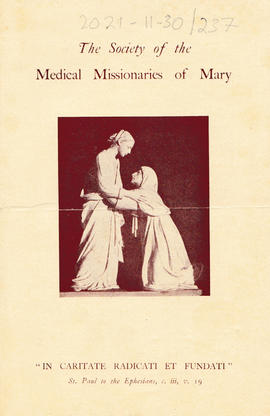
              Pamphlet introducing the Congregation with a note from Msgr Riberi, Archbishop of Dara

              AI CLEANED TEXT

              The Medical Missionaries of Mary The Society of the Medical Missionaries of Mary was founded in response to the appeal made by the late Holy Father, Pope Pius XI (the Pope of the Missions), for new institutes of Sisters to be formed for medical work on the mission field, with special concentration on maternity and child welfare work. The members of the Society are religious with public and perpetual vows, trained according to the common prescriptions of Canon Law and their own special constitutions. As their life is very exposed with much freedom of action for their apostolic work, a solid religious training is provided for the cultivation of a deep interior life. The constitutions have been specifically framed to meet the needs of the new work. The Sisters are animated by the spirit of St. Benedict in a broad spirit of charity, and the professed Sisters are available to serve the sick at any hour of the day or night. Their external religious practices are as unostentatious as possible. The dress worn is a plain professional one, adaptable to varying conditions of time and place. All branches of medical work will be undertaken by the Sisters. They will be specially trained and qualified as doctors, dentists, and in other medical fields.

              Professional Proficiency Their mission field is vast, and more and more professional members and young subjects with suitable education to train in the various branches of medicine are needed. The requirements for admission to the Society are those laid down by Canon Law and the Constitutions. In April 1952, the Society was erected into a Religious Congregation by the Most Rev. Mgr. Moynagh, Prefect Apostolic of Calabar, Southern Nigeria. On the Feast of the Nativity, 1953, the Sisters took charge of St. Luke's Hospital, Anua, Southern Nigeria. This hospital has 130 beds, a well-equipped theatre, and a dispensary, treating hundreds of patients daily. Dispensary work is undertaken in different mission field areas. In January 1954, the House of Studies was established at Rosemount, Booterstown, Co. Dublin, with the approval of His Grace Dr. Byrne, Archbishop of Dublin. At the end of the same year, the Novitiate of the Society was opened in Co. Louth by His Eminence Cardinal MacRory, Primate of All Ireland, in the presence of His Excellency the Apostolic Nuncio, Most Rev. Paschal Robinson. At the request of the Ecclesiastical Authorities, they are taking charge of The Hospital of Our Lady of Lourdes in Drogheda. Mother Mary has accepted the gracious offer of the Rev. Mgr. O'Callaghan, Archdeacon of Drogheda, to build her Novitiate on the same site, which is hoped to be completed within the next year, when the novices will be transferred from Collon. These works are a great drain on the personnel as well as the finances of a young Society. Vocations are urgently needed. As soon as Mary heard of her cousin St. Elizabeth's hour of need, the Gospel tells us that "rising up in those days, she went into the hill country with haste, into the city of Judea." We are confident that this call will sound in the hearts of many young Catholic women of Ireland and other lands who have heard of the pressing needs of so many women and children in the pagan countries, and they must be anxious to help Our Lady to bring Christ to those suffering mothers and to help her make Christ known to the pagan children. Our Lady brought Christ to St. Elizabeth; the Medical Missionaries of Mary prepare the way for Christ's coming through the ministry of His priests. Money is also needed to meet the material expenses of such an undertaking and to keep our hospitals and dispensaries in the condition required for scientific and efficient work. But the great need is for constant and fervent prayer. Men and women not themselves able to go on to the missions are asked to assist by prayers and alms to help Mary, Queen of Peace, in bringing the light of Christ's peace to pagan lands, rescuing innumerable mothers and children, and forming truly Catholic homes through the Medical and Social Services of the Medical Missionaries of Mary. A confident appeal is made to the cloistered nuns, and to the sick and suffering in hospitals and in their homes, to help the Sisters of the Medical Missionaries of Mary through their prayers and generous offering of their suffering. All may join in the work in the same spirit of Apostolic Charity. Prayer for Vocations Mary, Mother of God, Mediatrix of Grace, we humbly beseech thee to intercede with thy Divine Son for an increase of devoted handmaids who, renouncing the world to embrace a life of Poverty, Chastity, and Obedience, will spend themselves in the service of God for the sick and suffering, as Medical Missionaries of Mary, for God's greater glory, their own sanctification, and the salvation of souls. "The harvest indeed is great, but the laborers are few. Pray ye therefore the Lord of the harvest, that He send forth laborers into His harvest." (St. Matthew 9:37-38). Further inquiries should be communicated with the Mother General of the Society: MOTHER MARY MARTIN, MEDICAL MISSIONARIES OF MARY, ROSEMOUNT, BOOTERSTOWN, DUBLIN. SACRA CONGREGATIO DE PROPAGANDA FIDE, ROME, 16th August 1958. Very Reverend Mother, Your letter of July 31st gave me great pleasure, and I appreciate the expression of gratitude and thanks you address to the Sacred Congregation. I trust that the Novitiate, which is now under consideration, may soon be a consoling reality and give a new impulse to the spirit of charity that distinguishes your community. The news you gave me concerning the work of the Sisters in Africa is indeed welcome, and I take for my own the words of St. Paul: "I have had great joy and consolation in your charity." And I close this letter with the beautiful words of that same great Apostle addressed to the Philippians: "And this I pray, that your charity may more and more abound in knowledge and in all understanding." I pray God to fill you all with His graces, and as an earnest of heavenly favors and a witness of my goodwill, I bless you with all my heart. Yours devotedly in Christ,

              From the Letter of Mgr. Riberi: Dear Rev. Mother, This is the first letter I write to you in your capacity as Foundress and Superioress of the new Congregation of Mary's Medical Missionaries. Let me, therefore, begin by expressing my warmest congratulations for having so quickly secured such enthusiastic approval from the Holy See for the new Missionary Congregation. Without a doubt, this wonderful way of granting you an approval that comes so promptly and wholeheartedly from the Holy See has its meaning. It signifies, in addition to the ordinary approval of something good in itself, the supreme importance attached to your undertaking—nay, the pressing urgency of your intended work. It has already been my pleasant duty, after consultation with the Sacred Congregation for Propaganda, to urge the Superiors General of various Missionary Congregations working in this Delegation on the necessity of having Sisters who are fully qualified doctors. During my tours in Africa, I have been privileged to see how much they can do in the mission field. So let me hope that you will be able to prepare many Sister Doctors. But meanwhile, the Irish Missionaries, although working everywhere with wonderful enthusiasm and, in some places, with a great measure of success, are in many parts severely handicapped by two principal factors: having come late into the field and being deprived of Medical Missionaries. You intend, dear Rev. Mother, with a generous heart to make up for this latter deficiency. Let me, therefore, wish you every success in your very timely undertaking. I will not conclude this letter, however, without addressing an earnest appeal to those Irish girls, full of zeal and faith, who, were they to know the wonderful possibilities awaiting them in Mary's Medical Missionaries, would gladly join them. Hoping that this appeal will have a favorable response, I remain, dear Mother Mary, with renewed congratulations. Yours sincerely in Christ, ANT. RIBERI, Archbishop of Dara

              OCR ORIGINAL TEXT

              The Medical Mismonamcs of Mary
              THe Socet ofthe MedicaIMiSMonaresofMary wasfoundedin tesponse
              1o thc appcal made by the late Holy Pather, Pope Pius Kl (the Pope of
              Mhe Missions), that new instlutes of Sisters be formed for Medical work
              on the Mison Acld and with specialconcentraton on Malerniby and Child
              Metare Work.
              The members ofthe Society are Kelgious wich publc and perpetual
              Vows, taincd according to the common prescripuons of Canon Law and of
              thcir own spccial consttutions. As their lfe is very cxposed with mnuch
              Accdom of achon for thcir Apostolc Work, a sold Relgious taining is
              gven for te cultvaton of a dccp interior Lle.
              Theconsttudonshave becn specay Hamed tomcctthenccdsofthe ncw
              work. The Sisters arc animated by the Spiritof St Benedictin a broad
              Spintof Chamty and akow the Prolessed Sisters to be at the service of thc
              Mck at any hour of the day or night. Thcir ewiemnal sclgous prachccs
              Arc as unostentauous as possible. The dress worn is a plain prokcssonal
              one, adaptable to varying condiuons of dme and placc.
              AM branches ofMedical work wil be undertaken by the Ssters. They
              wil bespccially trained and qualkcd as Doctors, Dendsts, prokcssonal prohcicncy. Thcir Mission Acld is vast and more and more
              prokcssional members and young subiccts with suitable cducauon to tain
              in thc vamous branchcs of medicine arc nccded. The rcquirements of
              Admission to the Socicty arc thosc laid down by Canon Law, and the
              Consttudons.
              In Apcl 19sz, the Socicy was erccled into a Kelgious Congregaton
              by (he MostRev. Mgr. Moynagh. DrckectApomolcofCalabar, Sth. Migena.
              On the Feast ofthe Nalivity, 1ozy, the Sisters took charge ofSt. Lukcs
              Mospital, Anua, Sth. Migema. hs Hospital has 13o beds and s wel.
              cquipped thcatre and dispensary, at which hundreds of pabents arc teated
              daly. Dispensary workis undertakenin diWercntarcason the Mision Held.
              In fanuary, 1ozS, Me Mouse of Studics was cstabhshed at Roscmount,
              Bootcrstown, Co. Dublin, with the approval of His Grace Dr. BYrnc,
              Archbishop of Dublin. in the cnd of the same ycar the Noviuatc of hc
              Socicty was opcned in Co. Louth by His Emincnce Cardinal MacKory,
              PHmate ofAIrcland, andin the presence ofHis Ercckeney The Apomokc
              Nuncio, Most Rev. Paschal Robinson. At the rcqucst of the Ecclcsiasuc
              Authombcs they are taking charge ofThe Hospitalof Our Lady ofHourdes
              In Droghcda. Mother Mary has accepted the gracious ofer of the Rev.
              Mgr. O'Cakaghan, Archdcacon of Drogheda, to buid her Novidatc on (hc
              samc ste wiuchitishoped will be completed within te nerlycar, when the
              Nowices willbe tansterrcd Kom Colon. Thcse works arc agrcatdrain on
              te personnc) as wcl as the Ananccs of a young Socicty. Vocadons arc
              urgenlly nccdcd.
              As soon as Mary hcard of hcr cousin St. Elzabeths hour of nced, te
              Gospcl tels us that " rising upin thosc days, she wentinto the hil country
              with hastc, into the city of Judca. We are conkdent that this cal wilI
              sound in the hearts ofmany young Cathokc women ofIrcland and ofother
              Mands who have hcard of te pressing nccds ofso many women and children
              In the pagan countmes, and tey must be anvous tohelp Our Lady to brng
              Chrst to those sufering mothers, and to help her to make Christknown to
              Me pagan children. OurLady broughtChrist oSt. Elzabeth, the Mcdical
              Mismonanes of Mary prepare te way of Chnsts coming thcough Mhe
              minisry of His priests.
              Moncyisalonceded tomcetthematerialcxpenscsofsuchanundertaking,
              And to kecp our Mospltals and Dispensares in the condiuon rcquired for
              scienuhc and cMcient work.
              But the grcat nccd is for constantand fervent praycr. Men and women,
              not thcmnsclves able to go on to the Missions, are asked to assist by prayers
              and alns, 1o hclp Mary Qucen of Pcace in brghiening pagan lands by the
              Mght of Chris's peace in rcscuing thosc innumcrable mothers and children,
              in forming truly Cathokc homcs hrough the Mcdical and Social Services
              ofthe MedicalMismionamesof Mary.
              A conhdent appcal is madc to the Cloitered Nuns, and to the sick and
              suMcring in hospilals and in Mhcir homcs, 1o hcp thc Sistcrs of (c Mcdical
              Mimonurcsc'Mayb Met Mycrsand gencouscHerngolhGtsuHernE
              2
              Kor thcsc Sisters workingin bopical lands against many odds, long hoursin
              Mopicalhcat, diMculdesofnadvecustomsandfood, and materaldiscomtortS
              of many Mnds.
              Al may joinin the workin the samc spimtofApomolc Chamt.
              DRAYER FOR VocAmONS.
              MAnY, Mother of God, Mcdiatrix of Grace, we humbly bcsccch thee to
              interccde with thy Divine Son for an incrcasc of devotcd Handmaids who,
              renouncing the word to cmbrace a Mke of Poverty, Chasuuy and Obedience,
              wIllspend themsclves in the service of Cod for the sick and suGering, as
              Mcdical Missonarics ofMary, (or Cod's grcaterglory, thcir own sancuhca.
              Hon and Me sbauon ofsouls.
              Te Harvcstindccd is grcat bulihe lbourcrs arc (Cw.
              Dray ye thercfore the Lord ofthe Harvcst thatMc scnd forth labourcrs
              Inlo Me hamvest (St. Malthew ix 1718).
              AMimiercmedhouldcommunicae wiCh Che MotheT Gencralofthc Socicry,
              MOTHEN MAAY MAATIN.
              5.
              MYoICA. MIsmONAmIES Or MAAY,
              ROSEMOUNT,
              HOOTERSTOwN. DUbLIN.
              SACKA CONGRLGAIIONE DE PKOPAGANDA FIDE,
              ROME.
              16i August 19zS,
              Wery Reverend MotheT,
              Your leuer of Jul ZISt gave me preat pleasure and lapprecate
              the exprcsson of gradtude and thanks you addrcss to the Sacred
              Congcgauon.
              1 trust that the Noviuate whichisnow underconsideraton may soon
              be a consoling reality and give a new impulse to the spirit of charby
              which distinguishes your community.
              The news you gave me concerning the work of the Sistersin Afmca
              Isindccd welcomeand Itakeformy own the wordsofSt. Paul' (have
              had grcat joy and consolaton in your charity.
              And 1 ciose this leuer with Me bcauuful words of that same grcat
              Aposue addrcssed to the Dhilppians. And this ( pray. that your
              chanty may morc and morc abound in knowledge and in all
              understanding.
              IprayGod toAMyou alwithHsgracesandasancarnestofheavenly
              Lavours and wimness of my good wil 1 blers you with al y hcart
              Vours devolcdly in OhriS,

              Crom Me Leter of Mor. HiGer/.
              DeaTRev. MotheT.
              Thisis the Arstleuer Iwrice you in yourcapacity ofFoundres and
              Supemorcss of the new Congregauon of Mary's Medical Missionarics.
              Lct me, tercfore, begin by exprcssing my warmcst congratulations
              Yor having so quickly sccured from the Holy Sec such an enthusasuc
              Approval of the Mcw Missionary Congregaton. No doubt, this
              Wonderful way of giving you an approval that comes so prompdy and
              wholcheartedly &omn the Holy See Hasits meaning. Iemeans, besides
              the ordinary approval ofsomcthing whichis good in itselt, the supremne
              importance which is alachcd to your undertaking nay, the prcssing
              urgency ofyourintended work.
              1t has alrcady been my plcasant duty, afer consukaton with te
              Sacred Congrcgaton of Propaganda to urge on the Supemors General
              ofvamous Missonary Congregatons working in this Delegaton thc
              necesmty of having Simers who arc fuly qualked dociors. During
              my tours in Afmca 1 have been privllcged to scc how much tey cap
              doin the Mismon fcld. Soletmehope tatyou wil be able to preparc
              many Simer Doctors.
              But mcanwhile, the Mrish Misionares, alchoughworkingeverpwherd
              with wonderful enthusiasm, and in some placcs with great mcasurc of
              success, in many parts they are severcly handicapped by hwo principl
              factors: having come late in the Held, and being deprived of Mcdical
              Missionarics.
              Youintend, dcar Rev. Mother, wich generous heart to make upfor
              this lauer dchciency. Let me, thercfore, wish you cvery succcss in
              your very umcly undertaking.
              Iwilnotconclude thislcuer, however, withouladdrcssingan carncest
              Appealto those imsh girs, (uMofzealand Haith. who, werethey toknor
              the wonderful possibildes awaitng themn in Mary's Medical Misson.
              Arcs would gladly join them.
              Hoping hhat tis appcal wil have a tavourable response, (remain,
              dcar Mother Mary, wth fenewed congratulatons.
              Yours sncerely in Chcist.
              ANT. MBERI.
              Acchbishop of Dara,
              Hhonolc DeleymIG.

              "The Visitation" pamphlet
              IE IE/GLA IE/GLA/2020-03-06/9/2020-03-12/20/2021-11-30/238 · Stuk · 01-01-1938
              Part of Glenstal Abbey Archive

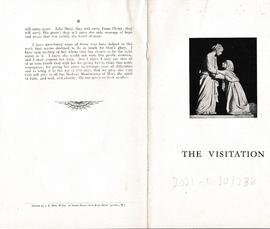
              Introductory pamphlet to the Congregation. No date. Title is simply "The Visitation"

              AI CLEANED TEXT

              Sermon preached by Father Kelly, S.J., on the occasion of the opening of the Novitiate House of the Medical Missionaries of Mary, at Collon, Co. Louth, on 11th December, 1938. THE MYSTERY OF THE VISITATION "And Mary rising up in those days went into the hill country with haste into a city of Judah." (St. Luke 1:39) In these words, St. Luke begins his narration of the Mystery of the Visitation, which was the first action of Mary after the overwhelming message of the angel. The first movement of grace in this new stage of life and holiness, the first movement of Christ whom she carried within her, was this long journey to her cousin, whose son, miraculously given to her in her old age, was to be so closely connected with the Saviour that Mary herself was carrying. She went with haste on her gracious message of charity. She leaves her home, the retirement she needed to enable her to understand her secret, to realize her blessing. She goes into the world, she climbs into the hill country. This first journey was symbolic. It typified the role of Our Lady in the whole history of the world. Not merely does she give Jesus Christ human nature from her most holy flesh and blood, not merely is He born of her, but she brings Him herself to the world. "Caritas Christi urget nos," St. Paul could cry. How incomparably stronger the urge and desire of Mary, driven by the infinite zeal of the unborn Saviour of the world. See the double aspect of that mystery: the gracious act of womanly charity to a friend in her trial of maternity, see the spiritual aspect, that she comes not alone but with One at whose approach the infant leaps in the prison of the womb and the mother is filled with the Holy Spirit. I have called the Medical Missionaries of Mary the latest manifestation of that spirit, and it is certainly not the least original and bold. It is the response to the appeal of the Holy Father for a new effort to meet new needs. It is a true religious congregation, whose members will have public vows, and the rights, responsibilities, and privileges of religious. Its distinctive work will be to help the missions not merely in Africa, but wherever the Church will call it in medical work. It will be oriented to that work in a very special manner, and its constitutions, rules, and way of life will be framed so as to give the fullest and freest scope for that work. In accordance with the instruction of the Holy See, it will procure the most modern equipment and training, and it will put the newest inventions of science and discovery at the service of religion and charity. Rooted in Charity Skilled, professional, and unwearied service—it will give. But it will give more because it will be more than a professional body. It will be a religious order. Its motto is St. Paul's "Fundati et radicati in caritate" (founded and rooted in charity). Its external activity is but the manifestation of an intense interior life—not doctors and nurses merely, but nuns. Their lives will be bound by the vows of poverty, chastity, and obedience, those holy bonds that do not depress but elevate, that do not shackle but set free. They will tend sick pagans because they love them, and they will love them because God has already loved them and given His Son for them. They will spend their professional skill and care on sick, fever-wracked, diseased bodies, but they will have a tender care, a deeper solicitude for the soul that is in darkness and the shadow of death. Let me end with the gracious picture with which I began. The Visitation came after the Annunciation when Our Lady had conceived Christ within her, then she went abroad to carry Him to the world. The Medical Missionaries of Mary will have their Annunciation; they will have St. Paul's ideal: "I live, now not I, but Christ lives in me." Their spiritual training will fashion them to an intense interior life. And then will come their Visitation. They will go forth in haste to the hill country, they will go into the ways of the mission fields. The jungle, the lonely hut, the hospital ward will be for them the city of Judah. To those wracked with fever, to lepers, to sick children, to suffering, mothering women; they will, as trained doctors and nurses, carry healing and comfort.

              His Grace the Archbishop of Dublin to open a house, Rosemount, in Booterstown, where aspirants and those following medical courses in the hospitals or University might stay. And the permission given by His Eminence to open the Novitiate at Collon, which is the ceremony we celebrate today.

              THREE BENEFACTORS.

              In its short history the young Society has met with many friends, none of whom it will forget, but there are three especially whose service to it has been incalculable, and whom it is only just to mention on this occasion. His Excellency the Apostolic Nuncio who from the beginning has taken the deepest and most helpful interest in every step of the foundation and whose presence here to-day is deeply appreciated; His Grace Archbishop Riberi, Delegate Apostolic in Africa for the Missions, who approved enthusiastically of the idea, hastened the foundation and secured all the necessary permissions at Home; and Mgr. Moynagh, Vicar Apostolic of Calabar who received the Society in his vicariate, petitioned Rome for its being made a religious institute and gave it a hospital and noviceship. The Medical Missionaries of Mary will never forget these benefactors whom God raised up for them and whose services made their existence possible.

              OUTBURST OF APOSTOLIC ENTERPRISE.

              Today's ceremony is the latest manifestation of the unquenchable missionary spirit of our people. The last twenty years have witnessed an outburst of apostolic enterprise which can be paralleled only by the days of Columba and Columbanus and Gall. To all the pagan lands, to China, to Africa East and West, to India a stream of priests, brothers and nuns are going forth, but we must not forget that it is the zeal and generosity of our people at home which have made that effort possible. The spirit that made St. Paul cry out (Vae mihi si non evangelizavero—"Woe to me if I preach not the Gospel"), the spirit that made those early missionaries desire peregrinari pro Christo, to be exiles for Christ's sake, that spirit still burns clear and strong in our people through God's mercy.

              At a moment when the whole world is filled with war, with the preparations for war, with racial hatred and injustice, it is consoling to think that our own country dreams of extending the kingdom of Christ, and subduing [nations to] Him, whose service [is] Life and freedom and justice.

              Joy, see Our Lady's charity on the double plane, the natural and the supernatural, and you will understand the propriety with which the mystery of the Visitation has been chosen as the inspiration of the Medical Missionaries of Mary.

              NOTABLE CEREMONY.

              The ceremony which you have come to witness and in which you take a part is something very simple, but very unusual. The foundation of a new religious congregation is in itself not often seen, but there is another consideration that makes this ceremony still more notable.

              It is the first response of Ireland, if not of the Catholic world, to the new call of the Holy Father, which marks by its nature and spirit and organisation and constitutions a new departure in the history of the missions, a new adaptation of the Church to the new needs of the missionary Apostolate.

              The presence of this distinguished congregation shows that the significance of that event is fully understood, that all recognise that this quiet ceremony is the putting into the ground of a small seed which with God's grace will grow and develop and become a great tree and send its branches far and wide and will provide shelter and life and rest for great multitudes.

              With this day's event the history of the Medical Missionaries of Mary may be said to begin officially, but the foundation of the Congregation has had its history, which may be briefly sketched here. The idea came eighteen or twenty years ago to one who worked in Nigeria under Dr. Shanahan; some years of experience as nurse and teacher among the pagans led to two convictions: one, the necessity of a professional medical service; the second, that such work needed a special organisation, that the spirit of sacrifice, the devotion, the constancy could be, as a rule, expected only from those who were freed from family ties and had special spiritual helps, that is, from a religious congregation. The idea persisted for years, though it seemed but a dream. Many things happened which seemed to make it impossible, among them continued bad health. But perhaps from the delay came fuller conviction and a clearer grasp. And after eight or nine years came the first faint steps towards realising the dream, and five or six others were found who had already vaguely thought and hoped for a kind of missionary work which they had not yet seen realised. In that first group there came a sifting and winnowing until there was left finally

              a few who had that spirit of courage and confidence that qualified them to be pioneers in a new spiritual enterprise. Those were years of slow growth of hope and prayer when only desire and zeal were certain, and all means and ways uncertain.

              DEEP AND FAR-REACHING ROOTS.

              The decisive event of that first period, the event which really began the process towards the formation of a religious congregation, was the invitation of the Prior of the Benedictine Abbey of Glenstal given to the foundress to live close to the monastery and share as far as could be in its spiritual life. The two years spent at Glenstal were decisive; they constituted a kind of noviceship, in which the principles of the religious and spiritual life were given to the aspirants by instruction and by assistance at the Liturgical Life of the Monastery. The Medical Missionaries of Mary would wish this public record on this occasion, of their incalculable debt to the sons of St. Benedict, and it is a significant fact that this latest venture in religious life, under the most modern conditions, should go back to drink at the spring from which came the beginning of monastic life in Europe eleven hundred years ago. All new movements in the Church spring from deep and far-reaching roots.

              While the idea was growing in clearness in the mind of the foundress and her companions a full sense of the difficulties was also growing. Like all the things of God the growing institute was fed on disappointments and trials; it was stamped with the cross, that truest guarantee of vitality and future success. There were practical difficulties of all kinds of ways and means, of permission: but perhaps the chief difficulty, which lay across the path like a great barrier, was the fact that the Church did not in general approve of unrestricted medical work for nuns. Certain fields of medical work, especially maternity work, had traditionally been considered as not suitable for religious. With such a restriction the [new] institute could scarcely exist. There were many who said that the restriction would never be removed. The work of preparation went on in hope and prayer and suddenly the great barrier which had seemed to block all advance was lifted.

              In February, 1936, the Sacred Congregation of Propaganda issued an instruction of immense import, which will be regarded as marking a decisive point in the history of the missions and which will be considered as one of the Great decisions of the present Holy Father.

              The Sacred Congregation said that its practise had always been to have the methods of apostolate conform to the varying needs of place and time, that the significance of medical work, especially for mothers and children, had been brought home to it by the reports of Bishops and Vicars Apostolic and missionaries all over the wide mission fields, and that after mature study it had decided that medical work, especially for women and children, would have better provision made for it in future. Consequently it expressed the desire for the foundation of new religious institutes of women who would dedicate themselves principally to that work, and the wish that already existing institutes might found special branches for this purpose also. It emphasised the necessity for the best and most modern professional equipment and training, it insisted that all that concerned the spiritual formation and security of such religious should be abundantly guaranteed.

              In itself this instruction made mission history. For the nascent institute it was decisive, it seemed like a special answer to prayer, it was an immense incentive and encouragement, the way now lay open, the Church had spoken her mind decisively and had called for an institute which corresponded exactly to the secret hope that the foundress and her companions had been cherishing for years. Difficulties of a practical order remained in abundance, but the fundamental one had been removed. Preparation could now be made with the assurance that what was aimed at was what the Church was calling for.

              I need not detail the different steps that led to the foundation of the society. The final step, the erection into a religious institute, was taken as was fitting on the mission field. At the end of 1936 the foundress and two companions left Dublin for Calabar in Nigeria, where a noviceship was canonically erected, in which the spiritual training was entrusted to a religious of the Society of the Holy Child Jesus. Here the Medical Missionaries of Mary were erected into a religious congregation by Mgr. Moynagh, Prefect Apostolic of Calabar, and on Low Sunday the foundress pronounced her vows of religion, and became first professed sister, taking the name of Mary of the Incarnation. She had been gravely ill with fever, had been anointed and had been taken to a Protestant Hospital because there was no Catholic one available. There seems to be a peculiar propriety in the fact that the ward of a fever hospital in Africa was the scene of the first profession in the Medical Missionaries of Mary. The two chief succeeding events worthy of mention here were the permission given by.

              OCR ORIGINAL TEXT

              Sermon preachedby'YathertKely,S.J., on the occasion
              of the OpeningoftherNovitiate House of the Medical Mission.
              Ames of Mary, at Colon,Go. Louth, on iith December, 1338.
              THEMYSTERY OF THE YISITAMON.
              LAnd Mary nong up in Chose days went imto (he
              MiM coumiry AItA Hasteimo a qly o/Juda.
              L1. Luke 1,30)
              N these words St. Luke begins his narration of the Mystery
              of the Visitation, which was the Arst action of Mary alter
              Re
              the overwhelming message of the angel. The Arst mnove.
              ment of grace in this new stage of Mile and holincss, the Arst
              movement of Chrst whomn she carried within her, was this
              Long journey to her cousin, whose son, mniraculously given to
              her in her old age, was to be so cioscly connccted with the
              Saviour that Mary herself was carrying. She went with haste
              on her gracious mnessage of charty. She leavcs her home, the
              retirement she needed (to enable her to understand her
              secret. to rcalise her blessing. she goes into the word. she
              climbs into the hill country. This Arst journey was symabolic.
              1t typikes the role of Our Lady in the whole history of the
              word. Not merely does she give Jesus Chrst human nature
              frorn her most holy Hcsh and blood, not merely is He born of
              her. but she brings Himn herselt to the worid. "" Caritas
              Christi urget nos'" St. Paul could cry. How incomnparably
              stronger the urge the desire of Mary driven by the infnite
              zeal of the unborn Saviour of the womd. See the double aspoct
              of that mystery. the gracious act of womnanly charity to a
              Iriend in her trial of maternity, see the spiritual aspect, that
              she comes not alone but with One at whose approach the infant
              Leaps in the puison of the womb and te mother is fled with
              1 have called the Mcdical Missionaries of Mary the latest
              mnanifcstation of that spirit, it is certainly not the least original
              And bold. it is the rcsponse to the appeal of the Moly Father
              4or a new cHort to mnect new needs. 1t is a true rcligious
              Congrcgation, whose members will have public vows, and the
              rights, responsibilitics and privileges of religious. Mts distinctive
              work wil be to help the missions not mercly in Africa, but
              wherever the Church wil cal it in mhedical work. It will be
              orientatcd to that work in a vey special mnanner, consbitutions,
              rules, way of 1ite, will be Mramned so as to give the fulest and
              Ircest scope tor that work. In accordance with the instruction
              of the Moly Sce it will procure the most modern cquipmnent
              and taining it will put the newest inventions of science and
              discovery at the serrice of religion and charity.
              ROOTED IN CHARITY.
              Skiled, professional, unwearied service, it will give but it
              will give more, because it will be more than a proicssional
              body. 1t will be a rcligious order. 1ls motto is St. Pauls
              Pundali ef radicalt in carilate founded and rooted in charity.
              Ms exteinal aclivity is but the mnanitestation of an intense
              interior Lle, not doctors and nurses muercly but nuns. Their
              Lives will be bound round by the vows of poverty, chastity and
              obedience, those holy bands that do not dcpross but clevate
              that do not shackle but set irce. They will tend sick pagans
              because they love themn, they will love themn because
              God has ahcady loved themn and given Mis Son (or
              themn. They willspend their proicssional skill and care on sick.
              fever-wrackcd, diseascd bodies, but they will have a tenderer
              carc, a dccper solicitude for the soul that is in darkness and
              the shadow of death.
              Met me end on the gracious picture with which 1 began.
              The visitation came after the Annunciation. when our Hady had
              conceived Christ within her then she went abroad to Carry
              Hirn to the word. The Medical Missionares ot Mary wIMhate
              thcir Annunciation: they will have St. Pauls ideal" 1 Mve,
              now not 1, but Christ Mves in me.' Their spirtual baining
              will fashion themn to an intense interior Mke. And then will
              come their Visitation. They will go forth in haste to the hil
              country, they will go into the ways of the mission Helds. the
              Junge, the lonely hut, the hospital ward will be for thern the
              city of Juda, to those wracked with fever, to lepers, to sick
              chidren, to sukering, mnothering women: they will, as trained
              doctor and nurse, cany assuasement, healing. comiort. They

              His Grace the Archbishop of Dublin to open a house, Rose.
              mount, in Mooterstown, where aspirants and those following
              medical courses in the hospitals or University might stay
              And the perrnission given by His Mmninence to open the
              Movibiate at Colon, which is the coremony we cclebrate today.
              THREE BENEFAGTORS.
              In its short history the young Society has met with many
              Miends, none of whom it will forget. but there arc thrce
              ospecialy whose service to it has been incalculable, and whorn
              It is only just to mention on this occasion. Mis Mxccllency
              the Apostolic Nuncio who irorn the beginning has taken the
              Hcepcst and mnost helpful intercst in cvery step of the (ounda.
              tion and whose prcsence herc to-day is deeply appreciated, Mis
              Grace Archbishop Kiberi, Delegate Apostolic in Africa tor the
              Missions who approved enthusiastically of the idea, hastencd
              the foundation and secured all the necessary permnissions at
              received the Society in his vicariate, petitioned Homne for its
              being mnade a religious institute and gave it a hospital and
              noviceship. The Medical Missionaries of Mary will never torget
              these benclactors who God raised up for them and whose
              serviccs made their existence possible.
              OUTBURST OF APOSTOLIC ENTERPHISE.
              Todays ceremony is the lalest manilcstabion of the
              unquenchable mnissionary spirit of our people. The last twenty
              ycars have witncssed an outburst of apostolic enterprise which
              can be paralleled only by the days of Columuba and Colurnbanus
              And Gall. To al the pagan lands, to China, to AHrica Hast and
              West, to india a shcarn of pricsts, brothers and nuns arc
              going forth, but we mnust not forget that it is the zeal and
              Home, and Mgr. Moynagh. Vicar Apostolic of Calabar who
              generosity of our pcople at homne which have mnade that cHort
              possble. The spirit that made St. Paul cy out ( Vae mih.
              si non cvangclisubero "' woe to mne if 1 prcach not the Gospel
              the spirit that made those carly missionares dcsre percgrinam
              pro Christo to be exiles tor Chuist's sake, that spirit shill burns
              cear and sbrong in our people through Gods mnercy.
              At a momnent when the whole womd is Hlled with war,
              with the preparations for war, with racial hatred and
              Injustice, it is consoling to think that our own country
              dreams of extending the kingdomn of Chrst, and subduing
              Mrsoncste Him. rhore servce LeMe and frecdom and
              justice.
              Joy, sce Our Lady's charity on the double plane the natural
              and the supernatural and you will understand the proprety
              with which the mystery of the Visitation has been chosen as
              the inspiration of the Medical Missionaries of Mary.
              NOTABLE CEREMONY.
              The ceremony which you have comne to witness and in
              which you take a part is something vey simple, but very
              unusual. The foundation of a new religious congregabion is in
              Mlselt not okten seen. but there is another consideration that
              makes this ceremony still more notable
              1t is the Arst response of Ireland, 1f'not of the Catholic
              worid. to the new cal) of the,Holy. Wather. which marks
              by its nature and spirit and organisation andlconstitutions
              a new departure in the history of the missions a new
              Adaptation of the Church to thenew needs of the missionary
              Apostolate.
              The prcsence of this distinguished congrcgation shows that the
              signicance of that event is fully understood, that all recognise
              that this quiet ceremnony is the putting into the ground of a
              smnall secd which with Gods grace will grow and developr and
              become a great trec and send its branches far and wide and
              wil provide shelter and Mie and rest for great mnultitudes.
              With this days event the history of the Medical Mission.
              Arics ot Mary mnay be said to begin ofcially. but the founda.
              Lion of the Congregation has had its history, which muay be
              bnely sketched here. The idea came cighteen or twenty years
              ago to one who worked in Migeria under Dr. Shanahan somne
              years of cxperience as nurse and teacher amnong the paganslest
              two convictions onc, the necessity of a professional medical ser.
              vice, the second, that such work nceded a special organisation.
              that the spirit of sacrihce, the devotion, the constancy could be,
              As a rule, cxpected only Aromn those who were frced frorn farnily
              Mcs and had special spiritual helps that is tromn a religous
              congrcgation. The iden persisted for years, though it scemned
              but a-dream. Many things happened which seemed to make it
              imnpossible amnong thern continued badhealth. But perhaps
              Mromn the delay camne (uller conviction and a clearer grasp.
              And akter cight or nine years came the Arst faint steps towards
              rcalising the dreamn. and Ave or six others were found who had
              slrcady vaguely thought and hoped for a kind of missionary
              work which they had not yet seen realised. In that Arst group
              There came a sluns and winnorins unbl Chere was lelt fnaly
              3

              a few who had that spirit of courage and conadence that
              qualiked themn to be pioncers in a new spiritual enterprise.
              Mhose were years of slow growth of hope and prayer when
              only desire and zeal were certain, and all means and ways
              uncertain.
              DEEP AND FAR.REACHING ROOTS.
              The decisive event of that Arst perod the event which
              really began the proccss towards the ormation of a religious
              congrcgation, was the invitation of the Drior of the Bencdictine
              Abbey of Glenstal given to the foundrcss to Mive close to the
              monastery and share as lar as could be in its spiritual Mfe.
              The two years spent at Glenstal were decisive, they constituted
              A kind oi noviceship, in which the principles of the relgious
              And spiribual life were given to the aspirants by instruction and
              by assistance at the Mturgical Mite of the Monastery. The
              Medical Missionaries of Mary would wish this public rccord on
              this occasion, of their incaiculable debt to the sons of St.
              Benedict. and it is a signhcant (act that this latcst venture in
              religious lite, under the most mhodern conditions, ghould oo back
              to drink at the spring kom which came the beginning of
              monastic lile in Europe cleven hundred years ago. Al new
              movements in the Church spring Momn decp and farreaching
              1o0tS.
              While the idea was growing in clearnessin the mind of the
              foundress and her cornpanions a ful sense of the diMcultics
              was also growing. Like al the things of God the growing
              institute was fed on disappointments and bials it was stamnped
              with the cross that truest guarantce of vitality and (uture
              success. There were practical ditcultics of all kinds of wayS
              and means, of permission: but perhaps the chies dimhculty,
              which lay across the path Mke a grcat barrier, was the (act
              that the Church did not in general appprove of unresbricted
              medical work for nuns. Certain Aclds of mcdical work
              cspecially maternity work had traditionaly been considered as
              not suitable for rcligious. with such a rosbriction (he po
              institute could scarcely exist. there were mhany who said that
              the resticton would never be rcmoved. The work of prepara.
              tion went on in hope and prayer and suddenly the grcat barrier
              which had seemed to blocke all advance was lilted.
              In February, 1936, the Sacred Congregation of Propa.
              sanda issued an instruction of inmnense import. which wiII
              be regarded as marking a decisive point in the history of
              the missions and which will be considered as one of the
              Sreat decimons of the present Holy Father.
              The Sacred Congrcgation said that its practise had always
              been to have the methods of apostolate coniormn to the varying
              nccds of place and timne, that the signikcance of mnedical work,
              cspecially for mothers and children, had been brought horne to
              It by the rcports of Bishops and Vicars Apostolic and mnission.
              Arics al over the wide mission Aclds, and that after mature
              study it had decided that mnedical work especially for womnen
              and children, would have better provision made for it in uture
              Conscquently it expressed the desire for the foundation of new
              cligious institutes of women who would dedicate thernselves
              puncipally to that work. and the wish that already existing
              institutes mnight found special branches tor this purpose also.
              1t emnphasised the nccessity for the best and mnost mnodern
              prolessional cquipment and taining, it insisted that all that
              concerned the spiitual formation and sccurty of such religious
              should be abundanby guarantced,
              In itselt this instruction made mission History. Nor the
              nascent institute it was decisive, it sccmed Mke a special answer
              to prayer, it was an immense incentive and encouragement,
              the way now lay open, the Church had spoken her mind
              decisively and had callcd for an institute which corrcsponded
              exacbiy to the secrct hope that the foundrcss and her com.
              panions had been cherishing ior years. Dimculties of a prac
              Micalorder remnaincd in abundance, but the fundamentalonehad
              been removed. Dreparation could now be mnade with the
              Assurance that what was aimned at was what the Church was
              calling Lor.
              I need not detall the diHercnt steps that led to the founda.
              tion of the society. The gnalstep the ercction into a rclipioug
              institute was taken as was Atbing on the mission Aeld. At
              the end of 1936 the foundress and two companions lelt Dublin
              for Calabar in Migeria, where a noviceship was canonicaly
              crected, in which the spiritual taining was entrusted to a
              rcligious of the Society of the Holy Child Jcsus. Here the
              Medical Missionaries of Mary were erccted into a roligious
              congregation by Mgr. Moynagh. Dretect Apostolic of Calabar,
              And on Mow Sunday the foundress pronounced her vows of
              rcligion, and becamne Arst prolessed sister, taking the namne of
              Mary of the Incarnation. She had been gravely il with fever.
              had bcen anointed and had bcen taken to a Drotcstant Hospital
              because there was no Catholic one available. There seers to
              be a peculiar propriety in the fact that the ward of a fever
              hospital in Airica was the scene of the Arst profcssion in the
              Mcdical Missionaues of Mary. The two chies succceding
              ovents worthy of menbon here were the pemmismion given by

              Order of work for novices
              IE IE/GLA IE/GLA/2020-03-06/9/2020-03-12/20/2021-11-30/247 · Stuk · ca 01-01-1939
              Part of Glenstal Abbey Archive

              Order of work for the various novices. Each page is a different novice with their name on top.

              IE IE/GLA IE/GLA/2020-03-06/9/2020-03-12/21/2023-01-25/477 · Stuk · 08-03-1936
              Part of Glenstal Abbey Archive

              Advice from C. Heerey C.S.S.P. about coming to Nigeria

              AI CLEANED TEXT

              My dear Sister Mary,

              I hope you will pardon me for my long delay in replying to your most welcome letter last Xmas. It was a very great happiness to hear from you again and to hear such good reports on your work. I hope Our Dear Lord will continue to bless your little company till He sees it in the midst of the active life of the missionary world. I was expecting your second letter as promised and this partly explains my delay. As yet I do not know much about your position, but I take it that you are the nucleus of a great Medical Missionary Body, a body which my experience of this Mission has taught me is a very great need. There is nothing I would appreciate more than to have a body of Religious women who are qualified and authorized to run a Medical Mission in all its aspects and details.

              You probably have heard of some of my experiences of these experiments of the Medical Missions run by a combination of Religious and lay people. With all the good will in the world on both sides, the position is fraught with many delicacies and difficulties. Anua has had its baptism of trials—trials is hardly the word—Satan's vendetta would be more suitable! Emekuku has also had its share, but the difficulties are in great part surmounted. I am blessed in having there an excellent doctor who puts the Mission work before any personal inconvenience.

              The ideal thing would be a Society such as yours to take over every aspect of the Medical Mission—doctors and nurses all of one mind, with one common purpose and one common obedience. I could enter into many details, but I do not care to write them. If I were talking to you I would speak more freely. But I am convinced that your Society is the ideal one for a Medical Mission. I wish your Society every blessing and hope its members will grow rapidly and that you and your daughters will spread to many Missions and do immense work for souls through your medical labours.

              Our celebrations of the golden Jubilee of the Mission and of the opening of the Cathedral were a great success. I am sorry I have not any snaps to send you. Miss Powell and Miss D'Arc[y] had been working in Emekuku Hospital since they came out till the beginning of Feb. They are two fine girls. I am sorry they have no doctor to work with them. I hope they will get one soon.

              God bless you, I hope you will write again and tell me more of the society. Don't forget me in your prayers please.

              Yours v. sincerely in J.C.

              C. Heerey C.S.Sp.

              ORIGINAL OCR

              My dear sister Mary.
              I hope you will pardon me for my long delay
              in replying to you most welcome letter last Kmas. It sas a
              Very great happiness to hear from you again amd to hear such
              good reports on your work. I hope Our Dear Lord will continue
              to bless your little company till He sces it in the midst of the
              Active life of the missionary world. I was expecting you second
              Letter as promised and this partly explains my delay. Ad yet I
              do not know much about your position, but I take it that you are
              she nucleus of a great Medical Missionary Body. a body which m
              experience of this of this Mission has taught me is a very great
              73
              need, There is nothing I would appreciate more than to have a
              body of Religious momen who are qualified and authorized to run
              A Medical Mission in all its aspects and details.
              Younprobably have heard of some of my experiences of these
              experiments of the Medical Missions run by a combination of Re-
              Ligious and lay people. With all the good will in the world on
              both sides, the position is fraugth with many delicacies and dit.
              ficulties. anwa has had its baptism of trails- trails is hardly
              the word- satan's vendella would be more suitable' Emeluku.
              has also had its share, but the difficulties are in great parts
              surmounted. I am blessed in having there an excellent doctor who
              puts the Mission work before any personal inconvienience.
              The ideal thing would be a Society such as yours to take
              over every aspect of the Medical Mission - doctors and nurses all
              of one mind, with one common purpose and one common obedience,
              I could enter into many delails, but I do not care to write
              them. 1f I were talking to you I would speak more freely. But
              I am convinced that your Society is the idial one for A Medscal
              Mission. I wish your Society every blessing and hope its members
              will grow rapidly and that you and your daughters will spread to
              many Missions and do immense work for souls through your medical
              Labours.
              Aur celebrations of the golden Jubilee of the M
              R
              CAHOLIG, MisszoN
              ONITSHLA.
              SOUTHER MIGERIA.