
Identity area
Reference code
Title
Date(s)
- 1913 - 1973 (Creation)
Level of description
Extent and medium
820 boxes approximately
Context area
Name of creator
Name of creator
Repository
Archival history
All of the records created during the episcopate of Archbishop John Charles McQuaid were stored in the archives of Archbishop House for their continued administrative use. Shortly after his death in August 1973 they were transferred to the Dublin Diocesan Archive, as required by the Code of Canon Law.
Under Canon Law, there are four distinct types of archives within a Diocesan system:
- Curial Archives (code 486) – These archives should include the ordinations register; documents recording the dedication or blessing of churches and cemeteries; and if convenient, copies of title deeds and other documents establishing the rights of the church. After 100 years the contents of the Curial Archives are transferred to the Historical Archives.
- Secret Archives (code 489) – These archives contain documents of criminal cases (church cases processed through church courts); register of secret marriages; preliminary investigations (pre trial documents); documents concerning canonical warnings or corrections. These documents are never transferred to the Historical Archives.
- Historical Archives (code 491) – Papers of the various Archbishops of the Archdiocese; lay associations and organisations; administration of the curia.
- Parish Archives – These should include parish registers; marriage papers; other documents and Episcopal letters of note; documents generated by the parish; inventory of temporal goods of the parish; documents recording the dedication of the church. It is becoming more common for parish registers and other parish archives to make their way to the Historical Archives.
Immediate source of acquisition or transfer
On the death of Archbishop John Charles McQuaid all of his documents were transferred to the Dublin Diocesan Archive as required by the Code of Canon Law (can .381.2, can. 491.2, can. 486).
Content and structure area
Scope and content
CONTEXT:
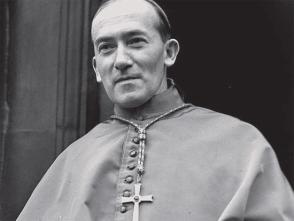
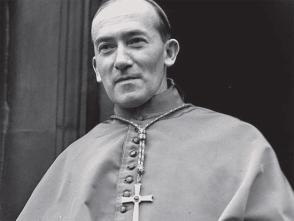
John Charles McQuaid was born in Cootehill, Co. Cavan, on 28 July 1895, to Dr. Eugene McQuaid and Jennie Corry. His mother died shortly afterwards. He attended St. Patrick’s College, Cavan, Blackrock College and Clongowes Wood. He entered the CSSp (Congregation of the Holy Spirit) in Kimmage in 1913. He was ordained on 29 June 1924. McQuaid obtained his Masters Degree at the National University of Ireland with his thesis entitled ‘Life and Philosophy of Seneca’. He received his Doctorate in Theology at the Gregorian University, Rome.
In 1925 John Charles McQuaid was appointed to the staff at Blackrock College where he remained until 1939. He served as Dean of Studies from 1925-1931 and President of the College from 1931-1939. He was appointed Archbishop of Dublin on 6 November 1940 at the age of 45. His motto was ‘Testimonium Perhibere Veritati’. He served as Archbishop from 1940-1971, resigning on 29 December of that year. He died on 7 August 1973 and is buried in the vaults at the Pro-Cathedral.
CONTENT AND STRUCTURE:
The episcopacy of John Charles McQuaid saw the Catholic population of Dublin grow from approximately 630,000 to over 800,000 people. The number of clergy rose from 370 to 600 and religious from 500-800. He constituted 60 new parishes, built over 80 new churches and 250 primary schools and 100 secondary schools.
His is especially remembered for his work in the area of charity. He oversaw the establishment of the Catholic Social Welfare Conference and the Catholic Social Welfare Bureau, between 1941-1942. He had a personal interest in providing for people who suffered physically, mentally and spiritually.
Archbishop McQuaid appeared to be a powerful and conservative figure who wielded much influence in all aspects of Irish society. His opinion and support were sought in many areas including the wording of the Irish Constitution, the Mother and Child Scheme, censorship, youth affairs, lay organisations, hospitals and the development of a Diocesan Press Office which was run by a layman. McQuaid also took an active interest in industrial relations and helped resolve more than one dispute during his time as Archbishop. One of the most notable disputes was the Teacher’s Strike of 1946. He was sympathetic with the teachers’ case and was very active on their behalf.
Vatican II brought about major changes in the structures of the Church and many believed McQuaid would retire at his Silver Jubilee in 1965. He stayed on, believing his role was pivotal in providing stability and reassurance at a time of great change. He was slow to implement the reforms of Vatican II especially in relation to liturgical change, greater lay participation and ecumenism. The more assertive laity soon began to question both his policies and personality. Irish society was changing. He tendered his resignation which was announced on 4 January 1972. A special programme marking the event was shown on RTE. He died fifteen months later.
Sections currently available to researchers include the Holy See, Nuncio, Bishops, Government, Vatican Council, Catholic Social Welfare Bureau, Emigrants, Universities (UCD and St. Patrick’s, Drumcondra), Hospitals, Communications and the Diocesan Press Office, Religious Men, Religious Women and papers relating to McQuaid prior to his appointment as Archbishop. Lay Organisations, Education, Arts & Culture, (including Censorship), Army Chaplains and Diocesan Priests are currently being catalogued.
Appraisal, destruction and scheduling
All records have been retained.
Accruals
On the death of Archbishop McQuaid his entire collection of documents was transferred to the Dublin Diocesan Archive. Accordingly, there will be no accruals.
System of arrangement
Conditions of access and use area
Conditions governing access
Access: By appointment only
Language: English, Latin and occasional Irish, Italian and French
Finding Aid: Descriptive Catalogue available for sections of the collection.