The cast of the 'Red Riding Hood' pantomime in Father Mathew Hall, Dublin, for the 1954-5 season.
An image of cast members of a pantomime production of 'Cinderella' distributing fruit to the audience following a performance in Father Mathew Hall on Church Street in Dublin in about 1955.
A Panegyric on Mother Mary Teresa Kelly, foundress of the convent, given by the Bishop of Kerry.
Presentation SistersThis series consists of pamphlets on topics related to Irish political, social and cultural issues published during the revolutionary era. The collection contains pamphlets and publications relating primarily to the political tensions of this period and includes original pamphlets written by Hanna Sheehy-Skeffington, the Most Rev. Edward Thomas O’Dwyer, Bishop of Limerick, William O’Brien, George Noble Plunkett, Cumann na mBan, Darrell Figgis, Frank Gallagher and Ėamon de Valera.
Short pamphlet promoting the Congregation. No date. Title is "The Society of the Medical Missionaries of Mary." Printed by the Drogheda Independent. 1938
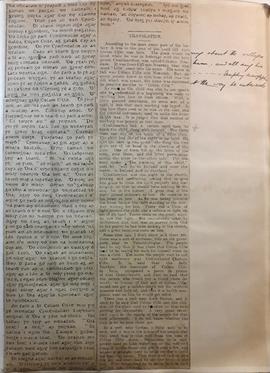
AI CLEANED TEXT:
It is hoped that a maternity wing may soon be built to further this most important branch of medical science. While our country has entered with wonderful enthusiasm into the work of God in pagan missions, and the youth of Ireland has gone forth with admirable generosity, in Medical Mission Work we are far behind continental countries. It is hoped that in the near future, young women will come forward from our Catholic medical schools and hospitals to join the ranks, as well as girls suited by education and Catholic tradition to enter upon the vast field of labor which the Society of Medical Missionaries of Mary has set before it. The urgent need at the moment is for doctors and nurses who will be fearless in shouldering the responsibilities of, in many cases, isolated work. Those who enter the society without these qualifications will be given facilities for such training as the Mother General may think fit, considering their talents and the needs of the society. As the scope of the work extends to the formation of Christian women in pagan countries, some members will be given opportunities for training in domestic subjects. It is to Catholic Ireland that the institute looks for the encouragement and help necessary for its expansion until it becomes one of those mighty forces sheltering the needy children of the Kingdom of God. Everyone can help in some way. Girls who are qualified as doctors or nurses will find a large field in which to labor. Parents and teachers can foster vocations in the young. Many can help by making the society known, distributing literature, etc. Some can send financial assistance or articles useful to the sisters at home and abroad. Mother Mary of the Incarnation, Rosemount, Booterstown, will gladly supply particulars and leaflets on application. All can help by prayer—constant, fervent prayer, especially through the intercession of the Blessed Virgin. "Ask of Me, and I will give thee the gentiles for your inheritance." Ps. 2:8.
THE SOCIETY OF MEDICAL MISSIONARIES OF MARY Several months ago, a short paragraph appeared in several Irish dailies, announcing that an Irish missionary nun, Mother Mary of the Incarnation Martin, had been received in audience by the Holy Father. How many who scanned this item were aware of its true significance? Did anyone realize that in the midst of the ever-changing world, something permanent had happened? "The Kingdom of Heaven is likened to a mustard seed, the smallest of all seeds," and every new growth of the Kingdom comes from a seed, small indeed, and for a long time hidden from sight, but finally growing into an immense tree. Such has been the history of all religious institutes, and the Society of the Medical Missionaries of Mary, to which the Holy Father gave a special blessing last January, is no exception. The Society has been founded to supply one of the most urgent needs of Catholic Missions in pagan countries: the care of the sick, of mothers and infants, of the lepers and plague-stricken, in hospitals, dispensaries, and the homes of the people. These missionaries will devote themselves entirely to this work and to the formation of Christian mothers or future religious. For this reason, its members will be qualified doctors, nurses, midwives, chemists, dentists, etc., though non-medical members will also be received. The Society is a Religious Institute, the members being true religious with the usual vows, and all the helps, rights, and obligations of the religious life. Although the requirements of their special work demand certain freedom, surgical procedures may involve as many as nine or ten operations a day. The natives take pride in having an operation and, once cured, return home with special distinction. Injections are also a popular form of treatment, and the reputation of the hospital often depends on them. The matter of catering is marvelously simplified, as it would be difficult for a European to unravel the intricacies of the native menus. Each patient brings a "small boy" from their tribe with them to the hospital. The "small boy" may vary considerably in age and size, for any man who is not a chief or wealthy describes himself as a "small boy." They act as water carriers for washing and cooking, cook their patient's food in the hospital kitchen, and carry it to the ward on their heads. Generally, the boys work quietly and peaceably, but occasionally a disagreement arises and must be settled judicially, so they bring the matter to Sister. A long discussion follows since justice cannot be done unless both sides fully state their case. Once heard and Sister's decision is given, there is no further appeal—justice has been done. However, it tests the patience of the over-busy Sister who must endure lengthy statements on matters that could be settled quickly. Yet, this exercise of patience is God's work, as nothing attracts the poor heathen as much as the Sisters' unfailing exercise of peace and charity. They glimpse through them a good God such as their code has never conceived, all their religion being founded on fear. So greatly does the charity of the Sisters impress them that it is rare for a poor pagan to die in the hospital without asking for Baptism. The rescuing of twins is one of the Sisters' most arduous duties. The pagans regard the birth of twins with the utmost horror, and it is customary to abandon the infants in the bush and expel the mother from the village. It requires endless patience and charity to induce these poor women to come to the hospital and save the lives of the neglected waifs. These infant souls, however, are God's harvest and future members of the household of faith if reared under the aegis of the Mission, where they are imbued with Catholicity from their earliest years. Unfortunately, the Sisters are often handicapped in this great work by a lack of suitable infant foods, which must be obtained from Europe.
How dear this work is to the Sacred Congregation for the Propagation of the Faith can be judged by the manuscript letter Sister Mary received from the Cardinal Prefect: SACRA CONGREGATIO DE PROPAGANDA FIDE, ROME, 16th August, 1938. Very Reverend Mother, Your letter of July 31st gave me great pleasure, and I appreciate the expression of gratitude and thanks you address to the Sacred Congregation. I trust that the Novitiate, which is now under consideration, may soon be a consoling reality and give a new impulse to the spirit of charity which distinguishes your community. The news you give me concerning the work of the Sisters in Africa is indeed welcome, and I echo the words of St. Paul: "I have had great joy and consolation in your charity." And I close this letter with the beautiful words of that same great Apostle addressed to the Philippians: "And this I pray, that your charity may more and more abound in knowledge and in all understanding." I pray God to fill you all with His graces, and as an earnest of heavenly favors and a witness of my goodwill, I bless you with all my heart. Yours devotedly in Christ, (Sgd) P. CARD. FUMASONI-BIONDI, PREFECT. The two Sisters who remained in Nigeria after Mother Mary's departure have since been professed, and this year they have been joined by three more members, all of whom are working at St. Luke's Catholic Mission Hospital, Anua, Southern Nigeria. Already, the fruit of their labors is being felt. One of the first maternity cases was that of a woman who had lost seven children in premature births. This last was also premature, but mother and child were happily saved. At present, St. Luke's Hospital consists of 130 beds divided between male and female wards. About 150 cases are attended to daily in the Dispensary. Every kind of tropical disease is dealt with, as well as pneumonia, tuberculosis, etc. The greater number of the cases come from the observances usual to religious life, i.e., choir, enclosure, etc. The absence of these will demand a more fervent interior life, which the Constitutions, rules, and training are specially designed to promote. Full scope will be given to professional work, and for this, the Society has adopted a simple dress, designed in the style of nurses' uniforms now in vogue, but adaptable to various climates or circumstances. The dress is given a religious character by a simple crucifix suspended from the neck. The Society of the Medical Missionaries of Mary has come into existence through the instrumentality of a Dublin lady, Miss Mary Martin. Her early years spent in a truly Catholic atmosphere prepared her for her future work. Uncertain of her vocation, she entered the Richmond Hospital at the beginning of the European War in 1914 as a V.A.D. After a year's training, she spent three years nursing in various war hospitals on the Continent. Here she experienced the opportunities a nurse's position gives to influence for good. From this and her devotion to Our Blessed Lady grew a desire to imitate her in the beautiful mystery of the Visitation, when, bearing Her Divine Son, she went to the assistance of her cousin, St. Elizabeth. When Miss Martin returned to Ireland, she heard from Bishop Shanahan, C.S.Sp., about the great need for medical assistance in the missions, especially for the care of mothers and infants. To prepare herself for this work, she entered the National Maternity Hospital, Holles Street, and after a full course of training took her C.M.M. certificate. Thus prepared, in 1921 she sailed for Southern Nigeria. Disappointment awaited her, for upon her arrival she found the Bishop in difficulties about his girls' schools, and so she volunteered to come to his assistance until qualified teachers should be forthcoming. This work was of primary importance, not only for the teaching and religious instruction of children but also for the protection of Christian girls who were given by parents or future husbands for training. For three years, Miss Martin carried on the work of the school in Calabar until she was relieved by a qualified teacher. The greater part of this time she lived alone with the native girls, an experience which gave her deep insight into local conditions.
Her practical knowledge of the difficulties and requirements of such a vocation was never very robust, and these years took a toll on her constitution. When relieved, it was necessary for her to return home. However, her ideal of establishing medical missions remained steadfast, but God's time had not yet come. Instead, disappointment and trials of every sort tested her vocation and her fidelity to it. Praying and hoping, she continued to seek God's will, meanwhile devoting herself to furthering the work of the missions in various ways. In 1933, she gathered around her a few earnest girls desirous of devoting their lives to God in the missions, and these proved to be the nucleus of the new institute. Having lived together under spiritual guidance for over three years, Miss Martin placed her companions in Holles Street Hospital for training in preparation for going out to Nigeria, where Mgr. Moynagh had offered an opening when the institute should come into existence. These girls had hardly completed their training when two circumstances combined to bring about the speedy erection of the Society. First, the Sacred Congregation of Propaganda issued an instruction on 11th February 1936, expressing a wish that new institutes be formed with the special intent of doing maternity and child welfare work. Heretofore, the practice of obstetrics was disallowed to religious, even to those fully qualified and engaged in general nursing. But the urgent necessity of this work on pagan missions had been repeatedly represented by the Apostolic Visitors. It is now deemed essential for the propagation of the Faith. In the second place, Mgr. A. Riberi, Auditor at the Irish Nunciature, was appointed Apostolic Visitor in Africa in 1933. He had met Miss Martin and was aware of her project. His first visitation convinced him of the urgent necessity of Catholic Medical Missions, and upon his return, he urged Miss Martin to take advantage of the recently issued instruction and commence her work at once. With two companions, she sailed for Nigeria in December 1936. The Society of the Medical Missionaries of Mary was erected in April 1937 into a religious congregation by Most Revd. Mgr. Moynagh, Prefect Apostolic of Calabar, Southern Nigeria, with the approval of His Excellency Mgr. A. Riberi, Delegate Apostolic to Africa, and the approval of His Eminence the Cardinal Prefect of the Congregation of Propaganda. Miss Martin made her vows, the first professed religious of the institute. She took the name Sister Mary of the Incarnation. This interesting ceremony actually took place in a Protestant hospital, for the foundress was stricken with fever shortly after her arrival in Africa. Owing to the sudden death of Dr. Dunleavy at the Catholic Mission Hospital, it was not possible for Sister Mary to receive medical treatment there. What more striking augury could attend the new venture? Having placed her two companions under the care of the Sisters of the Holy Child Jesus to make their novitiate, Sister Mary returned to Dublin, where, with the permission of His Grace, the Most Revd. Dr. Byrne, she opened a house of studies at Rosemount, Booterstown Avenue, and commenced a long and tedious search for a house suitable for a novitiate. This she has recently secured at Collon, Co. Louth, with the approbation of His Eminence Cardinal MacRory. The work undertaken by the Medical Missionaries of Mary in the mission field is one of heroic zeal and charity. Mgr. Riberi writes to Mother Mary, saying: "Indeed, although working everywhere with wonderful enthusiasm and in some places with a great measure of success, in many parts they are severely handicapped by two principal factors: having come late to the field, and being deprived of Medical Missionaries. You intend, dear Reverend Mother, with a generous heart, to make up for this latter deficiency. Let me, therefore, wish you every success in your very timely undertaking. I will not conclude this letter, however, without addressing an earnest appeal to those Irish girls, full of zeal and faith, who, were they to know the wonderful possibilities awaiting them in Mary's Medical Missionaries, would gladly join them. Hoping that this appeal will have a favorable response, I remain, dear Mother Mary, with renewed congratulations, yours sincerely in Christ."
ORIGINAL OCR
1t is hoped thab a malerniy wing may soon be built 1o
Huther this most impomtant branch of medical science.
Mhllemour counhy has entered with wonderful
enthusiasmu into the work ofGod on pagan missions and the
youth of Heland has gone forth with admirable generosity,
yetin Medical Mission Work we are far bchind continental
countmies. MItis hoped in the near future young women will
be forthcoming from our Catholic Medical Schools and
Hospitals to join the ranks. also gins Ebtad by educaton
And Cathohc tadilion to enter upon the vastAeld of labour
which te Society of Medical Miasiouaries ot Mary has set
before it
R
The ugent need at Me moment isLor Doclors ad
Nurses who willbe fearlessin shouldering te rcsponsblibes
of, in mauy cases, isolated work.aThose ho enter the
Society without these qualikcahons will be given facilities
for such training as the Mother Generalanay think Et,
having in wiew their talents ands the nceds of the Society.
As the scope of the worke extends to the formation
of Chmishanwomen in pagan counbies, somue members will
be given opportunimes for taining in-dcineslc subjects.
1t is to Catholic Meland tat the Iusbtule Looks for
The encouragement andr help necessary for its expansion
untl it becomes one of those mighty bces sheltering the
needy children of the Kingdom of God Everyone can
help in some way. girls who are qualiked as doctors or
nurses will And a large Aeld iu which to labour, parents and
teachers can foster vocations in bhe young. many can help
by making the Society known, dishabuting Mterature, elc.,
some can send fnancial assistance or arbcles useful to the
Sisters at home and abroad. Mother Mary of the
Incarnabon, Rosemount' Booterstown, will gladly supply
particulars and leakets on application.
All can help by prayer constant fervent prayer,
espccialy Mough te imlerccsmou of te Blessed Virsin.
MStMe, and 1 roill gioe thee (hr yenliles
Jo your inherdacC.) Ps. 11S.
THE SOCIETY OF
MEDICAL MISSONARIES OT. MARY.
DOMM months ago a short paragraph appeared in several
M irish Halies, announcing the fact (that an Mish
mnissionary nun, Mother Mary of the Icarnabion Martin,
had been rcceived in audience by the Moly Wather. Hor
many who scanned this ite were aware of its true
signiGcancel " Did any rcalise that in the midst of the
hurly-bullylof the everchanging world something pemmanent
had happened.
The Kingdom of Heaven is Likened to a mustard seed
the smallest of all sccds" and every ner growth of the
Kingdom comes of a seed sall indecd, and for a long time
hidden from sight: but Anally growing to an imense trce.
Such has been the history of all rcligious institules and the
Society of the Medical Missionaris of Mary. to which the
Holy Father gave a special blessing last January, is no
excepbon.
The Society has been founded to supply one of the most
urgent needs of Catholic Missions in pagan countries the
care of the sick. of inothers and infants, of the lepers and
plagueshicken, in Mospitals, Dispensaries, and the homes
of the people. These missionaries will devote themnselves
entirely to this work and to the formabon of Chrstian
mothers or future religious. For this rcason, its members
wil be qualiked doctors, nurscs, midwives, chemists,
dentists, etc., though nonnedical members will also be
rcceived.
The Society is a Religious Institule, the members
being true Religious with the usual vows,(and all the hclps,
Aghis and obligabons of the religious lite. Although the
rcquircmcnts of thcir spccial work demand certain Arccdomn
surgical and as many as nine or ten operations muay be
perfommed in a day. The natives glory in having an
operation and when cured return homne with an especial
distinction. Injections are also a popular forrn of treatment
And it is on the shrength of these that the reputation
of the Mospital depends. The matter of catering is
marvcllousy simpliked, for it may be imagined how difhcult
It would be for a European to unravel the intricacies of the
nalive menus. Hach pabent brings a "small boy" of the
Mibe with hirn to Mospital the (ismall boy 1 may vary
very considerably in age and size, for any man who is not
a chief or wealthy describes humself as "small boy"'. they
Act as waler carriers both for washing and cooking, they
cook their palent's (ood in the Mospital kilchen and carry
it on their heads to te ward. As a rule, the :boys
work quieby and peaceably, but occasionally a diference of
opinion arises and has to be setbled juridically, so they bring
the malter in dispute to Sister. A long palaver follows, for
Justice cannot be done unless both sides state their case
Fuly. but once heard and Sister's decision given, there is
no further appeal justce has been done/ But how it taxes
the palience of the over-busy Sister who must stand through
Lengthy statements of a maller which might be setuled in
A moment. Mtus, however, this exercise of pabience which
Hoes Gods work, for nothing so atlracts the poor heathen
As the unfailing exercise of peace and charity by the
Sisters. They glimpse through themn a good God such as
their code has never conceived, all their religion being
founded on fear. So greably does the charity of the Sisters
Impress themn that it is rare for a poor pagan to die in
Mospital without asking for Bapbsm. £
The rcscuing of twwing is one of the most arduous duties
of the Sisters. The pagans regard the birth of twins with
the utnost horror. and it is the custom to throw the infants
Into the bush and to drve the mother fromn the vilage.
1t nceds endless palience and charity to induce these poor
women to come to Mospital and to save the lives of the
ncglected waifs. These infant souls, however, are God's
harvest and fulure members of the household of the faith
If reared under the acgis of the Mission, where they are
ibued with Catholicity from their carliest years. Alas the
Sisters are often handicapped in this great work by lack of
suitable infant foods which must be obtained Hom Europe.
Mow dear this work is to the Sacred Congregabon Lor
the Propagabon of the Faith may be judged by the
manuscript lebter Sister Mary has received Hromn the Cardinal
Drefect:-
ISAORA CONGREGAMIONE DU TROTAGANDA MDIE,
ROMIE,
16th August, 1938.
. Very Revcrend Mother,
M Your lebter ol July 31st gave me great pleasure and
1 appreciate the expresmon of gratitude and thanks you
address to the Sacred Congregation.
II trust that the Novitiate which is now under
consideration may soon be a consoling rcality and give a
ne inpulse to the spirit of charity which distinguishes
your cominunity.
. he news you give me concerning the work of the
Sisters in Africa is indced welcome andnt take tor my
ownthe words of St. Paul (1 have had great ioy and
consolation in your charity.
.And I cose this letter with the beautiful words of
that same great Apostle addressed tothe Philippians.
LAnd this I pray. that your charity may more and muore
Abound in knoledge and in al understanding.
1.I pray God to A you al with His gracos and as an
carncst of heavenly favours and witness ot iy good will 1
bless you with al my heart.
Mours devotedly in Chcist,
(Sgd) P. CARD. FUMASONLBIONDL. PRMT.
The two Sisers who remained in Migemia afler Mother
Mary's departure have since been professeds and this year
have been joined by thrce more members, all of whomn are
working at St. Lukes Catholic Mission Mospital, Anua,
Southern Wigeria. Alrcady the fruit of their labours is
being felt. One of the Arst maternity cases was that of
A woman who had lost seven children in premature births.
this last was also premature, but mother and child were
Happiy saved.
At present St. Luke's Hospital consists of 130 beds
divided bebween muale and female wards. MAbout 150 casog
Are altended to daily in the Dispensary./ Mvery kind of
tropical disease is dealt with, as welt as pneumonia,
Luberculosis, elc. The greater number of the cases arc
3
Mromn observances usual to religious, ie., choir, enclosure,
etc., the absence of these will demand a muore fervent
interior Lfe, which the Constitutions, rules and training are
Specially designed to promote. Yull scope will be given to
professional work, and for this the Society has adopted a
simple dress, designed on the style of nurses' uniform now
in vogue, but adaptable to various climates or circumstances.
The dress is given a religous character by a simple
crucikx suspended Hrom the neck.
Te Society of the Medical Missionaries of Mary has
come into existence through the insbumentality of a Dublin
Lady Miss Mary Martin. Her cary years spent in a truly
Catholic atnosphere prepared her for her future work.
Uncertain of her vocabon, she entered the Hichmond
Mospital at the beginning of the Muropean War in 1914 as
A V.A.D. and, after a year's training, spent three years
nursing in various War Mospitals on the Continent. Here
she experiencd the opportunities which a nurses position
gives to inluence for good. Fror this and her devotion
to Our Blessed Hady grew a desire to imitate her in the
beautiful mystery of the Visitation, when, bearing Her
Divine Son, she went to the assistance of her cousin, St.
Bizabeth.
When Miss Martin reburned to Ireland she heard Arom
Bishop Shanahan, C.S.Sp.. of the great ncedzof medical
Assistance in the missions, especially for the care of mothers
And infants. "o prepare herselt for this work, she entered
the National Maternity Hospital, Holes Street. and after
A full course ok haining took her C.M.M. certikcate. Thus
prepared, in 1921 she sailed for Southern Migeria.
Disappointmnent awaited her. for on Her arriva) sho
found the Bishop in dithculbes about his girls schools, and
So volunlcered to come to his assistance until qualiked
Leachers should be forthcomning. This worke was of primnary
impoutance, not only for te teaching and religious
insbuchon of children, but also for the protechion of
Cristian girls who were given by parents or futurc
husbands for training. Wor three years Miss Martin carried
on the work of the school in Calabar, when she was relieved
by a qualiked teacher. The greater pait of this time she
Mved done with e uative ghis an expeuience which gave
her a practicalknowledge of the diMculties and requiremnents
of such a vocation. Mever very robust in health, these years
told on her constitution, and when relieved it was necessary
Lor her to return home. Mowever, her ideal of establishing
medical mhissions remained steadfast, but God's time had not
yet come, instead, disappointment and tials of every sort
Lested her vocation and her Adelity to it.
Praying and hoping, she continued to seck God's will,
meantime devoting herself to furthering the work of the
missions in various wayS.
In 1933,she had gathered around Herda few earnest
girls desirous of devoting their lives to Godin the missions
And these proved the nucleus of the new insttute. Having
Lived together under spiritual guidance for over three years,
MissMartin placedher companionsin HolesStreet Mospital
for training in preparation for going out totNigeria, where
Mgr. Moynagh had oKered an opening when the Institute
should comne into existence.
mhese gius had Hardly compleled thei taining when
two circuinstances combined to brino about the spoedy
erechon of the Society. Mirst, the Sacred Congregabion of
Dropaganda issued an lnstruchion on 11th February, 1936,
expressing a wish that new institules be formed with the
special intent of doing maternity and childs welfare work.
Herctofore the practce of obstetrics was disallowed to
Religious, even to those (ully qualiked and engaged in
general nursing. But the urgent necessity of this work on
pagan missions had been repeatedly represented by the
Apostolic Visitors. It is now deemedessential for the
propagabion of the Faith. In the second place, Mgr. A.
Ribem, Auditor at the Mish Nuncialure, was appointed
Apostolic Visitor in Africa in 1933. Merhad met Mise
Martin and was aware of her project. His Erst visitalion
convinced himn of the urgent necessity of Catholic Medical
Missions, and on his reburn he urged Miss Martin to take
Advanlage ot the recenly issued nstruchon and commence
her work at once.
Mith two companions she salled for Nigeria in
December, 1936. The Society of the Medical Missionaries
of Mary was erccled in Apcil, 1937, inle a Religous
5
Congregaton by Most Revd. Mgr. Moynagh, Prefect
Apostolic of Calabar, S. Migera, with the approval of His
Mxcellency Mgr. A. Hiberi, Delegale Apostolic to Africa,
And the approval of Mis Mminence the Cardinal Prefect of
The Congregation of Dropaganda.
Miss Martin made her vows, the Arst. professed
Religious of the institute. She took the namne, Sister
Mary of the. Incarnation. This intercsting ceremony
Actually took place in a Drotestant Hospital, for the
Moundrcss was stricken with fever shortly after her arrival
in Africa. Owing to the sudden death of Dr. Dunleavy at
the Catholic Mission Mospital, it was notpossible for Sister
Mary to receive medical treatmnent there. Mhat more
sbiking augury could attend the ne venture.
Having placed her two companions under the care of
the Sisters of the Moly Child Jesus to make theic novitiate,
Sister Mary returned to Dublin, where, with the permission
of His Grace, the Most Revd. Dr. Byrne, she opened a
house of studies at ROSEMOUNT, BOOTERSTOWN
AVENU. and commenced a long and tedious search for a
house suitable for a novibate. This she has recenlly sccured
At Colon, Co. Mouth, with the approbation of His Mminence
Cardinal MacRory.
Te work undertaken by the Medical Missionames of
Mary in the mission-keld is one of heroic zeal and charity.
Mgr. Hiberi wibing to Mother Maly says.
M. Ie MSH MiSMionaes, aMthougH WOTMDg QvOTYWHeTG
with wondemful enthusiasm, and in some places with a great
mneasure ofcsuccess, in many parts are severcly handicapped
by two principal factors. having come late to the Held, and
being deprived of Medical Missionaries.
. Yon intend. dear Revd. Mother, with generous Heart.
to make up for this labter dehciency. Het me, therefore,
wish you cvery success in your very timnely undertaking.
MI wil not conclude this letter, however, without
Addrossing an carnest appoal to those Irish girls, full ot
ycal and faitb, who, were they to know the wonderful
possibilities awaiting them in Mary's Medical Missionames
would gladly ioin them.
r Hoping that this appeal will Have a favourable
response, I remain, dear Mother Mary, with renewed
congratulabons, yours sincordly in Ohrist.
Includes; letters from Sr. Gabriel [Monks], Presentation Convent, Bailieboro’, County Cavan, during 1957 to Sr. M. Catherine giving details of the foundations in Pakistan; notes on Presentation Convents in the Punjab and Kashmir; Rev. Mother M. Ignatius McDermott an appreciation by Rev. Fr. Mullen, Mill Hill Father; notes on Sr. Evangelist Coatsworth; extract from magazine, ‘Presenting Christ’, Winter edition, Mission Newsletter giving an account of the mission in Sargodha and Jhelum; typed notes on The Presentation Sisters in Northern India and Pakistan; notes on the schools in Pakistan and Northern India; and sermon of the late Most Rev. Dr. Silvester Mulligan, Archbishop of Delhi- Simla on the Golden Jubilee of Presentation Convent, Rawalpindi in 1945.
connections between Presentation Convent in Sneem County Kerry and Presentation foundations in Australia.
A list of paintings on loan from ‘The Capuchin Annual’ office on Capel Street in Dublin. The paintings were loaned for the Tuam Art Club exhibition and include work by Jack B. Yeats, Richard King, Seán Keating, and David Clarke.
A list of paintings on loan from ‘The Capuchin Annual’ office on Capel Street in Dublin. The paintings were loaned for the Tuam Art Club exhibition and include work by Jack B. Yeats, Richard King, Seán Keating, and Harry Kernoff.