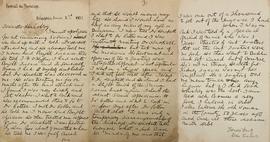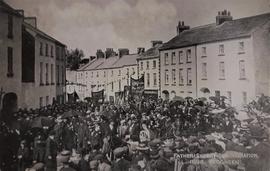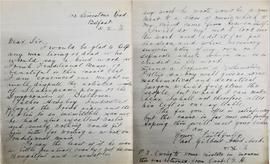
The subseries comprises a small collection of letters and clippings relating to the Fianna Fáil politician Cormac Breathnach. The clippings are tribute articles and obituaries published following Breathnach’s death on 29 May 1856. The file also includes some letters to Fr. Senan Moynihan OFM Cap. from Breathnach’s wife Bríd, and from Thomas MacGreevy and Margaret Mary Pearse.
The subseries comprises a small collection of papers relating to the Irish Catholic priest and novelist Canon Patrick Sheehan.
Sheehan was born in Mallow in County Cork on 17 March 1852. He was educated at St. Colman’s College in Fermoy. He studied for the priesthood in St. Patrick’s College in Maynooth, County Kildare (1869-75). Sheehan was ordained on 18 April 1875 for the Cloyne diocese and sent on mission to England, where he served in Plymouth and Exeter. He returned to Ireland in 1877 to take up a curacy in his native Mallow. He was appointed parish priest of Doneraile in County Cork in July 1895. In 1903 he was appointed to the Cloyne diocesan chapter; hence he is most frequently referred to as ‘Canon Sheehan of Doneraile’. He was a prolific and successful author, writing a series of articles and essays on a variety of topics, and several novels, including ‘Geoffrey Austin, student’ (1895) and ‘The triumph of failure’ (1898). His most popular work was ‘My new curate’, published in 1900. Much of his writing centred on the issues faced by priests engaged in parochial work in rural Ireland. Sheehan took a keen interest in promoting modern agricultural methods, especially in tillage and dairy farming. He held weekly meetings with his parishioners in Doneraile and advised them in negotiations with their landlords following the passage of Land Purchase Act (Wyndham Act) in 1903. Sheehan also maintained a life-long friendship with the agrarian agitator William O’Brien (1852-1928). Canon Sheehan was diagnosed as suffering from cancer in 1910. Following a lengthy residence at the South Infirmary in Cork, he died on 5 October 1913. He was buried at the entrance to his church in Doneraile. A bronze statue of Canon Sheehan by Francis William Doyle Jones (1873-1938) was unveiled not far from his grave in October 1925.
Fr. Senan Moynihan OFM Cap., the editor of ‘The Capuchin Annual’, was interested in Canon Sheehan’s literary career. Much of the material listed here was compiled for a special supplement marking the centenary of Canon Sheehan’s birth published in ‘The Capuchin Annual’ in 1952. A good portion of the original material was seemingly acquired by Fr. Senan from Presentation Sisters who resided in Doneraile and who were acquainted with Canon Sheehan during his lifetime.
The subseries comprises a small collection of papers relating to Aodh de Blacam, an author, journalist, editor, and politician. Aodh de Blacam (Harold Saunders Blackham) was born in London on 11 December 1891. He was born into a prominent Newry Protestant family but later rebelled against his upbringing, converted to Catholicism, and became involved with the Gaelic League in the English capital. In 1914 he moved to Ireland and emerged as a leading propagandist for the nationalist movement. Around this time, he also Gaelicised his name to Aodh Sandrach de Blacam and learned the Irish language. During the War of Independence, he worked as a propagandist for Arthur Griffith and was appointed editor of ‘Young Ireland’, a Sinn Féin newspaper which sought to encourage nationalistic sentiments in Irish children and young adults. He remained remarkably prolific in his journalistic and literary output throughout his life and produced two major two major political manifestos during the revolution: ‘Towards the Republic’ (1918) and ‘What Sinn Féin Stands For’ (1921).
De Blacam opposed the Anglo-Irish Treaty and subsequently sided with the anti-Treaty IRA during the Civil War. He was interned by the Free State authorities in 1922. Following his release, de Blacam strongly identified with the political ideals of Éamon de Valera and Fianna Fáil. He continued his journalist career, serving as a book editor for the ‘Irish Times’ and regularly contributing articles to the ‘Irish Press’ and other newspapers and literary journals. De Blacam also wrote extensively for several Catholic periodicals such as ‘The Standard’ and the ‘Irish Rosary’. The first edition of ‘The Capuchin Annual’ in 1930 carried two articles by de Blacam who forged a long-lasting friendship with Fr. Senan Moynihan OFM Cap., the founding editor of the periodical. Moynihan was clearly an admirer of de Blacam’s writing and published several of his articles in various Capuchin publications. De Blacam’s major published books included ‘Gaelic literature surveyed’ (1929) and ‘The Black North’ (1938). He died in Dublin on 13 January 1951. His funeral was attended by many notable political figures including Taoiseach John A. Costello and his predecessor Éamon de Valera. He was buried in New Mellifont Abbey in County Louth. De Blacam’s final article, an account of the closing ceremonies of the Holy Year celebrations in Rome, was published posthumously in ‘The Capuchin Annual’ (1950-1).
The material listed here was assembled by Fr. Senan Moynihan OFM Cap. following de Blacam’s death. The subseries includes drafts of de Blacam’s final articles for ‘The Capuchin Annual’ along with biographies, obituaries, tribute articles, correspondence, photographs, and ephemera.
A copy of ‘Papers on Irish idiom / together with a translation into Irish of part of the first book of Euclid / by the late Canon Peter O’Leary / edited by Thomas F. O’Rahilly’ (Dublin: 2nd edition, Browne & Nolan Ltd., 1927).
William Pearse was born in Great Brunswick Street in Dublin on 11 November 1881. He was the younger brother of Patrick Pearse, the writer, educationalist, and revolutionary. He joined the family sculpting business and ran it following the death of his father James Pearse in 1900. William attended classes at the Dublin Metropolitan School of Art between 1897 and 1910 and he seemed destined to embark upon a career as an artist. He later became a full-time art teacher at Scoil Éanna, the Gaelic school founded by his brother in 1908. Although William was more of an artist than a revolutionary, he shared his brother’s interest in the Irish language and Gaelic culture. Like his elder brother, William was also a founding member of the Irish Volunteers in 1913. During the Easter Rising he served as a captain on the headquarters staff and stood alongside his brother as he read the Proclamation of Independence. William Pearse was one of the last, if not the last person, to leave the General Post Office after the evacuation order was given. Following the surrender, he was court-martialled and, contrary to expectations, executed in Kilmainham Jail (4 May 1916). William Pearse was the only one of the executed leaders to plead guilty, though he exercised no real authority during the rebellion and his leadership role was said to be minimal.
academic paper on cleric's awareness and involvement on a local level in famine relief in the early part of Ireland's Great Famine observed through letters written by clergymen of all denominations.
Series includes Uncle David’s Deed of trust; the first letters found and especially 1767 “unusual shower of hail in Ballygriffin”; Thomas’s Roche’s short letter 1797; Indenture Roche and Coppinger; David Nagle appointing William Galwey as Attorney; accounts of Uncle Joseph; accounts of Uncle Joseph where Nano appears as beneficiary; and other less important papers addressed to Pierce G(C)reagh and Robert J. French. Most of the correspondence in this series is between Robert J. French and Pierce Creagh. Robert Joseph French was the son of Elizabeth Nagle and Robert French. Some of the correspondence is addressed to the Nagle family, in Circus, Bath, England.
It Is not possible to count the pages in this series due to their fragile condition.
These documents are in a very fragile condition and need to be handled with great care. Access to some documents in this series is restricted because of their extremely fragile condition.
The Capuchin Franciscans have worked in Ireland since the seventeenth century. From the middle of the nineteenth century the Irish Capuchins manifested a missionary zeal which took them from home to the furthest corners of the globe. Irish friars have undertaken overseas missions in the United States, Africa, New Zealand, and South Korea. Well over one hundred Irish Capuchins have ministered in Africa since the first friar arrived in South Africa in 1929, and in Zambia (formerly Northern Rhodesia) in 1931.
South Africa
In 1927 the Vicar Apostolic of Cape Province in South Africa, the Most Rev. Bernard O’Riley (1868-1956), invited the Irish Capuchins to open a mission. The friars responded positively to this request and in 1929 Fr. Casimir Butler OFM Cap. (1876-1958), Fr. Alban Cullen OFM Cap. (1902-1957) and Fr. Declan McFadden OFM Cap. (1901-1979) began missionary work in the Cape Flats on the outskirts of Cape Town. From the outset, the friars ministered among the marginalized black and ‘coloured’ (or mixed-race) populations of the area. Two foundational parishes were initially assigned to the Capuchins at Athlone (St. Mary of the Angels) and at Parow (Immaculate Conception). Parow is located eleven miles from the centre of Cape Town. The parish included the townships of Elsies River and Vasco located in the greater Cape Town municipality. The racial composition of Parow was mixed with both white and ‘coloured’ inhabitants. Athlone is located six miles from Parow and about twelve miles from Cape Town and has a predominately mixed-race population. In 1935 the Athlone foundation expanded to incorporate ministries at other locations including Langa and the Welcome Estate. Additional ministries were commenced in Matroosfontein (1933), Tiger Valley (1951), Belgravia (1954), Bridgetown (1967) and Elsies River (1979). All these parishes are situated in the Archdiocese of Cape Town. Within five years of arriving in South Africa, the Capuchins had built churches at Athlone and at Parow. Presbyteries, schools, and training colleges followed.
Of necessity, the Capuchins in Cape Town worked chiefly as parish priests offering public masses, attending sick calls, and promoting the cause of temperance. Other duties included evangelisation, organising lay religious sodalities, ministry to coverts, pre-nuptial courses, retreats, prison ministry, and promoting vocations and formation work for new friars. Despite the violent political unrest provoked by the system of racial discrimination known as apartheid, the Irish friars continued to labour among the poorest and most segregated in South African society. The work of the Capuchins with the ‘coloured’ population of Cape Flats and in the townships continued despite the frequent and fierce repression of the white minority government. In the seven parishes served by the Capuchins in South Africa in the 1980s, five were in the so-called ‘coloured’ areas, one in the African area, and one which straddled a racially mixed district. Education was a key element of missionary work within the Capuchin parishes and schools were established with the assistance of the Holy Cross Sisters, the Christian Brothers, and other religious congregations. The Capuchin Custody of South Africa remains under the jurisdiction of the Irish Capuchin Province and Irish friars continue to work in a variety of religious and social ministries in the country alongside missionary friars from Tanzania and India.
Zambia
In 1930 another field of missionary activity was offered to the Irish Capuchins. They were invited into vast area of 168,000 km2, comprising the Livingstone district and Barotseland, the western province of what was then called Northern Rhodesia (now the Republic of Zambia). Before 1931 there was no resident priest in the whole area from Livingstone to the Angolan border in the north. Prior to the arrival of the Irish Capuchins in 1931, the Barotseland mission was nominally under the control of the Prefect Apostolic of Broken Hill (now Kabwe), a town nearly four hundred miles north of Livingstone. The territory was effectively virgin-soil for Catholic missionary work. The only previous attempt at evangelization in Barotseland was unsuccessful. In 1881, the Jesuits had entered the territory and received permission from the local Paramount Chief but the presence of the Protestant missionary association, the Paris Evangelical Missionary Society ('Société des missions évangéliques de Paris'), disrupted their work in the district.
In 1931 three Irish Capuchins arrived in Livingstone with the intention of opening a new mission. Fr. Casimir Butler OFM Cap. set about constructing a friary in Livingstone. Fr. Declan McFadden OFM Cap. and Fr. Killian Flynn OFM Cap. (1905-1972) arrived in October 1931, with Fr. Timothy Phelim O’Shea OFM Cap. (1902-1979) and Fr. Seraphin Nesdale OFM Cap. coming in February 1932. Soon afterwards, the Capuchins began exploring the interior of Barotseland establishing a centre at Loanja, about one hundred and fifty kilometres north of Livingstone. The missionaries encountered many difficulties. There were no roads, and the friars travelled on foot or in canoes and on barges on the Zambezi River. Lions, leopards, and crocodiles posed some threat but more harmful to health were the smaller creatures such as tsetse flies and mosquitoes which carried a significant risk of malaria and other diseases. The friars also had to acquire knowledge of the local language of Lozi. Within two months of arriving at Loanja in 1932, the friars had built houses for themselves and their workers as well as a church and a school. These were simple structures with the walls supported by poles set into the ground interwoven with wattles and plastered with mud. The roofs were thatched. However, Loanja proved to be less than an ideal location as it was situated in a desert area and with a widely dispersed and small population. In 1936 the friars moved to Sichili. In the meantime, the friars worked diligently on acquiring an understanding of the local language and customs. The catechism was translated and printed in 1933 and this was followed by a translation of the New Testament. The influence of the Protestant missionary groups in the area continued to be a serious impediment as they laid to claim to vast swathes of the territory as their ‘sphere of influence’ to the definite exclusion of Catholic missionaries. Despite these difficulties, the Irish friars succeeded in opening a new mission station at Lukulu in December 1935.
In May 1936 Fr. Killian Flynn OFM Cap. was appointed the first Prefect Apostolic of Victoria Falls. Under his guidance, the provision of education and medical services became spearheads of mission development as new stations were opened at Mankoya (1938), Sihole (1943) and Katima Mulilo (1944) located in the Caprivi Strip in what was then South West Africa (now Namibia), and later at Malengwa (1947). A total of twenty-one Capuchin missions were established throughout Barotseland. Each friary, besides being a residence for the missionaries, acted as a base for outreach for evangelization and development in the surrounding districts. In March 1950 the Prefecture was raised to be the Vicariate Apostolic of Livingstone with Fr. Timothy Phelim O’Shea OFM Cap. consecrated as Vicar Apostolic in September 1950. In August 1959 the mission territory of the Vicariate of Livingstone was erected into the Diocese of Livingstone and the Most Rev. Timothy Phelim O’Shea OFM Cap. was installed as Bishop. He remained Bishop of Livingstone until the nomination of Monsignor Adrian Mung’andu (c.1920-2007) in 1974.
Additional mission stations were opened throughout the 1960s. Churches were built in each Boma or administrative centre, in Nalionwa (1960), Senanga (1966), Mongu (1966), Sesheke (1967) and at St. Conrad’s Friary in the capital, Lusaka. At this time the decolonization of Africa was continuing apace, and Zambia achieved independence from British rule in October 1964. Support for the Irish missionaries came in 1965 with the arrival of American friars from the New Jersey Capuchin Province. They were allocated the northern section of the Livingstone Diocese and they opened a new mission station at Kambompo (1966). This built upon the work of other religious congregations primarily in the fields of education and health care. The Holy Cross Sisters had worked in the country since 1936. This congregation was founded by a Swiss Capuchin priest, and the sisters devoted themselves to teaching and to the care of the sick (especially leprosy victims). An orphanage was opened in Sichili and later the sisters established secondary schools in Lukulu and in Malengwa. An emphasis was placed on the education of women and a female teacher-training college was also opened by the Holy Cross Sisters. The Franciscan Missionaries of the Divine Motherhood arrived in 1946 and established a hospital in Kasaba. From the late 1940s, they worked alongside the Irish friars in running hospitals in Mangango, Sesheke and Chinyingi. In 1967 the Irish Christian Brothers took over the running of secondary schools in Katongo and in Livingstone. Many lay people (from Ireland and elsewhere) came to Zambia to work as teachers, nurses, doctors and development workers at the Capuchin mission stations.
The rapid progress in the building of schools, hospitals and health-care centres in these years was remarkable, since the colonial government had made little or no provision for such services. These developments were largely due to the generous financial support offered by the Capuchins in Europe and in North America and through public fund-raising efforts of Capuchin mission offices and lay associations. In 1974, a total of two hundred and twenty primary schools were handed over by the Diocese of Livingstone to the government, which hereafter had responsibility for their administration. The provision of assistance to Angolan refugees became a major focus of the work of the Irish Capuchins in Zambia in the 1980s. Fr. Benignus Buckley OFM Cap. was the principal co-ordinator at the Sioma mission dealing with the huge numbers of refugees fleeing the civil war in Angola who were accommodated in various camps in Namibia and in Zambia. While there was an emphasis on education and health care services in the Zambian mission, the friars also strove to promote their own Capuchin way-of-life. A major weakness was identified in the lack of local vocations. Ad-hoc efforts were made to promote vocations and develop a novitiate programme before the establishment in 1983 of the Franciscan House of Studies just outside Lusaka to provide training for men aspiring to become friars. In 1992 the Franciscan House of Studies became St. Bonaventure’s College, a formation centre for the Franciscan Orders. In July 2007 a dedicated Capuchin novitiate was opened at Camerino near Lusaka.
Over one hundred Irish friars and nearly twenty American Capuchins have ministered in Zambia since the start of missionary work in the country. The numbers peaked in the late 1960s when there were sixty-two missionary friars in the country. Today, in the territory originally assigned to the Irish Capuchins, eighteen different religious congregations have a presence. There are approximately thirty-one parishes with various apostolic groups responding to the many spiritual and social needs of the local populace. Working alongside members of other religious congregations and lay professionals, the friars have had an immeasurable impact on the lives of many impoverished Zambians. The Capuchin Custody of Zambia remains under the jurisdiction of the Irish Capuchin Province. Irish friars are still working and ministering in Zambian continuing an unbroken ninety-year record of service on the continent.
Collection Content
The African mission collection in the Irish Capuchin Archives includes correspondence, visitation records, financial reports, diaries and journals, oral histories, publications, newspaper clippings and photographs (in albums, loose files and born-digital format) relating to the many years of Irish Capuchin missionary activity on the African continent. The collection comprises material sent back to the Irish Province and to the Capuchin Foreign Mission Office by Irish Capuchins in Africa from the 1930s onward. The papers chronicle the life and work of the Irish Capuchins since their arrival in South Africa in 1929 and in what was then known as Northern Rhodesia (later Zambia) in 1931. The files of correspondence between the missionary friars and their Provincial Ministers in Ireland illustrate the areas or spheres in which they laboured: parish work, education, health-care, social development and evangelization. Geographically, this work took place primarily in Cape Town, South Africa, and in Barotseland, later the western province of Zambia. The records reflect the impact of the Irish Capuchin missionary presence particularly in the building and management of parishes, and in the fields of education, health-care provision, and socio-economic development.
The Irish Capuchin Franciscans founded the Western American Province of the Order, establishing missions throughout the Western United States (firstly in Oregon and later in California), beginning in the early 1900s.
Origins and Early Timeline in Oregon
In 1910 the Irish Capuchins were requested by Charles Joseph O’Reilly, the Bishop of Baker City in Oregon, to minister to the pastoral needs of newly arrived immigrants and local Native Americans. The mission was explicitly driven by the need to provide religious services to growing immigrant populations in the Western United States in the early part of the twentieth century.
The Irish friars responded to this call and in early 1910 Fr. Luke Sheehan OFM Cap. and Fr. Thomas Dowling OFM Cap. travelled to Oregon, to a region bordering the Columbia River, between Bend and Hermiston, an area roughly the size of Ireland itself. They established their first residence at Our Lady of the Angels in Hermiston. The Capuchins celebrated their first Mass in Hermiston on 20 February 1910.
Other Irish Capuchin houses and churches were established in Oregon at Bend and in Roseburg. The historic St. Francis of Assisi Catholic church in downtown Bend was built in 1920 by Fr. Luke Sheehan OFM Cap. and was staffed by Irish Capuchin Franciscans for sixty-six years. Fr. Camillus Killian OFM Cap. and Fr. Edward Walsh OFM Cap. were the first Irish Capuchins assigned to St. Joseph’s Parish in Roseburg in 1912.
The Irish Capuchin leadership was willing to send more friars, but it was a long and difficult journey from Ireland to the West Coast of America, so parishes were accepted in Abbottstown, Pennsylvania, and later in Lincoln, Nebraska. This allowed the long journey, across one of America’s first cross-country passages, to be broken up into segments.
Mendocino County, California
In 1920, English Capuchin friars (who had established a parish ministry in Mendocino, California) were called to serve in missions on the Indian subcontinent. The Irish Capuchins were asked to take their place. As a consequence, Archbishop Edward Joseph Hanna of San Francisco transferred the administration of the whole of Mendocino County to the Irish Capuchin friars.
The Irish friars quickly expanded their ministry from Oregon into Northern California, building several churches and friaries, again mainly serving immigrant communities. Within Mendocino, there were several centres, notably in Ukiah, Fort Bragg, Elk, Mendocino Town, Willits, and Hopland. In each of these locations churches and schools were constructed serving as centres for parochial ministry and Capuchin missionary work.
Missions and Foundations
Serving as Archbishop of San Francisco from 1915 to 1935, Edward Joseph Hanna gave encouragement to the Irish Capuchins as the they expanded from their initial mission in Oregon into California.
In 1924 Fr. Albert Bibby OFM Cap. was sent to the United States and appointed Pastor of the Capuchin Mission at Santa Inés in Santa Barbara County, one of the twenty-one historic Spanish Franciscan missions established in Alta California.
A critical focus for the Irish friars was restoring the historic, early-nineteenth century Santa Inés Mission, located north of Los Angeles. Fr. Albert Bibby, alongside Brothers Reginald O’Hanlon and Colmcille Cregan, installed modern plumbing and electricity to revitalize the mission’s physical structure.
Father Albert Bibby was ardent Irish nationalist and fluent Irish speaker who was prominent in the 1916 Rising. He was sent to California in 1924 to lead the Santa Inés mission but died only three months after his arrival. He was initially buried outside the mission’s chapel, but his remains were repatriated to Ireland in 1958.
Santa Inés remains an active Catholic parish while the mission itself has been designated a National Historic Landmark.
Elsewhere in California, Archbishop Hanna blessed and opened St. Mary’s Church in Ukiah on 25 March 1924, which served as major foundation for the Irish Capuchin friars in the West.
Watts, Los Angeles
A few years after they had taken charge of Mendocino County, the Irish Capuchin friars moved further south in California to Los Angeles at the request of the Limerick-born Bishop John Joseph Cantwell (later the Archbishop of Los Angeles). In 1922 he asked the friars to take charge of the parish of Watts, a parish of mixed ethnic backgrounds, now home to a large population of Hispanic Americans and African Americans. The friars dedicated this parish to the Capuchin saint, Lawrence of Brindisi.
Burlingame, San Mateo County, California
Having impressed with their work in the Mendocino County, in 1926 Archbishop Hanna invited the Irish Capuchin friars to take up a ministry in his Diocese of San Francisco. He entrusted the new parish of Burlingame to their care which was dedicated to Our Lady of the Angels with Fr. Thomas Dowling OFM Cap. appointed the first pastor and Fr. Berchmans Cantillon OFM Cap. as his assistant.
Further Development
By 1936 the Irish Capuchins were present in four states and six dioceses with a total of fifteen foundations. With the opening of a new novitiate in Wilmington, Delaware (1937-1963), the Irish friars’ presence in Pennsylvania and Nebraska ended.
The Irish Capuchin mission in the United States was officially termed the Custody of St. Patrick and local vocations were increasingly deemed a priority.
St. Francis High School, La Cañada Flintridge, California
Up to 1945, the foundations established by the Irish friars in the United States had been directed almost exclusively towards parochial ministry. For several years the question of founding a high school had engaged the attention of superiors.
In 1945, Fr. Stephen Murtagh OFM Cap., the Irish Capuchin superior in California, secured property in the Flintridge (now known as La Cañada) district of Los Angeles with the intention of establishing a high school.
St. Francis High School opened on 16 September 1946. Many of the school’s early administrators and teachers were Irish-born friars, notably Fr. Valerian O’Leary OFM Cap., Fr. Emilian Meade OFM Cap., and Fr. Cyril Kelleher OFM Cap.
St. Francis High School now has a total student population of approximately 620 boys and is consistently ranked among the best of its class in California. It continues to be sponsored and operated by the Capuchin Franciscan Order of the Western America Province (known as the Province of Our Lady of Angels).
San Lorenzo Novitiate, Santa Ynez Valley, California
By 1963, the friars decided they no longer needed the Delaware foundation on the East Coast as a new novitiate, San Lorenzo, was established in the Santa Ynez Valley in California, near the Santa Inés Mission. The Capuchin novices at San Lorenzo engage in a life of prayer and service, participating in community activities and ministries, such as preparing food for the homeless, as part of their formation and training. Today, San Lorenzo serves as the inter-provincial novitiate for the North American Capuchin Conference.
Establishment of the Western American Capuchin Province
After nearly seven decades under the Irish friars, the Western American Capuchin mission became an independent jurisdiction known as the Province of Our Lady of the Angels on 18 April 1979.
At the time the province gained its administrative independence, the Irish friars maintained thirteen houses in California and one in Oregon.
In 1985, the friars established their own mission in Northern Mexico, beginning at Yécora, in the state of Sonora. Friars from other American Capuchin provinces assist this mission, which is now the Custody of San Juan Diego.
The Capuchin friars in California remain focused on serving a diverse population, including Hispanic, Native American, and African American communities, following the Franciscan charism of aiding the poor and marginalized.
Current Presence
A very small number of Irish-born friars still minister in the United States. Today, the Western American Province continues its mission, serving communities across six states (California, Oregon, Washington, Idaho, Nevada, and Arizona) and in Northern Mexico.
Their varied work includes:
• Parish ministry
• Hospital and prison chaplaincy
• Community outreach, including serving the homeless and marginalized
• Campus and school ministry and evangelization
Legacy
The legacy of the Irish Capuchin friars in the Western United States forms an important part of California’s Catholic history, a testament to their dedication to serving poor immigrants and establishing vibrant faith communities.
'The Capuchin Annual' was published by the Irish Province of the Capuchin Franciscans from 1930 to 1977. The purpose of the publication was clearly stated:
'"The Capuchin Annual" from its foundation presents Ireland to the world, sets forth the Irish way of life in all its phases: spiritual, cultural, intellectual, and social. It has been said that Ireland has a spiritual mission, and we believe that her mission is best fulfilled by showing her people, their customs, their literature, their art to the world. Our interest in Ireland exists beyond the confines of her shores to the achievements of Irishmen wherever their native genius has contributed to the glory of their own country or the country of their adoption'.
The 'Annual' was founded by Fr. Senan Moynihan OFM Cap. (1900-1970), a Kerry-born Capuchin friar who exuded a deep literary interest. Shortly after his ordination in 1928 he was appointed editor of 'The Father Mathew Record', a popular monthly publication of the Irish Capuchins which promoted the Order’s overseas’ missions (particularly in Africa) and carried articles supporting the cause of total abstinence which had as its champion Fr. Theobald Mathew OSFC (1790-1856), a charismatic friar who led a nationwide temperance campaign in the nineteenth century. Fr. Senan strove to create a higher grade, more literary publication. He was acquainted with many well-known Irish writers and artists and he secured permission from his superiors to publish the 'Annual' in 1930. Although its ethos always remained the promotion of Christian values and a Catholic way of life, the 'Annual' found many unique ways of exploring these subjects. In addition to the task of presenting Ireland and the Irish way of life to the world, 'The Capuchin Annual' also presented the Capuchin friars, their ideals, their history and their missionary endeavours to a wider audience. From its inception, the 'Annual' attracted a very high quality of contributing authors. It was a journal unique in Irish publishing containing many literary, historical, topographical, photographic, biographical, artistic, and cultural articles. Many Irish writers, artists and educators who later gained prominence such as Benedict Kiely (1919-2007), Francis MacManus (1909-1965), and Augustine Martin (1935-1995) received their first opportunities to publish in the 'Annual'. Other leading writers, artists, politicians and public figures who contributed to the 'Annual' included Pádraig Ó Siochfhradha (1883-1964), Pearse Hutchinson (1927-2012), Daniel Corkery (1878-1964), Alice Curtayne (1898-1981), Aodh de Blácam (1890-1951), Richard Mulcahy (1886-1971), Leon Ó Broin (1902-1990), Brian O’Higgins (1882-1963), and Francis Stuart (1902-2000).
Fr. Senan crafted 'The Capuchin Annual' into a finely tuned expression of Irish nationalism. His editorial office was located on Capel Street in Dublin and it became a regular meeting place for artists and writers. He was also an acquaintance of Éamon de Valera and his successor as leader of Fianna Fáil, Seán Lemass. De Valera supported the 'Annual' and appreciated its editorial alignment with the nationalist agenda espoused by the Fianna Fáil party. The 'Annual' also strove to develop a wider public appreciation of Irish art. With the assistance of his friend Thomas MacGreevy (1893-1967), a noted literary figure and director of the National Gallery of Ireland from 1950-63, Fr. Senan promoted the work of Irish artists such as Jack B. Yeats (1871-1957), Seán O’Sullivan (1906-1964) and Richard King (1907-1974). Fr. Senan was naturally gifted as a page-setter and the 'Annual' was regularly lauded. The 'Irish Times’ review of the 1937 edition complimented Fr. Senan as a ‘distinguished editor’ who had produced ‘one of the brightest magazines of the season’ ('Irish Times', 28 Dec. 1936). In 1942, Patrick Kavanagh (1904-1967) referred to the 'Annual' as an 'amazing phenomenon of modern political Catholic Ireland’ ('Irish Times', 10 Jan. 1942). The publication spread knowledge of and heightened awareness of Irish painting, sculpture, music, poetry and literature. Although its readership was predominately Irish, its circulation was international as it was frequently sent to Irish emigrants in the United States, Canada and Australia. The publication was immediately successful from a circulation point-of-view. Only 2,000 copies of the first edition of the 'Annual' were printed in 1930 and these were sold out within a month. By 1940 the print run had increased to 25,000 copies.
The 'Annual' was always published on high quality glossy paper, ensuring that reproductions of artwork were as good as one would expect in a fine arts journal. The publication increased in physical size by the 1940s. The 1930 edition had two hundred and thirty-six pages. This had increased to three hundred and ninety-eight pages in 1940. Throughout the difficult years of the Second World War (or ‘The Emergency’ as it was referred to in Ireland), the 'Annual' continued to be published, albeit on slightly coarser paper due to wartime restrictions. The high quality of the publication meant that it was a costly endeavour to produce. Printing full-colour reproductions of artwork along with the generous honorariums offered by Fr. Senan to contributors greatly increased production costs. Benedict Kiely was paid an exorbitant fee of thirty guineas for one poem about the 1916 Rising published in the 1942 edition. In 1936 Fr. Senan wrote to the Capuchin Provincial Minister to assure him that the publication was ‘solvent’. (CA CP-1-12-1). 21,000 copies of the 1937 edition were printed at a total cost of £2,500 with a profit of around £800. Despite these reassurances, it appears that Fr. Senan remained profligate in his spending. In 1954, he outlined a series of measures aimed at reducing the escalating debt of the Capuchin Publications Office (CA CP-1-5-1-2). This included selling off the office’s valuable collection of art (including three original paintings by Jack B. Yeats which he had purchased and reproduced in the 1942 'Annual'). These financial difficulties inevitably resulted in a strain on Fr. Senan’s health and he required hospitalization for periods in the late 1940s and in the early 1950s. In 1955 a decision was made at the Capuchin Provincial Chapter to remove Fr. Senan from the editorship of the 'Annual'. Fr. Nessan Shaw OFM Cap. (1915-1997), a fellow friar and friend, offered this assessment of the reasons for Fr. Senan’s departure:
'At the Provincial Chapter of 1955, Fr. Senan was transferred to the Capuchin Friary of the Most Holy Trinity in Cork with no definite assignment. Fr. Henry Anglin OFM Cap. was appointed editor of the 'Annual' with Fr. Felix Guihen OFM Cap. as manager. The appointment of a manager was significant because it considered that the financial arrangements and the editorship was too much for one man. That proved to be the case with Senan with the result that in spite of his best efforts the publication ran into serious debt, certainly from 1950 onwards (note that the 1950 and 1951 issues were amalgamated). It is my opinion that this caused him serious worry and very definite stress. Due to his constant work in the promotion of culture and the art and the necessity of contact with contributors of first-class quality, Fr. Senan lived a life somewhat removed from the lifestyle of the ordinary Capuchin. He had premises at 2 Capel Street which served both as an office and an art gallery. There might be found famous writers and painters etc. who contributed to the Annual – Jack B. Yeats, Seán Keating, Count John McCormack etc. In addition, there was maintenance staff, so the financial resources were not there to meet the demands. This was the real cause of his problems'.
Finding it impossible to continue as editor of the publication he had founded, Fr. Senan later requested secularization and left the Capuchin Order to become a diocesan priest in Australia. He arrived in Perth in 1959 following an invitation from Archbishop Redmond Prendiville (1900-1968), a fellow Kerryman. On arrival, Fr. Senan took up a position as chaplain to the Mercy Sisters at St. Anne’s Hospital in Mount Lawley, Western Australia (now St. John of God Mount Lawley Hospital). Archbishop Prendiville appointed him archivist of the Perth Archdiocese in 1962. He died in Perth on 26 July 1970 and was buried in Karrakatta Cemetery.
The appointment of Fr. Henry Anglin OFM Cap. (1910-1977) as editor of the 'Annual' in 1955 occasioned no real change in the ethos of the publication. The 'Annual' continued to publish an eclectic mix of content ranging from scholarly articles on the struggle for Irish independence to features extolling physical achievement, the national myth, rebellion, adventure, and spiritual and moral self-improvement. An awareness of the Capuchin Order’s commitment to the missionary work of the church explained much of the publication’s content as did an adherence to the predominantly conservative culture of the Irish state. Fr. Henry reflected on the 'Annual’s' purpose in 1965 as a publication ‘of prestige value … run by an Order on a shoe-string but produced as a Catholic and patriotic effort which has, I have no doubt, done much good for these objects over thirty years’ (CA CP-1-5-2-20).
Under Fr. Henry's editorship, the 'Annual' cemented its position as a popular cultural journal. He greatly expanded content which examined events associated with the Irish Revolution. The 1966 edition published detailed articles, profusely illustrated, on the 1916 Rising. The 1967 edition offered a striking pictorial record of the nationwide commemorations marking the fiftieth anniversary of the insurrection. Reproductions of contemporary photographs were also used to illustrate articles which reflected upon the ‘resurgence of the national spirit of Ireland after the 1916 prisoners were released’. More than two hundred and fifty pages of the 1970 edition were given over to memorializing key figures and events in the War of Independence. These anniversary features provided plenty of scope for forthright displays of national sentiment. Comparatively little was published on the contested history of the Civil War. Like Fr. Senan before him, Fr. Henry maintained the 'Annual’s' decidedly republican perspective. In a reassuring letter to the leading Fianna Fáil politician, James Ryan (1891-1970), Fr. Henry remarked that ‘the tradition of "The Capuchin Annual", as you know, has always been along the other [republican] side, and it is my intention that it shall remain so’ (25 Feb. 1969. CA CP-1-5-1-8).
'The Capuchin Annual' presented an unusual form of miscellany. Its extended length, designed to meet the needs of an annual publication, ensured that it exhibited a broadly conservative and nationalistic ideology in a comprehensive fashion. However, its goals of educating and elucidating in areas beyond the narrow confines of the prevailing culture of the state resulted in a varied mix of religious, literary, historical and artistic content. The 'Annual' attracted a readership who normally would not have even glanced at what was, outwardly, a religious journal. The renowned Irish playwright and critic, George Bernard Shaw (1856-1950), was an avid reader of the 'Annual', and it was one of the few Irish periodicals he subscribed to (CA CP-1-6-9). The final edition of the 'Annual' was published in 1977. A cursory note in this issue attributed its demise to the increasing costs of production. A ninety percent increase in printing costs from 1973-76 made the continued publication of the 'Annual' economically unviable. The print-run in 1976 (about 6,300 copies) cost over £14,500 and arrears in the Publications Office were running at over £1,200 per annum. Despite increases in the retail price of the periodical, it was clear that such losses were not sustainable. Many contributors, academics and literary critics lamented the journal’s demise. Fr. Henry limited himself to expressing an opinion that the decision to cease publication was a ‘mistake’ (CA CP-1-5-1-15). He died on 30 May 1977 just a few months after completing work on the final edition.
'The Capuchin Annual' was one of the most widely read Irish literary publications of the twentieth century. Though Irish-Ireland in its politics, the journal was never narrowly Catholic. The deployment of a wide range of topics ensured that it could not be easily located within the prevailing periodical culture of the period. Interested primarily in literature, history and art, it also took an astute view on issues of social and political import. The complete run of 'The Capuchin Annual' (1930-1977) has been digitised and is now freely accessible online.
'The Father Mathew Record' (later 'Eirigh')
'The Father Mathew Record' was a monthly periodical published by the Irish Capuchins. The 'Record' began publication in January 1908 and was founded by Fr. Aloysius Travers OFM Cap. (1870-1957). The stated aim of this popular magazine was to ‘record, month by month, the efforts made by the Father Mathew Total Abstinence Association and the Father Mathew Hall to advance the sacred cause of temperance’. Fr. Senan Moynihan OFM Cap. was appointed editor in 1928. Under his editorship, the 'Record' increased the amount of coverage of the Capuchin overseas' missions, and by 1934 circulation had increased to 12,000 copies a month. During the Second World War foreign mission reportage was curtailed and, in its place, there was a greater emphasis on Franciscan spirituality along with articles on Irish culture, art and literature. Around this time, Fr. Gerald McCann OFM Cap. (1910-1948) assumed the editorship of the 'Record' leaving Fr. Senan to concentrate on the production of 'The Capuchin Annual'. Fr. Gerald was also a gifted artist and his humorous depictions of Franciscan life were regularly published in both the 'Annual' and in the 'Record'. 1967 marked the last year of the publication under the title of 'The Father Mathew Record'. Following his appointment as editor in 1967, Fr. Donal O’Mahony OFM Cap. (1936-2010) decided to broaden the appeal of the Capuchin publication and sought permission to change the name and enhance the content of the 'Record' to reflect current ideas about social and cultural issues affecting Christian living. From January 1968 the periodical was known as 'Eirigh' and it continued to be published by the Irish Capuchins until December 1973.
Collection Content:
'The Capuchin Annual' was published from 1930 to 1977. It only ever had two editors, Fr. Senan Moynihan OFM Cap. (1900-1970) and Fr. Henry Anglin OFM Cap. (1910-1977). The distinctive cover illustration of St. Francis and the wolf was designed by Seán O’Sullivan RHA (1906-1964). The Three Candles Press founded by Colm Ó Lochlainn (1892-1972) printed the first three issues of the Annual. John English & Co. of Wexford assumed printing responsibilities from 1934 until 1957, and from 1958 until the final issue in 1977 it was printed by Dollard Printing House in Dublin.
Very many of the surviving records in 'The Capuchin Annual' collection relate to the editorship of Fr. Henry Anglin OFM Cap. who assumed responsibility for the Capuchin publication in 1955 following the resignation of Fr. Senan Moynihan OFM Cap. Fr. Senan subsequently settled in Australia in 1959. It has not been ascertained why so little of the archive associated with Fr. Senan’s editorship of the 'Annual' has survived. Fr. Henry noted Fr. Senan’s practice of ‘returning to all writers any manuscripts he had received and had not paid for’ (25 Nov. 1954. CA CP-1-5-2-1). It also appears that Fr. Senan did not maintain much contact with the Capuchin Publications Office following his departure for Australia. Many years later Fr. Henry affirmed that Fr. Senan ‘has had nothing to do with this place for over twenty years’ (21 July 1976. CA CP-1-5-1-15). It is conceivable that Fr. Senan took much of his personal archive (including papers relating to the operation of the 'Annual') with him to Australia. The Archives of the Catholic Archdiocese of Perth (Fr. Senan was appointed archivist in 1962) confirmed that he died without making a will and that his papers were subsequently auctioned and dispersed following his death. In an article by Ormonde D.P. Waters on the Fenians in Australia published in 'Seanchas Ard Mhacha' in 1996, it is noted that Fr. Senan was a ‘dedicated Fenian researcher’ and that ‘his very specialized library was scattered in a second-hand bookshop shortly after his death’. In 2003 the National Library of Ireland acquired manuscript drafts of two poems ('The Mother' and 'The Fool') by Patrick Pearse (1879-1916). The Library purchased the manuscripts from the Archdiocese of Perth. The provenance note suggested that these manuscripts were gifted by Pearse’s sister, Margaret, to Fr. Senan before he left for Australia. A recent discovery by Professor Richard Sharpe of the first printing of Brian Merriman’s (c.1747-1805) 'Cúirt An Mheán Oíche' ('The Midnight Court') in the National Library of Ireland also refers to the prior ownership of ‘Fr. Senan Moynihan, Saint Anne’s Hospital, Mount Lawley, Western Australia’. Other material with a direct provenance to Fr. Senan (including an autograph poem presented to the Capuchin friar by Donagh MacDonagh, son of Thomas MacDonagh, the executed 1916 Rising leader) has been offered for sale at auction. This would seem to support the contention that many of the papers and ephemera of cultural and historical significance acquired by Fr. Senan during his time as editor of 'The Capuchin Annual' were dispersed and sold in the years after his death.
Many of the records held in the Irish Capuchin Archives are draft articles received by Fr. Henry Anglin OFM Cap. for publication in the 'Annual'. A significant twentieth-century photographic archive is also extant. The collection also includes volumes containing copies of Fr. Henry’s outgoing letters along with financial records dating from the 1960s until the closure of the publication in 1977. A very large assemblage of ephemera in the form of photoengraving plates and stereotype printing blocks is also extant in the collection. These were likely returned to the Capuchin Publications Office by the firms responsible for the printing of the 'Annual'. The survival of certain record series is seemingly haphazard. In 1976 Fr. Henry referred to the destruction of ‘many periodicals and papers’ when the Publications Office moved from Father Mathew Hall to new premises adjacent to the Capuchin Friary on Church Street. (28 Apr. 1976. CA CP-1-5-1-15). The surviving records were subsequently transferred from the Publications Office following its closure. It is very likely that this transfer occasioned a further loss of material as the Capuchins had not yet acquired a suitable space for the storage of their archives.