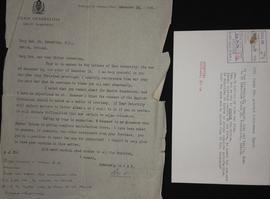
Sketch map of St. Joseph’s Cemetery ‘5 acres 2 roods 0 perches, late botanic gardens, representatives of Rev. Fr. Theobald Mathew’, bordered by ‘South Spittal Lands’ and by ‘the back road to the cemetery called on [the] city map “Tory Top Lane”’. The map also shows various numbered denominations of land possibly on the former Botanic Gardens' site. A numbered schedule of deeds and lease (nos. 3-16), possibly relating to the aforementioned site, is extant on the reverse of the sketch map.
A property mortgage agreement between the Franciscan Capuchin Order of the Diocese of Baker City and an unspecified second party for a property in Oregon. It secures a loan of £500 or $2,500 against a 2.5-acre parcel of land defined by the Willamette Meridian survey system. The mortgage specifically includes a two-story combination church and residence building measuring 50 by 24 feet, along with all internal church and house furniture.
A copy of Fr. Paschal Larkin OSFC, ‘Property in the eighteenth century / with special reference to England and Locke’ (Dublin and Cork, London, New York [etc.], Cork University Press, Longmans, Green, 1930). The fly-page has a manuscript dedication from Fr. Paschal Larkin OFM Cap. to Fr. Kevin Moynihan OFM Cap. (8 October 1930).
Larkin, Paschal, 1894-1976, Capuchin priestThis Series primarily contains deeds and other legal documents and correspondence relating to the ownership and sale of a primary school at Garretstown, near the Old Head of Kinsale, County Cork.
The collection includes records created by the Property Defence Association (PDA) which was formed in Dublin in December 1880 to assist landlords targeted by the Land League or by rural agitation in general.
Includes; kept original file titles as received from solicitors.
Valuation ledger providing an official appraisal of property holdings managed by the Capuchin Franciscans in Douglas County, Oregon, dated 11 April 1919. Signed by Fr. Edward Walsh OFM Cap. the document items and calculates the total value of church real estate at $45,600.00. The breakdown highlights the primary Roseburg parish property, consisting of an entire city block measuring 220 by 325 feet valued at $28,000.00, alongside its house, church, and school buildings. Additionally, it accounts for regional mission properties throughout Douglas County, including four lots in Canyonville and two lots alongside a church building in Glendale.
Walsh, Edward, 1881-1961, Capuchin priestThis section includes legal records relating to the management of properties at Ard Mhuire Capuchin Friary. The series also includes papers relating to the construction, renovation and repair history of Ards Friary and the Capuchin House of Studies. A sub-series includes correspondence, architectural plans, and financial records relating to the construction of a new friary and theological seminary on the existing Ard Mhuire site in the 1960s.
This series contains property documents including title deeds, legal correspondence, and memoranda relating to the acquisition of properties in Cork by the Capuchin Franciscan friars. Towards the end of the eighteenth century, Cork experienced a dramatic physical growth. George’s Quay had been built during the second half of the century, making the River Lee navigable for shipping and in 1806 Parliament Bridge had replaced an earlier structure connecting both sides of the city for the flow of commercial traffic. A location below this bridge, near the mercantile and commercial centre of the city, was chosen by Fr. Theobald Mathew OSFC as the site for a new church. The foundation stone of what was to become Holy Trinity Church was laid on 10 October 1832. However, the building was not opened for public worship until 1850. The gothic portico and spire were not constructed until 1889-90. Prior to the opening of the new church, the Cork Capuchins had lived in a friary situated on Blackamoor Lane in the South Parish. Following the construction of Holy Trinity Church, the community obtained a lease of 8 George’s Quay in 1855. Later, they moved across the river to a house built by Fr. Cherubim Mazzini OSFC (1831-1906) situated at the corner of Queen Street and Charlotte Quay. Fr. Cherubim Mazzini OSFC, (sometimes referred to as Cherubini in contemporary newspapers and other documents) was a Capuchin friar from Bologna in Italy. The Cork Gas Company later took possession of this site on the quay. It is now occupied by Radió Teilifís Éireann. In the summer of 1884 the Capuchin community took up residence in the present-day friary. The building of this friary was started by a French Capuchin, Fr. Simeon Gaudillot OSFC (1836-1910), and completed by Fr. Seraphin Van Damme OSFC (1820-1887) who became the first Provincial Minister of the newly reconstituted Irish Capuchin Province in 1885.
This section contains property documents including title deeds, leases, legal correspondence and memoranda relating to the acquisition of properties in Dublin by the Capuchin friars. For the most part, the documents relate to the present-day St. Mary of the Angels Friary located on Church Street. The section also includes legal documents relating to properties located on streets immediately adjoining Church Street (such as Bow Street and North King Street). These documents relate to buildings which were either previously held by the friars (and have since been disposed of), or to properties which continue to be used for various apostolates such as the Capuchin Day Centre located on Bow Street.