
1846034 Blessd Charles Houben, C.P., Writings: McEvoy family:original letter (with typed copy attached) written by Blessed Charles from St. Paul's Retreat, Mount Argus, Dublin, to Miss Pauline McEvoy (address not quoted), thanking her for her help with raffle tickets and her proposed help with a bazarr. He also commiserates with her on her recent accident and assures her of his prayers for herself and her parents. Pauline's parents resided at Tobertynan House, Enfield, Co. Westmeath, and the family was visited by Fr. Charles on several occasions. In gratitude for the gift of a baby daughter (i.e. Pauline) - some maintain as a result of intercession by Fr. Charles - they erected a shrine to Our Lady of Lourdes in the woods at their house in 1868. Fr. Charles may have blessed this shrine. For interesting developments re the shrine see correspondence located at 4/4/3/20-25. The daughter, Pauline, named after St. Paul of the Cross, may also have been cured in later life by Blessed Charles. She married the Duke de Stacpoole in 1883.
Charles Houben1846034; Blessed Charles: Papal Decree that the Cause of Charles Houben may be introduced.
Blessed Charles - Cause:- Bound Volume containing 9 Dcuments: (1) Informatio, (2) Decretum de Validate Processum, (3) Tabella/Index Testimentum, (4) Summarium e Proc. Ordinariis: Testimonies - Fr. Charles's letters, pp 323-329, (5) Iudicium super scriptis Servi. Dei, (6) Decretum super Intro. Causae, (7) Animadversiones Prom. Fidei, (8) Responsio ad has and (9) Syllogus Virtutum
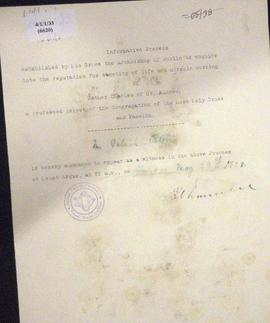
1846034: Blessed Charles: Cause: Informative Process: notice issued to a Mr. Patrick Byrne to appear as a witness at the Informative Process to be held in Mount Argus.
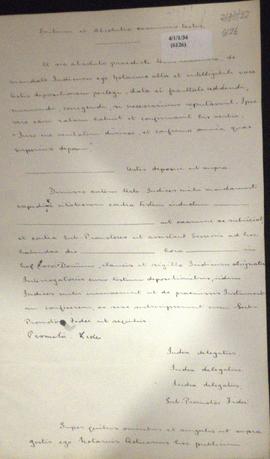
1846034: Blessed Charles: Cause: Informative Process: Latin text of the document (certification) issued concerning the opening and closing of the examination of witnesses. The document is entitled "Initium et Absolutio examinis testis". For typescript of the document and translation - both of which were done by Osmund Slevin, C.P., see item under serial nos 6127 and 6128). The location of this document is not chronologically correct.
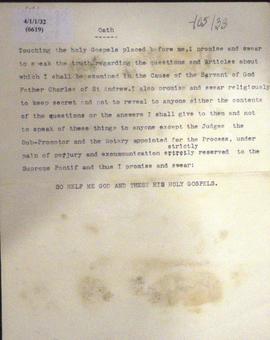
Blessed Charles: Cause: Informative Process: Typewritten copy of the oath to be administered to witnesses before giving evidence at the Informative Process.
1846034 Blessed Charles: 1921074 Coleman, C. P. Christopher: Hugh P. Allen, CTS of Ireland, Veritas House, Lr. ABbey St., Dublin to Fr. Christopher, Mount Argus; Sends galley-proof of cover of Christopher's life of CVharles. Plans to come and take a photo of Charles's grave.
1846034 Blessed Charles; 1921074 Coleman, C.P., Christopher: Book revies from The Standard of Christopher's life of Blessed Charles.
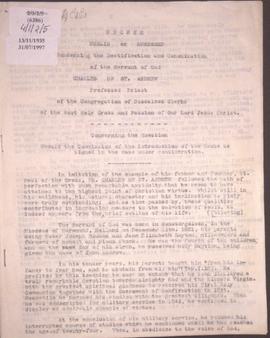
1846034 Blessed Charles Houben - Cause - Apostolic Process:- typescript and printed copy of translation of Decretum An Signanda sit introductio Causae. Printed copy has been given the location as 4/1/2/6,
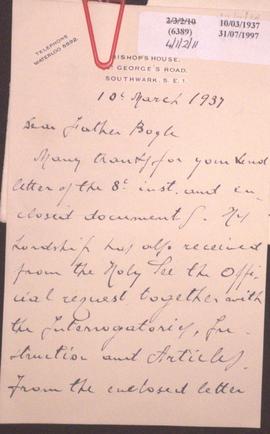
1846034 Blessed Charles Houben - Cause - Apostolic Process:- letter from the office of the Bishop of Southwark to Gerald O'Boyle, C.P. enclosing letter from the Abbot of Ramsgate in which he agrees to act as the Bishops delegate as judge at the Rogatorial Court in Herne Bay for the examination of two Passionists who are witnesses in the Cause of Fr. Charles. (Actual letter is located at serial no 6390.)