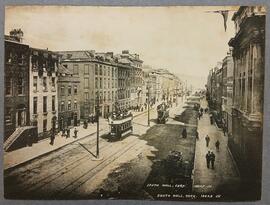
A copy print of South Mall, one of the principal commercial streets in Cork. The print is credited to the firm of James Valentine and Sons.
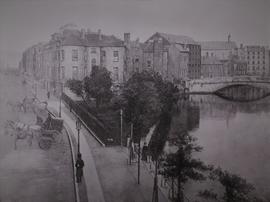
Copy photograph of South Mall in Cork showing the uncompleted Holy Trinity Church in the background (behind Parliament Bridge). The image is possibly a copy of an original glass plate held in the Lawrence Collection in the National Library of Ireland.
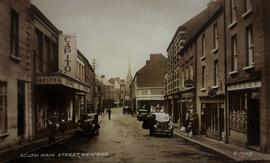
A postcard print of South Main Street in Wexford Town.
This record is part of the list of all the missions preached by the Passionist Fathers in St. Patricks Province (Ireland and Scotland), from 1927 up until 1965. It is just an electronic list with no physical counterpart. It has been made available to aid research into the Passionists.
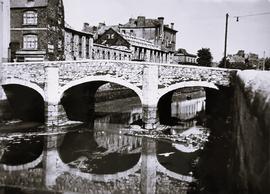
An image of South Gate Bridge in Cork. This triple-span limestone arch bridge was built in 1713.
"Provincial Chapter".
A copy of South East Province Newsbrief, Summer 2000.
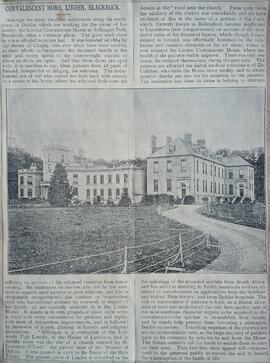
Presentation SistersA bound volume containing pasted-in clippings of mainly antiquarian descriptions of various historical buildings and scenic locations in South County Dublin and in County Wicklow. Several of the clippings appear to be reprinted descriptions taken from Samuel Lewis’s ‘A topographical dictionary of Ireland’ (1837). Other descriptions are clippings taken from contemporary newspapers and magazines. Some texts by Patrick Weston Joyce and Miss K.L. Montgomery. Includes texts and illustrations relating to Kingstown (Dún Laoghaire), Dalkey, Killiney, Bray, Blackrock, Enniskerry, Powerscourt, Poulaphuca, Avoca, Glendalough, Carrickmines, Kilternan, and Drimnagh. Manuscript title to the front cover reads ‘South County Dublin and County Wicklow’.
Includes; photos of Saint Finbarr's Church, also known as the South Chapel, church that Nano Nagle used to attend; photo of John Hogan's sculpture of Christ.
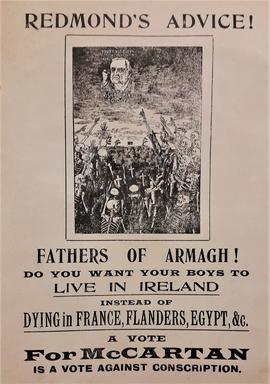
An election handbill produced by Patrick McCartan (1878-1963), the Sinn Féin candidate, during the South Armagh by-election which was held on 2 February 1918. The handbill strongly attacks John Redmond’s call for Irish nationalists to support the British war effort.