The subseries includes records relating to St. Joseph’s Church in Roseburg, Oregon.
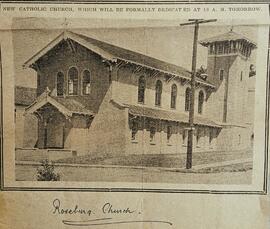
A clipping announcing the upcoming dedication of St. Joseph’s Catholic Church in Roseburg, Oregon. The clipping is taken from ‘Evening Roseburg Review’ (5 August 1916).
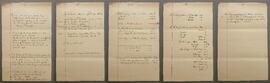
Valuation ledger providing an official appraisal of property holdings managed by the Capuchin Franciscans in Douglas County, Oregon, dated 11 April 1919. Signed by Fr. Edward Walsh OFM Cap. the document items and calculates the total value of church real estate at $45,600.00. The breakdown highlights the primary Roseburg parish property, consisting of an entire city block measuring 220 by 325 feet valued at $28,000.00, alongside its house, church, and school buildings. Additionally, it accounts for regional mission properties throughout Douglas County, including four lots in Canyonville and two lots alongside a church building in Glendale.
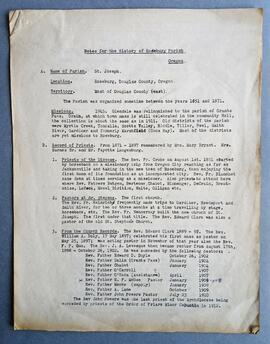
Sem títuloA document titled ‘Notes for the History of Roseburg Parish, Oregon’ by Fr. Urban Riordan OFM Cap. providing an overview of the early organization, changing territories, and pastoral leadership of St. Joseph’s Parish in Douglas County, Oregon. It records that the parish was organized between 1851 and 1871, originally covering most of eastern Douglas County, with numerous outlying missions including Myrtle Creek, Yoncalla, Riddle, and formerly Marshfield (Coos Bay). The text outlines structural transitions, such as relinquishing Glendale to the Grants Pass parish in 1945, while keeping town masses in Drain active within a community hall. The history includes detailed chronological record of serving clergy compiled from records. It begins with the pioneering missionary travels in 1851 by Rev. Fr. Croke and early pastors at the original St. Stephen’s Church, traces the construction of St. Joseph’s Church under Rev. Fr. Wensersky, and provides an exact timeline of successive pastors from 1889 through 1910, including the transition from diocesan priests to Capuchin friars in 1912 and its subsequent history up to 1946.

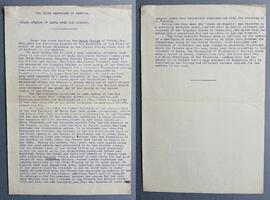
Sem títuloA typescript copy of a document titled ‘The Irish Capuchins in America: Grand Opening of Santa Ynez Old Mission’ reproducing a November 1924 article from the ‘Watts Review’ documenting the Capuchin Order’s official takeover of the California mission. It details how, following a request from Bishop Cantwell and approval from Rome, the Capuchin Fathers arrived at the old mission on Thursday, 20 November 1924, marking the return of brown-robed friars to the site after a 74-year absence. The text lists the newly appointed community members – Father Albert Bibby (Rector), Father Reginald O’Hanlon (Assistant), and Brother Columcille Cregan – who were accompanied by the Superior of the Irish Capuchins in America, Fr. Joseph Fenelon. It describes an installation ceremony on Sunday, 23 November, featuring a Solemn High Mass sung by Father Joseph, an inaugural sermon tracing the mission’s history from its 1804 founding to the 1850 departure of the Franciscans, and musical accompaniment directed by Mrs. H. Labarare. It also highlights the order’s expanding educational ventures, specifically mentioning the opening of a college under the patronage of St. Anthony in Mendocino, California, which was endorsed by Archbishop Edward J. Hanna of San Francisco to train efficient workers for church service.
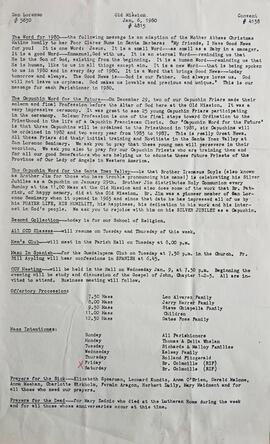
Bulletin from San Lorenzo Novitiate and Old Mission Santa Inés, serving as a parish newsletter outlining community announcements and regional Capuchin updates. It highlights a solemn profession ceremony held on 29 December 1979 involving 25 young Capuchin friars, outlining future ordination projections through 1987 and requesting prayers for the seminarians training in the Santa Ynez Valley. Additionally, it honours Brother Irenaeus Doyle OFM Cap. (Brother Jim), a pioneer member of San Lorenzo Seminary since 1965, on his upcoming Silver Jubilee as a Capuchin on 29 January. The page concludes with administrative assignments for the Sunday Offertory Procession, specific daily Mass intentions – notably marking the passing of Brother Colmcille Cregan OFM Cap.
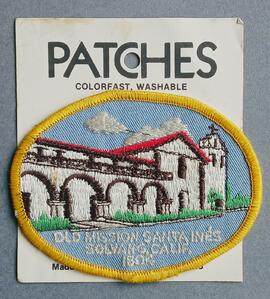
A souvenir embroidered patch attached to its original cardboard retail backing card. Stitched in light gray thread along the bottom foreground is the text: ‘OLD MISSION SANTA INES / SOLVANG, CALIF. / 1804’, commemorating the mission’s name, location, and founding year.
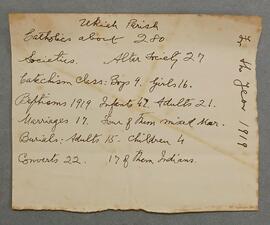
A demographic and sacramental summary of Ukiah Parish for the year 1919. It tracks a community of approximately 280 Catholics, detailing local church engagement through catechism attendance and Altar Society membership. The document refers to several parish events, including numbers for baptisms, marriages, burials, and 22 faith conversions, explicitly noting the inclusion of Indigenous community members.
A report providing a structural, financial, and demographic overview of the Catholic Ukiah Mission and surrounding out-stations. The document outlines the territorial boundaries and pastoral history of the mission under the administration of the Capuchin friars, listing its active churches and dependencies across regional stations like Hopland, Willits, and Covelo. Additionally, it details the mission’s financial standing – accounting for itemized receipts, expenditures, and bank balances – and compiles the exact census data and sacramental figures (baptisms, marriages, and conversions).
A clipping of an article reporting on the construction of St. Mary’s Church in Ukiah, California. On Saturday evening, Archbishop Edward Joseph Hanna of San Francisco will arrive to lay the building’s cornerstone. He will be accompanied by Monsignor Cantwell and Fr. Joseph Fenton OFM Cap., with a large class of candidates scheduled for confirmation on Sunday morning. Designed by architect Jos. A. Leonard, the new edifice is built of concrete and reinforced brick, replacing a smaller frame structure built in 1870. The estimated cost of the church is $25,000, though the true value is much higher due to extensive donations of building materials and labour from the community. Once completed around the end of October, it will feature handsome stained-glass windows, a large choir loft, and landscaped grounds. The local parish dates back to 1865, and this new, modern church is expected to be a lasting source of pride for both the congregation and the city. The clipping is taken from the ‘Ukiah Republican Press’ (13 June 1923).