Statement titled 'Partition' issued by the Pro-Treaty Government Publicity Department suggesting that Éamon de Valera 'was aware of the "Ulster" clauses of the Treaty long before the Treaty was signed, and that he made no protest; that he had assured Mr. Lloyd George that force would not be used against "Ulster" in order to bring the six counties into a United Ireland ...'.
The newspaper contains reports of Civil War hostilities and to the messages of sympathy which are still being received following the death (22 Aug. 1922) of Michael Collins.
The file comprises the following editions this weekly journal published by the Publicity Department of Dáil Eireann: 5 June 1922 (Vol. 1, no. 3) – 17 July 1922 (Vol. 1, no. 9). Printed in Dublin by Wood Printing Works, Fleet Street, and The Gaelic Press, 27 North Frederick Street, Dublin. There is some duplication of editions in the file and one undated edition [c. July 1922]. Most of the journal’s articles deal with cataloguing and detailing anti-Catholic riots in Belfast and in the rest of Northern Ireland.
Pamphlet titled 'Draft Constitution as approved by Dáil Eireann ... Stand by Ireland's Declaration of Independence and Social Justice / Vote "Yes" on July 1st'. The text contains the draft of the Fianna Fáil-drafted Irish constitution of 1937. Includes side-by-side Irish translation of the English text. The constitution was translated into Irish over a number of drafts by a group headed by Micheál Ó Gríobhta (assisted by Risteárd Ó Foghludha) from the Department of Education. Issued by the Director of Elections for and on behalf of Fianna Fáil candidates, 13 Upper Mount Street, Dublin.
The 'Irish Bulletin' was the official daily gazette of the government of the Irish Republic. The first edition of the 'Bulletin' appeared on 11 Nov. 1919 shortly after the suppression of the entire republican press. The purpose of the 'Bulletin' was succinctly stated in the edition of 11 Nov. 1920 (Vol. 6 No. 17). ‘When it became certain that the majority party in Ireland was not to be proclaimed “illegal” the "Bulletin" had of necessity to be published secretly. It was designed to circulate principally not in Ireland but among the publicists in England and on the Continent. At its inception less than fifty copies were printed. To-day it reaches almost every country in the world and is reprinted in four European languages. It is received by the press, public men, and the leading political and other organisations of many nations’.
The 'Bulletin' was published daily but weekly editions containing summaries of ‘acts of aggression committed in Ireland by the military and police of the usurping English government’ were also routinely circulated. These weekly summaries were not assigned volume or issue numbers. Daily issues consisted mainly of sometimes detailed lists of raids by British security forces and the arrests of republican suspects. Extracts from foreign publications and sometimes sympathetic English sources were also published in the 'Bulletin'. Accounts of the activities of Dáil Courts were likewise included. It was produced by the republican publicity department during the War of Independence, and its offices were located at 6 Harcourt Street, Dublin. On 26 Mar. 1921, after sixteen months of publication, the offices of the 'Bulletin' were raided. Later, forged issues of the journal were produced with printing machinery and paper captured in the offices. These fabricated issues were sent to all the usual addresses on the list of recipients, a copy of which had also been seized. Issues of these forged 'Bulletins' were subsequently circulated for over a month.
The paper’s first editor was Desmond Fitzgerald, until his arrest and replacement by Robert Erskine Childers. The collection includes a chronological record of peace overtures which would eventually lead to the Treaty negotiations. The issue of 7 Dec. 1921 (Vol. 6, No. 35) carried an ‘advance copy’ of the articles of agreement between Great Britain and Ireland, more commonly known as ‘The Treaty’. Many of the issues of the 'Irish Bulletin' are stamped ‘Official Copy’.

The file contains volume 2 of the 'Irish Bulletin'. The series is incomplete but multiple copies of some issues are extant:
7 May 1920. No. 5
28 May 1920. No. 19
1 June 1920. No. 21
2 June 1920. No. 22
4 June 1920. No. 24
14 June 1920. No. 31
7 July 1920. No. 46
8 July 1920. No. 47
22 July 1920. No. 57
23 July 1920. No. 58
26 July 1920. No. 59
4 Aug. 1920. No. 65
6 Aug. 1920. No. 67
7 Aug. 1920. (Weekly Summary: 2 copies)
9 Aug. 1920. No. 68
11 Aug. 1920. No. 70
13 Aug. 1920. No. 72
14 Aug. 1920. (Weekly Summary: 2 copies)
21 Aug. 1920. (Weekly Summary: 2 copies)
25 Aug. 1920. No. 80
28 Aug. 1920. (Weekly Summary: 2 copies)
31 Aug. 1920. No. 84
The file contains volume 4, 3 Jan. 1921 (No. 1)-31 May 1921 (No. 100) of the 'Irish Bulletin'. The series is complete with multiple copies of some issues.
An illustration by Grace Plunkett which appeared in ‘The Plain People / Na Daoine Macánta’ newspaper on 16 April 1922.
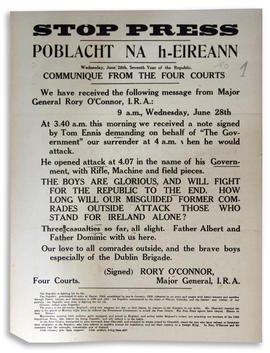
The file comprises the following editions: 28 June 1922 (no. 1) – 16 Mar. 1923 (no. 175). The series is missing a small number of editions but there are multiple copies of other issues extant in the file. The publication began with the attack on anti-treaty republicans in the Four Courts, and the publication focused on ways of conveying news of the changing situation to journalists, republican supporters and the general public. The first (un-numbered) edition was styled as a communiqué from Rory O’Connor, Major General, IRA. It read:
‘The boys are glorious, and will fight for their Republic to the end. How long will our misguided former comrades outside attack those who stand for Ireland alone?’ Reference is made in this first communiqué to Fr. Albert Bibby OFM Cap. and Fr. Dominic O’Connor OFM Cap. who were ministering to the besieged republicans.
The file comprises the following: an undated first edition of 'Freedom' containing an ‘extract from a letter from Rory O’Connor’ regarding the attack on the Free Courts; 17 Sept. 1922 (no edition number) with a portrait of Lawrence Ginnell by Constance Markievicz; 24 Sept. 1922 (No. 7) with a drawing of the ‘the branded arm of James O’Reilly sketched from life’ by Constance Markievicz; 22 Oct. 1922 (No. 11), 3 copies; Dec. 1922.