A studio photographic print of Fr. James Cullen SJ, a Jesuit priest, and the founder of the Pioneer Total Abstinence Association.
The text of a poem titled ‘Resurrection’ with an ink drawing of a prisoner cap labelled ‘The noblest crown an Irish head can wear’. The text was seemingly written by an Irish political prisoner in Lewes Prison in England. The text is signed with the initials ‘J.J.B.’.
A studio photograph of Terence MacSwiney signed by his sister Eithne (Annie) MacSwiney.
A telegram from Nora Ashe which reads ‘Prisoners all here. Frank [Fahy] in great form’. The telegram is most likely to addressed to Frank Fahy’s wife (Anna Fahy) in Tralee, County Kerry.
A postcard print of an image of a worshippers at a religious service to commemorate the centenary of Catholic emancipation held in the Phoenix Park in Dublin in June 1929. The image is credited to the 'Irish Independent'.
An illustration by Seán O’Connor (also known as John ‘Blimey’ O’Connor), a London-born republican prisoner at Tintown No. 3 Camp at the Curragh in County Kildare. The drawing is dated July 1923 and is titled ‘Frongoch’, a reference to the well-known internment camp in North Wales in which O’Connor and nearly two thousand Irish prisoners were detained following the 1916 Rising.
A postcard print of James Connolly. The caption reads ‘Commandant-General, Dublin Division / Executed May 9th 1916 / one of the signatories of the “Irish Republic Proclamation”’.
A postcard print of Major John MacBride. The print is credited to Keogh Brothers’ Studio.
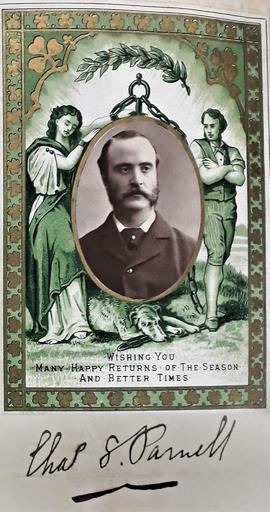
A Charles Stewart Parnell Christmas greeting card (with oval portrait print). Fr. Senan Moynihan OFM Cap. seemingly also obtained Parnell’s autograph slip which he afterwards laid into the volume underneath the card.
A pamphlet written by Laurence Ginnell (1854-1923) who opposed the Anglo-Irish Treaty that was ratified by the Dáil in January 1922. He was elected as an anti-Treaty Sinn Féin TD for the constituency of Longford-Westmeath at the 1922 general election on the eve of the Civil War. Imprint date based on p. 4. With typescript letter from Ginnell to the Most Rev. Edward Byrne, Archbishop of Dublin, referring to the ‘murder gang’ employed by the Free State Provisional Government. 14 Sept. 1922.