A clipping of an article reporting on the death of Eoin O’Duffy. The obituary was published in the ‘Irish Press’ (1 December 1944).
A handbill with the lyrics for ‘MacGuinness's March’. The item is an electoral propaganda leaflet produced for Joseph McGuinness in the South Longford by-election of 1917.
A clipping of a report on the assassination of Field Marshal Sir Henry Wilson by Irish republicans. The report is taken from ‘Country Life’ (1 July 1922).
A membership certificate for the ‘Wolfe Tone and Ninety Eight Memorial Association’. The document presents four scenes broadly connected with the 1798 rebellion with titles: ‘Cave Hill Compact, June 11th, 1795; Dublin, 23rd July, 1803; French Landing at Killala, August 22nd 1798; Foundation stone, National Memorial, S. Green Dublin, laid August 15th 1898’.
A report on a meeting of Irish socialists in the Mansion House, Dublin. The purpose of the meeting was to ‘congratulate the Russian people on the triumph they have won for democratic principles’. The speakers included Dr Kathleen Lynn, Constance Markievicz, William O’Brien, and Maud Gonne MacBride. The article reports that ‘The Red Flag’ was sung at the meeting. The article was published in the ‘Irish Times’ (5 February 1918).
A printed flier from Ailtirí na hAiséirghe (‘architects of resurrection’), a small Irish neo-fascist party. Includes references to the ideology of the party’s founder Gearóid Ó Cuinneagáin (1910-1991).
A clipping of a report on requiem mass for William ‘Willie’ Redmond held in the Church of St. Francis Xavier in Dublin. The article was published in the ‘Evening Telegraph’ (13 June 1917).
A copy print of an engraving of Patrick Sarsfield, 1st Earl of Lucan (c.1655-1693), an Irish Jacobite soldier. The source of the original print is not given but it likely dates to the mid-eighteenth century. A note states that the likeness of Sarsfield is derived from the ‘original picture in the possession of Sir Charles Bingham Bart. of Castlebar in the County of Mayo, in the Kingdom of Ireland’.
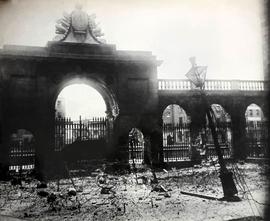
An image of the interior courtyard area of the Four Courts in Dublin following the attack on the building at the outset of the Civil War. A manuscript caption on the reverse of the print reads ‘Rebel garrison surrenders / Four Courts in flames after great explosion / Picture shows the barricade behind the inside gates after the surrender’. The republican forces occupying the Four Courts, commanded by Rory O’Connor, surrendered after two days of shelling by the National Army (28-30 June 1922).
A photographic print of individuals praying outside Brixton Prison in London during Terence MacSwiney’s hunger strike. The caption refers to the persons as ‘two Irish sympathizers’. The image is credited to Wide World Photos.