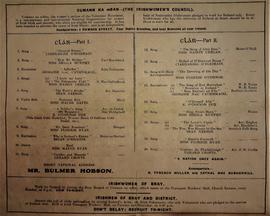
A programme for a concert organised by Cumann na mBan in Bray, County Wicklow. The date is not given but an accompanying note elsewhere in the volume suggests that the event was held just a few weeks before the 1916 Rising. Many of the performers in the concert were participants in the Rising. Douglas ffrench-Mullen (1892-1943) was a younger brother of Madeleine ffrench-Mullen, the well-known republican, feminist, and labour activist. He served in the South Dublin Union under Éamonn Ceannt during the Rising. He was wounded during the fighting and was detained initially in Richmond Barracks and later at Frongoch Camp in Wales. Ffrench-Mullen was released in September 1916. His fellow accompanist at the Bray concert was the Carlow-born Cathal Mac Dubhghaill (d. 1926). A talented musician and composer, he arranged the music for Peadar Kearney ‘A Soldier’s Song’ in its published form. He participated in the Rising and was afterwards interned at Frongoch Camp, where he illustrated several well-known sketchbooks. Gerard Crofts (1888-1934) was a poet and operatic singer. During the Rising, he served with Commandant William James Brennan-Whitmore in the General Post Office and in the final retreat to Moore Street. He was court-martialled and sentenced to ten years imprisonment but was released under the terms of a general amnesty in June 1917. Seosamh MacCathmhaoil (Joseph Campbell) was born in Belfast in 1879 and emerged as an influential poet and Irish music lyricist. He supported the Rising and was active as a non-combatant during Easter Week, performing rescue and first-aid work. In 1917, he published a translation from Irish of the short stories of Patrick Pearse. He died in County Wicklow in June 1944. (Volume page 190).
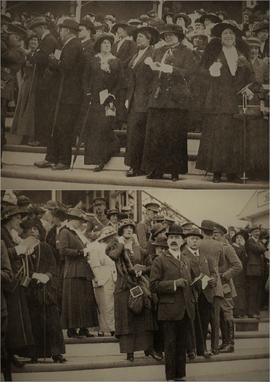
A clipping of two photographs showing the crowds in attendance at Leopardstown Racecourse in Dublin in May 1915. The images were published in the ‘Irish Life’ magazine (7 May 1915). The original captions read (upper) ‘In the front, Marchioness Conyngham consulting her programme, on her right Mrs Faudel Philips, and on her left Miss Beatrice Murphy and (lower) ‘In the members’ enclosure watching the start’. The ‘Marchioness Conyngham’ referred to in the caption is Frances Elizabeth Conyngham (1862-1939), the widow of Henry Francis Conyngham, 4th Marquess Conyngham (1857-1897), of Slane Castle in County Meath. Marchioness Conyngham’s eldest son, Victor George Conyngham (5th Marquess), was a lieutenant in the South Irish Horse, a cavalry battalion of the Royal Irish Regiment which was deployed to the Western Front during the Great War. He survived the fighting but was stricken with pneumonia in the trenches, and died on 9 November 1918, at the age of 35, just two days before the Armistice. He was chronologically the last of the forty-two British parliamentarians who died during the war (he sat in the House of Lords as an Irish Peer). (Volume page 197).
A clipping of an image of a crowd at a recruitment meeting in Macroom in County Cork. The image was published in the ‘Irish Life’ magazine (8 October 1915). (Volume page 202).
A clipping of a report of a speech by Nora Connolly, the daughter of James Connolly, in St. Andrew’s Hall in Glasgow. The article is taken from ‘Forward’, a Scottish socialist newspaper (18 October 1919).
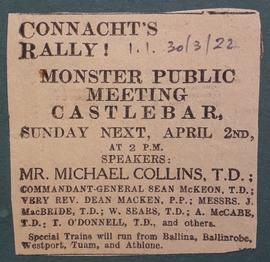
A clipping referring to a public demonstration in Castlebar, County Mayo, on 2 April 1922. The event included speeches by Michael Collins, Seán McKeon (Seán Mac Eoin), and Alexander McCabe (Alasdair Mac Caba). The article is taken from the 'Irish Independent' (30 March 1922).
Letter from Pádraig Ó Siochfhradha (‘An Seabhac’) to Fr. Senan Moynihan OFM Cap. and Fr. Gerald McCann OFM Cap.
A leaflet listing Irish republicans who died in English jails. The final line reads ‘What are you going to do?’ Manuscript annotation reads ‘9th March 1919’.
A leaflet promoting the Dáil Éireann loan and encouraging people to purchase government bonds to support the Irish Republic.
A flier with the text of a ballad satirizing the electoral reverses of John Redmond and the Irish Parliamentary Party at the hands of Sinn Féin.
A flier with the text of a ballad titled ‘A Recruiting Come-all-ye’. The ballad derides the recruitment of Irishmen into the British armed forces.