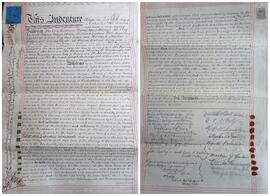
Assignment from Fr. Albert David Mitchell OSFC, Fr. Daniel Patrick O’Reilly OSFC, Fr. Michael Louis Hennessy OSFC, Fr. Goodwin Peter Augustine Lawless OSFC, North King Street, Dublin, and Fr. Stephen Bolger OSFC, Chester, to Fr. Pacificus Anthony Perucci OSFC, Chester, Fr. Simeon Gaudillot OSFC, Charlotte Quay, Cork, Fr. Joseph Martin Harkins OSFC, Fr. Thomas B. Kavanagh OSFC, North King Street, and Fr. Nicholas Maurice Murphy OSFC and Fr. Bernard Joseph Jennings OSFC, Charlotte Quay, of the residue of a lease dated 8 Mar. 1875 (CA HT/2/1/2/13) of premises on Charlotte Quay in consideration of 10s. Endorsed on title page: ‘Assignment of lease of Convent’.
The volume is titled ‘Cash account book of the Sisters of the Third Order of St. Francis attached to the Capuchin Convent, Walkin Street, Kilkenny, under the presidency of the Father Guardian, the Very Rev. Albert Mitchell OFSC’. The volume contains monthly debit and credit cash entries. Most of the income is derived from subscriptions, donations, and collections.
Correspondence of John George MacCarthy, solicitor, MP, 70 South Mall, Cork, with Fr. Albert Mitchell OSFC regarding the serving of notices to quit on tenants occupying premises on Tory Top Lane, Cork.
Epitome of deeds and leases relating to properties held by the Capuchins in Cork. The epitome commences with an abstract of a lease by John Lecky to Fr. Theobald Mathew OSFC on 2 Nov. 1832 (CA HT/2/1/2/10) and concludes with a summary of an assignment by Fr. Cherubim Mazzini OSFC and others to Fr. Albert Mitchell OSFC and others of all interest and claims on premises on Charlotte Quay and on Queen Street dated 8 Mar. 1875 (see CA HT/2/1/2/13). The volume also includes transcripts and notes taken from the ‘old account book of the Cork Friary’, covering the personnel, governance and history of the Order in Ireland (specifically in Cork) from 1836 to 1859. The original volume is extant at CA HT/3/1/1.
Report of the Halston Street Total Abstinence Sodality founded by Fr. Albert Mitchell OSFC in 1881. The report refers to the efforts to improve and renovate the Hall since the sodality took possession of the building. The report reads ‘When we took possession of this place it was in a very sad and forlorn condition, so dilapidated by time, and the many uses it was put to (I believe its last use was that of a blacksmith’s forge)’. The report also provides figures for income and expenditure. The figures read: debt: £35 7s 11½d; expenditure: £255 12 2½d. It also notes that the pledge has been given to over 1,000 men in the Hall and to over 900 in St. Michan’s Church, Halston Street. With a typescript copy of said report.
Flier for a Grand Bazaar to raise funds for the completion of the Church of St. Mary of the Angels, Church Street, Dublin. The prizes included: ‘30 fat sheep or £100 (1st); pony and phaeton or 50 guineas (2nd); Kerry cow’ (3rd); Diamond ring’ (4th); magnificent medallion, pure gold’ (5th); splendid Harp by Egan’ (6th).
The file also includes a flier for the ‘Lottery for the Marble Pulpit exhibited by the Operative Stonecutters’ Trade Association’, 1 May 1886 and a blank authorisation card for collectors for funds to pay off ‘the heavy debt on this Church and New Convent which is giving the Fathers much anxiety’. The card is authorised by Fr. Albert Mitchell OSFC. Another flier notes that ‘the new Church, which is now nearly completed, but over six thousand pounds in debt, is to be in every way worthy of being the temple of the Living God’. Reference is also made to the previous Capuchin chapel on the site: ‘The inhabitants of the neighbourhood are of the poorest class … at the ceremonies of religion in the old humble Church … the attendance of one thousand weekly attests the virtue of these poor Irish Catholics’. With a newspaper clipping from the 'Irish Press' referring to the discovery of a book of tickets for the said Grand Bazaar draw by Patrick Fitzsimons. The 'Irish Press' clipping is dated 20 October 1949.
Historical accounts written and compiled by Fr. Angelus Healy OFM Cap. documenting the foundation, establishment and early development of the Capuchin Franciscan Monastery of St Joseph at Rochestown, County Cork. Several accounts detail monastery’s origins and its significance within the history of the Irish Capuchin Province. They describe the acquisition of property at Rochestown in January 1873, including an eight-acre holding containing a farmhouse known as Brook Lodge, secured from Joseph Mintern, a Quaker landowner. The property was initially intended to provide a place of rest and recuperation for members of the Capuchin community resident in Cork.
Many of the accounts trace the subsequent development of the property into a religious foundation, including the adaptation of existing buildings, the construction of additional accommodation, the establishment of a resident community and the provision of facilities for religious worship. Particular attention is given to the complex administrative and jurisdictional relationship between the Irish and English Capuchin communities following the reorganisation of the Order in 1873. The accounts discuss the separation of the Irish and English houses, the transfer of responsibility for the Cork establishment, and the correspondence and disagreements involving the Minister General and senior members of the Order.
The narratives record the activities of several Capuchin friars associated with the establishment and administration of Rochestown, including Fr. Albert Mitchell OFM Cap., Custos, Fr. Patrick O’Reilly, Fr. Simon Gaudillot, Fr. Alphonsus Carroll and other members of the Irish and continental European communities. The manuscripts also document the development of the monastery’s religious life, including the reception of novices, professions, the appointment of superiors and the arrival of students from France.
Other notes detail the construction, furnishing and dedication of the monastery church in November 1878. This includes a description of its Gothic architectural character, internal arrangement, sanctuary, altars, sacristies, choir, furnishings and decorative features. One extract provides exact physical measurements and aesthetic descriptions of the newly built Gothic-style chapel (44 feet long, 34 feet wide, rising 46 feet to the apex). It specifies building details such as the polished pine altars, plain tinted glass windows in leaden frames, the red brick exterior, and total construction costs (£1,000) noting the architect and contractor was John Delaney.
Several notes refer to the administrative difficulties affecting the Irish Capuchin Custody in 1879. It describes the decree of 3 July 1879 suppressing the existing Custody and establishing separate administrative jurisdictions for Dublin and Kilkenny, and for Cork and Rochestown, together with restrictions on communication between their respective members.

Healy, Angelus, 1875-1953, Capuchin priestHistory of the Capuchin Friary, Father Mathew Quay, Cork, possibly compiled by Fr. Angelus Healy OFM Cap. The notes are described as incomplete, requiring ‘supplementation and possibly correction’. The first section deals briefly with the history of the Capuchins in Cork from 1620 to 1832. At page six Fr. Angelus traces the efforts made by the Capuchins to build a friary adjacent to Holy Trinity Church. This history is divided into distinct sections:
I. 1855: Very. Rev. Vincent McLeod OSFC, guardian.
II. 1866: Very. Rev. Edward Tommins OSFC, guardian. Includes an article from the Cork Examiner (24 Sept. 1866) referring to the laying of the foundation stone of a new friary. This project was later abandoned.
III. 18[ ]: Very Rev. Father Cherubin [Mazzini] OSFC, guardian.
IV. 1877: Very Rev. Father Thomas Sheehy OSFC, guardian.
V. 1878: Very Rev. Father Albert Mitchell OSFC, Custos-Provincial.
VI. 1879-1884: Very Rev. Father Simeon Gaudillot OSFC, Commissary General; Very Rev. Seraphim Van Damme of Bruges, Provincial Minister. (Includes an account from the Cork Examiner (10 June 1884) re the opening of the new Capuchin Friary.
Addenda: Historical notes re the Irish Capuchin Custody, the ‘dismemberment of the Irish Province’, the transfer of the Cork and Rochestown Friaries to the English Capuchin Province, and the re-creation in 1885 of the Irish Capuchin Province.
The final page consists of an incomplete obituary list of Cork Capuchins. The file includes copy typescript extracts from the volume.
Account book giving details of donations and collections for the Church Street Friars. Reference is made to the collections for vestments and to the sale of Adoration Cards (Oct. 1852). Information is given in respect of the name of the donator and the amount received. Reference is made to Fr. Daniel Patrick O’Reilly OSFC (d. 1894) and to Fr. Albert Mitchell OSFC (1826-1893). A short note re expenditure from January-February 1850 is made on the final the page including the payment of £8 8s for ‘rent for school’.
Indenture of assignment recording the transfer of the remaining interest in a long-term lease of land in the Parish of Carrigaline, Barony and County of Cork, between two expanded groups of Capuchin Franciscan friars, executing a transaction for a nominal sum of 10 shillings. The deed assigns approximately 8 acres of land in Rochestown, including the plantation of grown timber on its north side, tracing its root of title back to a foundational Indenture of Lease dated 9 January 1873 made between Joseph Mintern and the original four friars (including Father Cherubini Mazzini OFM Cap.) for a term of 850 years at an annual rent of £28 sterling.