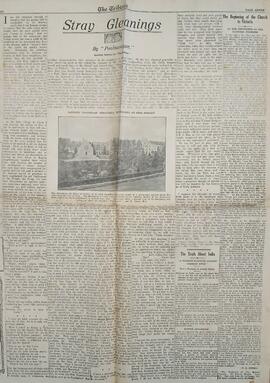
A clipping of an article titled ‘Stray Gleanings’ by ‘Poulnasagart’ [an anonymous Irish Capuchin] referring to Rochestown Capuchin Friary in County Cork. On the reverse is an article by Fr. James O’Mahony OFM Cap. titled ‘Intellectual Charity’. Published in ‘The Tribune’ (11 December 1924).
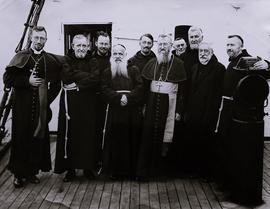
A photograph of Fr. Virgilio de Valstagna OFM Cap., Minister General, with a group of Irish friars on board a ship at Dún Laoghaire in County Dublin. The group includes Fr. Edwin Fitzgibbon OFM Cap., Fr. Eugene Carroll OFM Cap., Fr. Aloysius Travers OFM Cap., Monsignor Killian Flynn OFM Cap., Archbishop Sylvester Mulligan OFM Cap., and Fr. Charles Brophy OFM Cap.
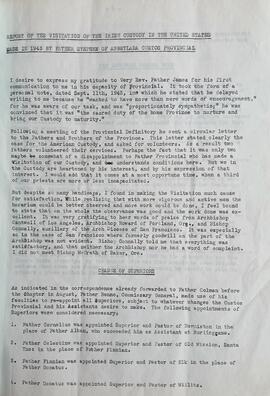
Canoncial visitation report compiled by Fr. Stephen Murtagh OFM Cap. for the Irish Capuchin custody in the United States. The report includes extensive commentary on the spiritual, physical and financial condition of various churches and friaries in Oregon, California, and Delaware. Father Murtagh expresses deep gratitude for a letter from Fr. James O’Mahony OFM Cap., Provincial Minister, who pledged the home province’s duty to nurture the American Custody toward maturity and successfully called for two Irish volunteers to reinforce the depleted American staff – a crucial intervention given that one-third of the custody’s priests were incapacitated. Despite these ongoing personnel shortages, the report records excellent spiritual observance and notes high praise from Archbishop Cantwell of Los Angeles and Archbishop Howard of Portland. Most notably, it records a major reconciliation in San Francisco, where Auxiliary Bishop Connally confirmed that previous administrative tensions had been completely resolved. The document also notes various personnel matters detailing the wartime reappointments of Father Cornelius to Hermiston, Father Celestine to Old Mission Santa Inés, Father Finnian to Elk, and Father Donatus to Willits.
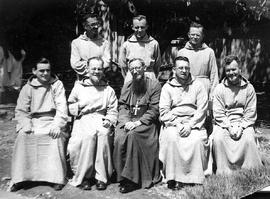
Photograph of a group of Capuchin friars taken on the occasion of a visitation by Fr. James O’Mahony OFM Cap. The group includes (standing) Fr. Fergus Lawless OFM Cap., Fr. Laurence Dowling OFM Cap., Fr. Conleth Killian OFM Cap.; (seated) Fr. Joseph Fenelon OFM Cap., Fr. Joseph O’Mahony OFM Cap., and Fr. Thomas Dowling OFM Cap.
A group of Capuchin friars in Livingstone. The group includes Bishop Timothy Phelim O’Shea OFM Cap., Fr. Albeus McQuillan OFM Cap., Fr. Salvator Quinn OFM Cap., Fr. Ultan Weldon OFM Cap., Fr. James O’Mahony OFM Cap., Provincial Minister, Fr. Alfred O’Mahony OFM Cap. and Fr. Capistran Singleton OFM Cap.
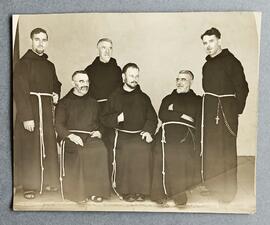
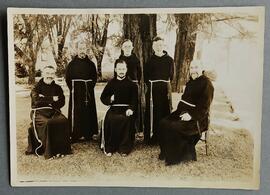
Photograph of a group of Capuchin friars in Ukiah, Californian probably on the occasion of a visitation by Fr. James O’Mahony OFM Cap. The group includes (seated) Fr. Joseph Fenelon OFM Cap., Fr. Berchmans Cantillon OFM Cap.; (standing) Fr. Celestine Quinlan OFM Cap., Fr. Stephen Murtagh OFM Cap. The photograph is credited to Detrick’s Studio, 106 W. Church Street, Ukiah, California.
A photograph of a group of Capuchin friars in the garden of the Church Street Friary in Dublin. The group includes Sylvester Mulligan OFM Cap., Archbishop of Delhi Simla, and Killian Flynn OFM Cap., Prefect Apostolic of Victoria Falls.
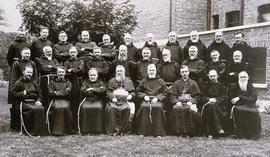
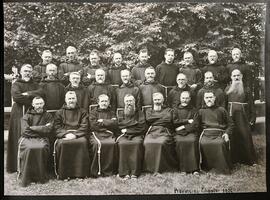
Photograph of Capuchin friars at the Provincial Chapter in St. Mary of the Angels, Church Street, Dublin.
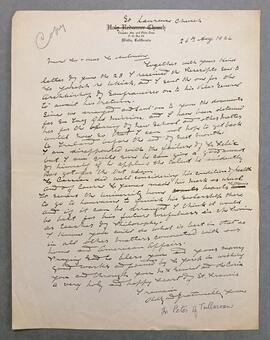
Copy letter from Fr. Peter Bowe OFM Cap., Provincial Minister, to Fr. Antonine Wilmer OFM Cap., Definitor General, regarding administrative and personnel matters within the Irish Capuchin mission. Father Peter acknowledges receiving legal documents (Rescripts) concerning the mission in Ukiah, California. He forwarded the documents intended for the Archbishop of San Francisco to his Vicar General to await the Archbishop’s return. He expresses disappointment over Fr. Felix’s failure in an exam but remains optimistic about his talents. Fr. Cassian performed well despite health issues.
Fr. James ‘made his mark as usual’ and wishes to go to Louvain (Belgium) to finish his scholarship. Fr. Peter supports this, believing it will prepare him to be a teacher of Philosophy for the Irish Capuchin Province.
Draft poetry by Daniel Laurence Kelleher (1883-1958) submitted for publication in 'The Capuchin Annual'. The file includes drafts of ‘Nietzsche’ (1924), ‘The forties of the Twentieth Century’, ‘Marie, do you remember?’, ‘Resurrection Morn’, ‘Question Mark’, ‘Travellers’ Tales’, ‘The Medallist’, ‘Loneliness’, ‘Decadence’, ‘Thistle’, ‘Return to Ireland, 1928’, ‘Sappho Spoke Our Name’, and ‘Three Thoughts for 1936’. The file also includes correspondence, draft articles, notes and newspaper articles written by Kelleher. Many of the drafts of stories are seemingly connected with Kelleher’s work for the Irish Tourist Association. Many relate to important historic personages associated with places around Ireland particularly in Dublin including Belvedere House, St. Stephen’s Green, Werburgh Street, Meath Street, Parnell Square, O’Connell Street, the Guinness Brewery and Dublin Castle. Other locations referred to include ‘Armagh City – First Impressions’ published in 'The Capuchin Annual' (1943), Limerick, Tory Island and Lough Derg. Many of the stories are written in a travelogue style and some may have been written with a view to publication in the 'Annual'. The correspondents include the Government Information Bureau, Fr. James O’Mahony OFM Cap., T.J. Kiernan, Frank Flynn, the Irish Tourist Association. The file includes the following items:
• Clipping from the 'Evening Telegraph' (2 Oct. 1915) of an article by Kelleher titled ‘The Colour of Cork’.
• Clipping of an article titled ‘A Picture of Dublin’. (1928).
• A story titled ‘Sir Kay the Senechal’.
• Draft story titled ‘Father was always like that’.
• An article titled ‘Adventures in Europe / The Great St. Bernard Monastery’.
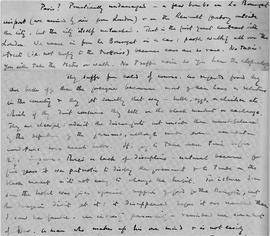
• Letters to Kelleher from Edward J. Phelan (1888-1967), the Director-General of the International Labour Organisation from 1941-8. Phelan’s letters date from 19 Feb. 1927 to 8 Jan. 1956. One of the letters (24 Dec. 1945) gives an eye-witness account of conditions in post-war Paris. See image of letter extract which reads:
‘Paris? Practically undamaged – a few bombs on Le Bourget airport (we arrived by air from London) and on the Renault factory outside the city, but the city itself untouched. That is the first great contrast with London. We came in from Le Bourget in a car: people walking all over the streets (i.e. not keeping to the trottoirs) because cars are so rare. No taxis: you either take the metro or walk. No traffic noise so you hear the clop-clop.
They suffer from cold of course. As regards food they are better off than the foreigner because most of them have a relative in the country and they get something that way – butter, eggs, a chicken etc which if they don’t consume they sell on the black market in exchange. They are cheerful; admit the discomforts but consider them counterbalanced by the departure of the Germans, although under German occupation conditions were much better. It’s going to take some time before things improve. There’s a lack of discipline – natural because for five years it was [a] patriotic duty to disobey the government and to trade on the black market and its not easy to change the habit. For instance I am sure the hotel was given special supplies of food for the delegates, but the delegates didn’t get it; it disappeared before it ever reached them. I saw de Gaulle. An interesting personality – reminded me somewhat of Dev [Éamon de Valera]: a man who makes up his own mind and is not easily [shifted when he has]'.