A collection of prints of Irish Capuchins in Zambia. Most of the prints have been annotated by Br. Hugh Davis OFM Cap. (1931-2016). The file includes:
• Fr. Benignus Buckley OFM Cap. and Patrick Mayengo ‘with the Litunga, Ilute Yeta’ at the Ngonye Falls (or Sioma Falls) on the Zambezi River in Western Zambia. June 1981.
• Fr. Philip Baxter OFM Cap. near the bridge crossing to Zimbabwe.
• Fr. Benignus Buckley OFM Cap. with Fr. Theophilus Murphy OFM Cap.
• Br. Gabriel McGillicuddy OFM Cap. with Fr. George O’Connor OFM Cap. and the Most. Rev. Donal R. Lamont, O. Carm., Bishop of Umtali, Zimbabwe.
• Exterior view of Mangango Church (built by Br. Gabriel McGillicuddy OFM Cap.).
• Group photograph of Fr. Benignus Buckley OFM Cap., Fr. Seán Cahill OFM Cap., Fr. Donat OFM Cap. (a Swiss friar), Fr. Theophilus Murphy OFM Cap. and others at St. Bonaventure’s, Lusaka.
• Fr. Patrick Lynch OFM Cap. and Fr. Donal O’Mahony OFM Cap.
• Br. Vianney Holmes OFM Cap., Fr. Benignus Buckley OFM Cap. and Fr. Theophilus Murphy OFM Cap.
• Fr. Noel Brennan OFM Cap. on the rope bridge built by the American Capuchins over the Zambezi River.
• Bishop Timothy Phelim O’Shea OFM Cap. with Fr. Benignus Buckley OFM Cap. at Lukulu.
• Br. Hugh Davis OFM Cap. (1931-2016) working as a welder with Sr. M. Matthew. It is noted that Sr. Matthew is from the Falls Road, Belfast.
• Br. Vianney Holmes OFM Cap. with Bishop Timothy Phelim O’Shea OFM Cap.
• A Capuchin friar and a religious sister waiting alongside an aircraft in Zambia.
Note: The file includes a cover letter to Fr. Richard Hendrick OFM Cap. (26 Jan. 2010).
Transcript of an interview with Senator Margaret Pearse (1878-1968), sister of Patrick and Willie Pearse, with Fr. Donal (Augustine) O’Mahony OFM Cap. and Fr. Fergus Lawless OFM Cap. in 1967. The interview refers to recollections of St. Enda’s School, her brothers, and various family members, priests, and other acquaintances.
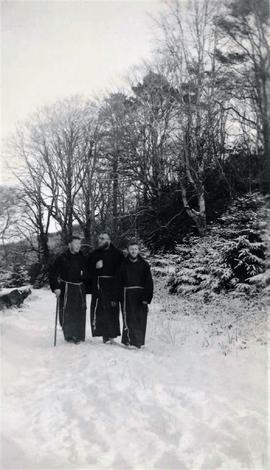
Bound volume containing photographic prints of student friars at the Ard Mhuire House of Studies. Some of the prints are captioned. The album includes images of student friars at work (potato harvesting, bailing hay and routine household work) and at recreation (theatrical plays, weekend retreats, sleighing on snow-covered hills, and visits to the beach). Locations visited by the friars include Burtonport, Errigal Mountain, Aranmore, Doe Castle, Fanad and Kindrum. The album contains several views of Ard Mhuire Friary (formerly Ards House) and surrounding gardens. A small number of prints show friars examining what appears to be un-exploded ordnance on the shoreline. Other prints show ordinations at Ard Mhuire in 1955. Fr. Eustace McSweeney OFM Cap. and Fr. Donal O’Mahony OFM Cap. are present in some of the prints.
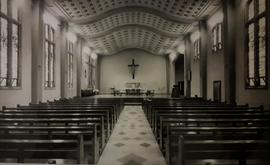
Photographic prints of the interior (and High Altar) of the Oratory in Ard Mhuire Capuchin Friary in County Donegal. The prints have annotations on the reverse: ‘Fr. Augustine [Donal] O’Mahony OFM Cap.’ and ‘A. O’Shea, Art Studios, Letterkenny’. The prints were probably for publication in 'Eirigh', an Irish Capuchin periodical.
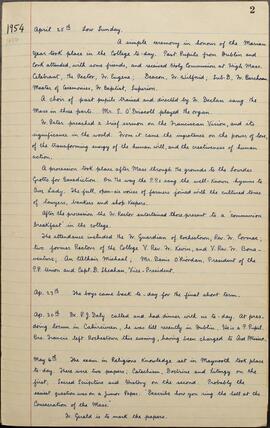
This institutional chronicle provides a historical record of the Capuchin Friary and the adjoining St. Francis College secondary school in Rochestown, County Cork. Functioning as both a chronicle and an academic registry, the volume offers a perspective on the ecclesiastical governance of the Capuchin community and the socio-educational life of the secondary school.
The initial section of the chronicle, spanning from April 1954 to July 1960, is composed in English and systematically documents the principal internal affairs of the friary alongside the activities of the college. Religious and administrative milestones are prominently featured, including the formal reception of novices, elections of the Provincial Minister, and routine personnel reassignments within the community. The record notes the campus visit of Frank Duff, founder of the Legion of Mary, on 24 October 1954, as well as regular Third Order fraternity assemblies. Academic and social life is represented through examination notices, meetings of the Past Pupils’ Union, and obituaries of distinguished alumni and faculty. Of particular importance is the detailed entry from 14 June 1958, which documents the re-interment of Fr. Albert Bibby OFM Cap. and Fr. Dominic O’Connor OFM Cap., two prominent Capuchin friars celebrated for their pastoral and political involvement in the Irish revolutionary period.
The subsequent era of the chronicle, covering the years 1973 to 1979, reflects a shift in both authorship and language. Compiled entirely in Irish by Fr. Pádraig Ó Cuill OFM Cap., this section focuses heavily on the internal administration of St. Francis College and the athletic achievements of its Gaelic Athletic Association (GAA) teams. Rather than relying solely on narrative entries, Fr. Ó Cuill extensively augmented the volume with contemporary press cuttings and photographic prints. These textual and visual inserts include earlier archival photographs of the college's Gaelic football teams from the late 1940s and early 1950s, alongside local press coverage, such as an ‘Evening Echo’ report from 23 November 1974, detailing the opening of a new science laboratory by senior past pupil Eamonn de Barra. Cultural and faculty profiles are also preserved, featuring a June 1977 ‘Evening Echo’ feature on a student exhibition and an ‘Irish Weekly Examiner’ profile of the arts and crafts instructor, Fr. Aengus Fegan OFM Cap.
The chronicle also reports on broader national history through media clippings that document the Capuchin community's involvement in contemporary political events. Notably, the volume preserves documentation regarding the diplomatic and pastoral role assumed by Fr. Donal O’Mahony OFM Cap. and his fellow friars during the high-profile 1975 Herrema kidnapping case. Finally, the physical and structural evolution of the Rochestown campus is updated via a subsequent addendum covering 1992 to 1995. This supplemental page explicitly notes the demolition of the old Marian Hall (formerly the Temperance Hall) during the summer of 1994, concluding the historical arc of a campus building that had remained vacant since 1989.