An image of Tomás MacCurtain (seated on the tractor) with a nationalist pipe and drum band at a demonstration of a Fordson tractor (manufactured locally by the American Ford Motor Company) in Cork in 1920. Fr. Dominic O’Connor OFM Cap. is among the crowd at the event.
The file contains the following editions of this illustrated weekly newspaper:
8 July 1922 (No. 4,342. Vol. 161); 15 July 1922 (4,343. Vol. 161). The editions contain numerous photographic prints of the fighting in Dublin at the outbreak of the Civil War. Includes a photograph of ‘Father Dominic [O'Connor OFM Cap.], who was reported to have been with the Rebels in the Four Courts’.
Statement of Masses for the Parish of Hermiston in the Diocese of Baker City, Oregon, covering the period from 1 November 1922, to 1 July 1925. The ledger tracks the fulfilment of Mass intentions (spiritual requests with associated stipends) by the Irish Capuchin friars: Total intentions received: 1,905 (including 62 carried over from 1922). The document is signed by Fr. Casimir Butler OFM Cap. and Fr. Dominic O’Connor OFM Cap.
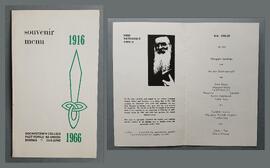
Commemorative souvenir booklet and menu produced for the Rochestown College Past Pupils’ Re-Union Dinner held on 26 June 1966. The text highlights Capuchin friars Father Albert and Father Dominic, who famously provided spiritual ministering to the insurgent forces in Dublin during Easter Week 1916. It also honours John Hayden of Blarney (Fr. Augustine), one of the college's original five pupils at its founding in Kilkenny in 1884, who served as college rector from 1896 to 1910 and similarly acted as a fearless chaplain to the fighting men in Dublin in 1916.
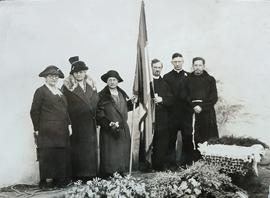
A photograph of Fr. Dominic O’Connor OFM Cap. and Sarah Mellows standing at the graveside of Fr. Albert Bibby OFM Cap. in Mission Santa Inés in California. Other individuals in the group include Fr. Stephen Murtagh OFM Cap., Rev. Paul Dillon, and Mary McWhorter.
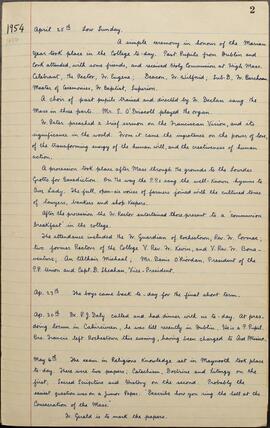
This institutional chronicle provides a historical record of the Capuchin Friary and the adjoining St. Francis College secondary school in Rochestown, County Cork. Functioning as both a chronicle and an academic registry, the volume offers a perspective on the ecclesiastical governance of the Capuchin community and the socio-educational life of the secondary school.
The initial section of the chronicle, spanning from April 1954 to July 1960, is composed in English and systematically documents the principal internal affairs of the friary alongside the activities of the college. Religious and administrative milestones are prominently featured, including the formal reception of novices, elections of the Provincial Minister, and routine personnel reassignments within the community. The record notes the campus visit of Frank Duff, founder of the Legion of Mary, on 24 October 1954, as well as regular Third Order fraternity assemblies. Academic and social life is represented through examination notices, meetings of the Past Pupils’ Union, and obituaries of distinguished alumni and faculty. Of particular importance is the detailed entry from 14 June 1958, which documents the re-interment of Fr. Albert Bibby OFM Cap. and Fr. Dominic O’Connor OFM Cap., two prominent Capuchin friars celebrated for their pastoral and political involvement in the Irish revolutionary period.
The subsequent era of the chronicle, covering the years 1973 to 1979, reflects a shift in both authorship and language. Compiled entirely in Irish by Fr. Pádraig Ó Cuill OFM Cap., this section focuses heavily on the internal administration of St. Francis College and the athletic achievements of its Gaelic Athletic Association (GAA) teams. Rather than relying solely on narrative entries, Fr. Ó Cuill extensively augmented the volume with contemporary press cuttings and photographic prints. These textual and visual inserts include earlier archival photographs of the college's Gaelic football teams from the late 1940s and early 1950s, alongside local press coverage, such as an ‘Evening Echo’ report from 23 November 1974, detailing the opening of a new science laboratory by senior past pupil Eamonn de Barra. Cultural and faculty profiles are also preserved, featuring a June 1977 ‘Evening Echo’ feature on a student exhibition and an ‘Irish Weekly Examiner’ profile of the arts and crafts instructor, Fr. Aengus Fegan OFM Cap.
The chronicle also reports on broader national history through media clippings that document the Capuchin community's involvement in contemporary political events. Notably, the volume preserves documentation regarding the diplomatic and pastoral role assumed by Fr. Donal O’Mahony OFM Cap. and his fellow friars during the high-profile 1975 Herrema kidnapping case. Finally, the physical and structural evolution of the Rochestown campus is updated via a subsequent addendum covering 1992 to 1995. This supplemental page explicitly notes the demolition of the old Marian Hall (formerly the Temperance Hall) during the summer of 1994, concluding the historical arc of a campus building that had remained vacant since 1989.

Following the deaths in exile of Fr. Albert Bibby OFM Cap. (d. 1925) and Fr. Dominic O’Connor OFM Cap. (d. 1935), there were numerous calls to have their bodies returned to Ireland. Prominent republican supporters in the United States and Old IRA men in Ireland frequently petitioned ecclesiastical authorities to have the bodies of the ‘two patriot priests’ repatriated. These calls were initially rejected, and the outbreak of the Second World War prompted a postponement of the campaign. In 1954, a repatriation committee was set up by Cork No. 1 Brigade of the Old IRA to collect the funds necessary to defray the expenses involved in returning the remains to Ireland. Florence O’Donoghue, head of intelligence for the Cork Brigade during the War of Independence, was appointed Honorary Secretary. Cornelius Neenan was appointed the Committee’s representative in the United States. Aside from the financial difficulties, the Committee also had to contend with a certain reluctance on behalf of the church authorities in having the bodies of two priests moved in such an overtly public manner. The reburial was a departure from the normal rule of the Capuchin Franciscan Order. Also, as they were priests, a high religious content would have to be included in any civil ceremonies connected with the repatriation. Having at length gained the approval of both the state and the church, the repatriation took place in 1958. On 13 June, the priests’ remains arrived at Shannon Airport to be greeted by Seán T. O’Kelly, President, Ėamon de Valera, Taoiseach, Fr. Hilary McDonagh OFM Cap., Capuchin Vicar Provincial, and many representatives of the Old IRA. The funeral cortege then proceeded to Cork for a requiem mass in Holy Trinity Capuchin Church. Fr. Albert and Fr. Dominic were interred in the cemetery attached to Rochestown Capuchin Friary on 14 June 1958. The sub-series consists of correspondence, newspaper clippings, printed ephemera and photographs connected with the reparation campaign and ceremony in 1958. The series also includes records relating to the unveiling of a memorial to the two priests on the grounds of the Capuchin Friary in Raheny, Dublin, by veterans of Fianna Éireann in 1959.
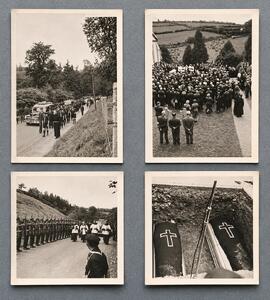
Eight black-and-white photographic prints depicting the repatriation and burial of Fr. Albert Bibby OFM Cap. and Fr. Dominic O’Connor OFM Cap. in the cemetery at Rochestown Friary, County Cork. One print is inscribed on the reverse: ‘Repatriation, 1958. Rochestown, left to right, Fr. Hilary McDonagh OFM Cap., Br. De Montfort Barron OFM Cap. (later Fr. Gerald Barron OFM Cap.), and Fr. Nessan Shaw OFM Cap.’
A compilation of recollections of Irish Capuchin friars compiled by an unknown author (but certainly written by another friar). The text contains miscellaneous remembrances and accounts of several friars including:
Fr. Laurence Dowling OFM Cap.
Fr. Cassian O’Shea OFM Cap.
Fr. Dermot O’Reilly OFM Cap.
‘The National Friars’ (Fr. Albert Bibby OFM Cap. and Fr. Dominic O’Connor OFM Cap.). Includes the text of a ‘short talk broadcast (in both news bulletins) by Fr. Michael O’Shea OFM Cap., from Saorstát Stations, October 18th’).
Fr. Matthew O’Connor OFM Cap.
Fr. Senan Moynihan OFM Cap. (references his editorship of ‘The Capuchin Annual’ and outlines his routine in terms of managing the publication and his several notable acquaintances).
Fr. Canice Bourke OFM Cap.
Fr. Maurice Dowd OFM Cap.
The second half of the volume appears to contain the texts of sermons or possibly retreat notes.
Draft recollections of deceased Irish Capuchin friars compiled by an unknown author (but certainly by another friar). The texts are titled ‘Some who have gone before’ and ‘Predecessors / A Capuchin Reverie’. The text includes personal recollections of:
Fr. Leonard Brophy OFM Cap. (1869-1930)
Fr. Albert Bibby OFM Cap. (1877-1925)
Fr. Matthew O’Connor OFM Cap. (d. 27 Apr. 1930)
Br. Felix Harte OFM Cap. (d. 11 Jan. 1935)
Fr. Fidelis Neary OFM Cap. (d. 22 June 1932)
Fr. Sebastian O’Brien OFM Cap. (1867-1931)
Fr. Paul Neary OFM Cap. (d. 20 June 1939)
The text also refers to several friars who have been given pseudonyms such as ‘Philemon’, ‘Junius’, and ‘Marcion’. The text includes references to Fr. Albert’s role in the 1916 Rising and in the later revolutionary period. It reads: ‘He felt, as few did, the piercing griefs of the young widows of Easter Week. Often would he visit them of an evening. … He made friends with the wistful little son and daughter who were orphaned by the bullets that took [Thomas] MacDonagh’s life away, and who were made motherless by the cruel waves that closed over the drowning body of the patriot’s bride [Muriel MacDonagh drowned in the sea off Skerries, County Dublin, on 9 July 1917]. For them he had a special corner in his affections. All his heart went out to that wee pair, so tragic, so utterly lonely’. The file also includes an attached clipping referring to the re-interment of the bodies of Fr. Albert Bibby OFM Cap. and Fr. Dominic O’Connor OFM Cap. in Rochestown Capuchin Cemetery on 14 June 1958