Showing 58 results

Archival description
43 results with digital objects Show results with digital objects
IE CA CP/3/197/378 · Item · c.1922
Part of Irish Capuchin Archives

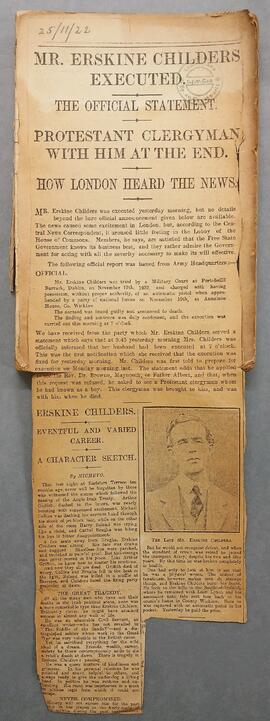
A copy of Erskine Childers, ‘The riddle of the sands / a record of the secret service’ (London: George Newnes Limited, [c.1922]). A newspaper clipping of an article reporting on the execution of Erskine Childers in Beggars Bush Barracks in Dublin (24 November 1922) is pasted into the front of the volume. The clipping is seemingly taken from the (London) ‘Herald’ (25 November 1922). The article refers to the request made by Childers to see Fr. Albert Bibby OFM Cap. before his execution.

The Kilkenny Moderator
IE CA KK/11/6 · Item · 1 Jan. 1868
Part of Irish Capuchin Archives

The file contains the following edition of this local newspaper: 1 Jan. 1868 (No. 68,857). The edition has a manuscript annotation ‘Mr. Bibby’ referring to an article by Rev. Wm. Andrews titled ‘Roman Catholic Proselytism’.

IE CA KK/11/4 · File · 21 Mar. 1863-28 Dec. 1867
Part of Irish Capuchin Archives

The file contains the following editions of this newspaper published in Kilkenny:
21 Mar. 1863 (Vol. XXXIV, No. 3,343)
27 Dec. 1867 (Vol. XXXVIII, No. 3,391)
The latter edition has a manuscript annotation ‘Mr. Bibby’ referring to an article penned by ‘the nephew alluded to’ relating to the presence of a Catholic clergyman at his uncle’s bedside during his final illness.

Terentii Afri … Comoediae
IE CA KK/10/1 · Item · 1552
Part of Irish Capuchin Archives

Date: 1552
Author: Terence (195/185-159 BC), [var. Publius Terentius Afer]
Publisher: Parisiis, Apud Ioannem de Roigny
Full title: 'P. Terenti Afri poetae lepidissimi, Comœdiæ: Andria, Evnvchvs, Heavtontimorvmenos, Adelphi, Hecyra, Phormio: ex emendatissimis ac fide dignissimis codicibus summa diligentia castigatæ, versibus in suas dimensiones restitutis, ac variis lectionibus in margine appositis ...: omnium quæ in his interpretum commentariis explicantur, index locupletissimus'.
Physical description: Text surrounded by commentary. The commentators are Philipp Melanchthon, Desiderius Erasmus, Antonius Goveanus, Julius Caesar Scaliger, Vittore Fausto, Pietro Bembo, Aelius Donatus, Giovanni Calfurnio, Adriaan van Baerland, Bartholomaeus Latonius, Pietro Marso, Johann Rivius, Etienne Dolet, Henricus Glareanus, Joannes Theodoricus Bellovacensis and Jodocus Willich; numerous small woodcuts, some repeated, within text (R. Brun, 'Le Livre illustré en France au XVIe siècle', p. 310).

IE CA MR/1/2/2/4 · Item · 1906
Part of Irish Capuchin Archives

Report by Fr. Albert Bibby OSFC on temperance missions from Oct.-Dec. 1906. The report includes the location of the mission, information on the success (or otherwise) of the preaching including the numbers taking the pledge and the general state of the temperance cause in the locality. The locations include Ballyforan, Ballygar, Louisburgh and Clare Island. The report on Ballygar, County Galway (where a mission was held from 2-16 Dec 1906) reads as follows: ‘Nearly all the heads of families took a pledge not to give intoxicating drinks at funerals or wakes or American wakes (held on night previous to some member of family going to America) whilst all others promised not to accept drink on these occasions’. The ‘American Wake’, sometimes referred to as the ‘Live Wake’, was a unique leave-taking ceremony for rural Irish people travelling to the United States. ‘American Wakes’ took place prior to the Great Famine, but most of the documentary evidence survives from the late 1800s and early 1900s. It was most commonly practiced in counties along the western seaboard where traditional customs remained most potent. Usually held on the evening prior to an emigrant's departure, the ‘American Wake’ resembled its ceremonial model, the traditional wake for the dead. It represented a permanent breaking of earthly ties for people who regarded emigration as death’s equivalent.

IE CA IR-1/9 · Series · 1935-1981
Part of Irish Capuchin Archives

Following the deaths in exile of Fr. Albert Bibby OFM Cap. (d. 1925) and Fr. Dominic O’Connor OFM Cap. (d. 1935), there were numerous calls to have their bodies returned to Ireland. Prominent republican supporters in the United States and Old IRA men in Ireland frequently petitioned ecclesiastical authorities to have the bodies of the ‘two patriot priests’ repatriated. These calls were initially rejected, and the outbreak of the Second World War prompted a postponement of the campaign. In 1954, a repatriation committee was set up by Cork No. 1 Brigade of the Old IRA to collect the funds necessary to defray the expenses involved in returning the remains to Ireland. Florence O’Donoghue, head of intelligence for the Cork Brigade during the War of Independence, was appointed Honorary Secretary. Cornelius Neenan was appointed the Committee’s representative in the United States. Aside from the financial difficulties, the Committee also had to contend with a certain reluctance on behalf of the church authorities in having the bodies of two priests moved in such an overtly public manner. The reburial was a departure from the normal rule of the Capuchin Franciscan Order. Also, as they were priests, a high religious content would have to be included in any civil ceremonies connected with the repatriation. Having at length gained the approval of both the state and the church, the repatriation took place in 1958. On 13 June, the priests’ remains arrived at Shannon Airport to be greeted by Seán T. O’Kelly, President, Ėamon de Valera, Taoiseach, Fr. Hilary McDonagh OFM Cap., Capuchin Vicar Provincial, and many representatives of the Old IRA. The funeral cortege then proceeded to Cork for a requiem mass in Holy Trinity Capuchin Church. Fr. Albert and Fr. Dominic were interred in the cemetery attached to Rochestown Capuchin Friary on 14 June 1958. The sub-series consists of correspondence, newspaper clippings, printed ephemera and photographs connected with the reparation campaign and ceremony in 1958. The series also includes records relating to the unveiling of a memorial to the two priests on the grounds of the Capuchin Friary in Raheny, Dublin, by veterans of Fianna Éireann in 1959.