
- demo user
- Familia
- 1700-2020

Mostrando 277 resultados
Registro de autoridad- blackrock
- Entidad colectiva
- 1900-2020
- Vtest
- Entidad colectiva
- 1600-2020
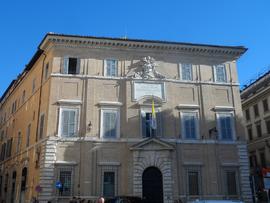
Sacra Congregatio de Propaganda Fide
- VA/SCPF
- Entidad colectiva
- 1622-2023
The Sacred Congregation de Propaganda Fide, whose official title is "sacra congregatio christiano nomini propagando" is the department of the pontifical administration charged with the spread of Catholicism and with the regulation of ecclesiastical affairs in non-Catholic countries. The intrinsic importance of its duties and the extraordinary extent of its authority and of the territory under its jurisdiction have caused the cardinal prefect of Propaganda to be known as the "red pope".
Sisters of St. Joseph of Chambery Auth Rec
- SJCH
- Entidad colectiva
- 1939- present
The Sisters of St. Joseph Chambery arrived in Wales from India in 1939. In 1958 they founded a house in Dublin at the invitation of Archbishop John Charles McQuaid.
This is the current site of St. Josephs hospital, Raheny. They sold this hospital in 1997, but still maintain a convent on the same site.
In 1977 they also bought a house for the purposes of supporting a novitiate, but sold this in 2005.
- RM/SCR
- Entidad colectiva
- 1588-1969
The Sacred Congregation of Rites was a congregation of the Roman Curia, erected on 22 January 1588 by Pope Sixtus V by Immensa Aeterni Dei; it had its functions reassigned by Pope Paul VI on 8 May 1969.
The Congregation was charged with the supervision of the liturgy, the dispensation of the decrees of Canonical coronations, other various sacraments, and the process of canonization of saints.
- RM/BK
- Persona
- 21 March 1887 – 20 October 1962
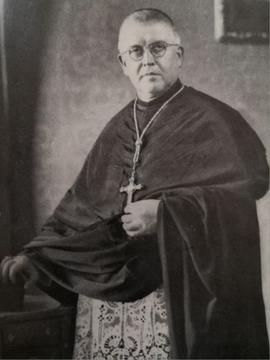
Josef Martin Kälin was born in Einsiedeln, Switzerland, on 22 March 1887. His parents were Josef Martin & Anna Verena (née Schön) Kälin. His father was a timber merchant and the family sought to educate all their children. From 1899 to 1907 he attended the high school located at Einsiedeln Abbey. He then entered the monastic life at Muri-Gries Abbey in northern Italy in 1908 and made his religious profession on 5 October 1909 being given the name "Bernard." He continued his education in the fields of Philosophy and Theology at the University of Freiburg and was ordained a Roman Catholic priest on 18 October 1912. He continued his studies at the same university receiving a doctorate in philosophy in 1918 with a dissertation on the Epistemology of Saint Augustine entitled "Die Erkenntnislehre des hl. Augustinus." Between the years 1913-1945 Kälin taught at Kantonsschule Obwalden overseen by the Benedictines, serving as teacher and rector of the school. During this time, he wrote a number of philosophy textbooks that became popular.
On 10 August 1945 Kälin was elected as the Abbot of Muri-Gries Abbey and received his blessing on 13 August 1945. He served in the role for only two years until he was elected as the third Abbot Primate of the Benedictine Confederation and Order of St. Benedict on 16 September 1947. As Abbot Primate he resided in Rome, Italy, while also overseeing Sant'Anselmo all'Aventino. He traveled quite extensively in his role as Abbot Primate, but was also instrumental in his work at the Pontificio Ateneo Sant'Anselmo where he founded a monastic institute, taught philosophy, and redesigned the Church of Sant'Anselmo. He served in this role until 1959 when he was not reelected as Abbot Primate, at which point he returned to Muri-Gries Abbey where he died on 20 October 1962.
- PC
- Familia
- 1642-2024
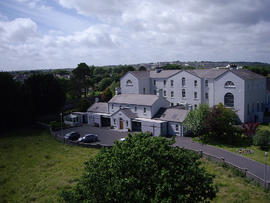
In the early 17th century, as a result of continued persecution of Catholics, it was illegal for women to train in Ireland as religious so many opted to travel to Spanish Flanders, France or Spain in order to fulfill their calling. This was the case with the foremothers of our community. They travelled to the Poor Clare monastery in Gravelines, then in the territory of Spanish Flanders, modern-day Northern France. Some of them had brothers who were already Franciscans in the Irish Franciscan College in Louvain. That college had been founded in 1607.
The Poor Clare monastery of Gravelines was founded in 1609 to provide a house for English women who wished to become Poor Clares.As the Irish friars were already established in Louvain they provided spiritual assistance to this monastery before their Irish sisters arrived. Our foremothers joined this community in the early 1620s and by 1626, they numbered five sisters. In that same year on the 20th of May they left the Gravelines community and set out to found a separate house specifically for Irish women in the neighbouring town of Dunkirk. As circumstances changed they eventually decided to return to Ireland in 1629 now numbering seven. After a short period in Dublin they eventually settled in a rural part of Co. Westmeath not far from Athlone. The monastery was appropriately called 'Bethlehem' to emphasise the central focus of Franciscan spirituality, namely the poverty and humility of the Son of God in taking on our human flesh and becoming one with us in the Incarnation.
As the number of women joining the community grew daughter houses were established in Galway, Drogheda, Athlone and Wexford.
We thank God for the life and witness of our sisters and for their faith, courage and dedication to Christ and His holy Mother after the example of St. Francis and St. Clare. We pray that whatever our state in life, we may be faithful to God as they were and that our lives may bear great fruit as theirs did.
This year, 2022, marks the 400th anniversary of the solemn profession of blood sisters Cecily and Eleanor Dillon on the 8th of September 1622. . Sr. Cecily was the Abbess of Bethlehem monastery, the motherhouse of our Galway monastery at the time that the foundation was made in 1642.
- PB
- Entidad colectiva
- 1795-2021
The Presentation Brothers are an international, Catholic congregation of religious brothers, founded in 1802 by Blessed Edmund Rice in Waterford, Ireland. The expressed mission of the Presentation Brothers is to "form Christ in the Young" and traditionally they have worked to achieve this through education.
Edmund Rice was born in the townland of Westcourt near the village of Callan in County Kilkenny on 1 June 1762. His parents, Robert Rice and Margaret Tierney Murphy, were prosperous farmers. At the age of 17, Rice was apprenticed to his uncle, Michael Rice, in Waterford city. Several years later, Edmund’s uncle signed the business over to him and Edmund began to invest his growing fortune in land and property. At the age of 25, Edmund married Mary Elliott but, sadly, Mary died in January 1789 following a horse-riding accident. Edmund and Mary had a daughter who was also called Mary.
After his wife’s death, Rice became more religious and he developed a devotion to St. Teresa of Avila. He also became involved in charitable works and regularly visited the poor of Waterford providing financial assistance to those in need. In 1798, Edmund helped the Presentation Sisters open a convent and school for girls in Waterford. Rice decided to try something similar for young boys, and in 1800 he began to teach youngsters at his business premises in Barronstrand Street with the assistance of some volunteers. The following year, Rice converted some stables on New Street into a makeshift school. His friends and colleagues described it as an act of "mad folly". Two men, Patrick Grosvenor and Patrick Finn, arrived to help. The three men lived above the school where they prayed together and shared their possessions. This school would go on to be known as Mount Sion Primary School which exists to this day.
Between 1802, when he opened his first school and 1808, Rice gathered around him a group of companions to help him in his work. These first Brothers took their vows on 15th August 1808 in the chapel of the Presentation Convent, Waterford, and together they became known as the Society of the Presentation. They lived their religious life based on the Rule of the Presentation Sisters (founded by the Venerable Nano Nagle in 1775), adapted for men. The Presentation Rule defined the new institute as a diocesan institute. This meant that, initially in Waterford, and later on in other dioceses where the Brothers worked, the local Bishop was their Superior. Unlike institutes of pontifical rite, the new religious institute had no Superior General of its own.
As the work of Edmund Rice expanded to Dublin, Cork and other Irish cities and towns, a need for central planning and direction emerged in the developing educational mission of the Brothers. From 1817 onwards, Edmund Rice began to consider adopting a constitution along the lines of that used by the Brothers of the Christian Schools in France. The De La Salle Brothers were an institute of pontifical rite, and had their own Superior General and elected administration. They were, to a great extent, independent of local bishops and this gave them great freedom in the development and expansion of their work. Rice felt that the Presentation Rule had served the group well in its early years, but Rome would only grant his group pontifical status if they adopted a pontifical rule already in existence. He decided to propose to his Brothers that the group should adopt a new De La Salle style rule. Controversy and debate ensued over a number of years and ultimately led to a division within the group. The vast majority of the Brothers ultimately accepted the adoption of a rule along the lines of that used by the Brothers of the Christian Schools in France. A minority of two continued to live the Presentation Rule and remained under the jurisdiction of their local bishops. The majority, known as the Christian Brothers since 1822, elected Edmund Rice as their first Superior General. The group experienced considerable expansion and development during the following decades.
Of the two Brothers who chose to remain with the Presentation Rule, Brother John Ignatius Mulcahy taught at a school in Cappoquin, County Waterford until his death in 1845. He was not joined by any followers. The second Brother, Michael Augustine Riordan of Cork, was joined by a number of followers and continued to follow the Presentation rule.
Brother Michael Augustine Riordan had entered the North Monastery in Cork in 1814 (there had been a community of Brothers in Cork since 1811; Brother Jerome O'Connor and Brother John Baptist Leonard founded the Peacock Lane Monastery, also known as the North Presentation Monastery, and were given charge of the Cork Charitable Society’s North School off Chapel Lane by the Bishop of Cork, Dr Francis Moylan). There had been considerable division in the North Monastery concerning the acceptance of the new rule over a number of years. An architect by profession, Riordan had helped in the building of many Cork churches before his entrance to the Brothers. His personal sense of loyalty to the then Bishop of Cork, John Murphy, greatly influenced his decision to remain with the Presentation Rule. In 1827, with the support of Bishop Murphy, he left the North Monastery and was given a house in Douglas Street, on the south side of the city. This became known as the South Monastery and Brother Riordan was joined there by some companions who lived as Presentation Brothers under the jurisdiction of the Bishop of Cork.
The Brothers began to conduct two schools in the city, one in the South Monastery itself, another a Lancasterian School on Great George's Street, today known as Washington Street. Thus, Brother Riordan played a pivotal role in the survival of the Institute of Presentation Brothers who would continue to live the original rule chosen by Edmund Rice and his early companions.
The Presentation Brothers continued their work in the Cork schools and expanded to Kerry in 1838. A foundation was made in Deptford, England in 1876 and in Birr, Co. Offaly, in 1879. By the 1870s however, a new younger group of Brothers began to address the issue of diocesan versus central control. As various types of schools were founded in diverse places, it became obvious that the Presentation Congregation should develop from its present diocesan status to being an institute of pontifical rite. In 1874, the Bishops of Cork and Kerry, on behalf of the Brothers, requested Rome to grant pontifical approval to the Presentation Institute. A Decree was received from Rome in the same year granting temporary approvaI. In 1885, the Presentation Brothers submitted a petition to Rome requesting its approval for a central government for the Presentation Institute under its own Superior General. By 1889, Rome granted temporary approval and final approbation came ten years later in 1899.
Throughout these developments, the Brothers retained the original Presentation Rule. Changes were inserted however to allow for a central government under a superior general and council. The first formal general chapter of the Brothers of the Presentation Institute was held in the South Monastery Cork in July 1889. Brother Patrick Shine was elected superior general and with him four assistants to help in the government of the Congregation.
The number of communities and schools established and managed by the Presentation Brothers greatly increased in the subsequent decades, both in Ireland (including Cork, Cobh, Kinsale, Bray, Dungannon, Enniskillen, Carrick-on-Shannon, Boyle, Letterkenny) and overseas (including Canada, USA, Ghana, Nigeria, Barbados, Grenada, St Lucia, Trinidad and Tobago, Peru, and Slovakia).
The Presentation Brothers have a presence in a number of these locations to the present day, and continue to work in the area of education as well as a wider range of ministries including with the homeless, elderly, disadvantaged youth and the Roma people.
Much of this history of the Presentation Brothers was sourced from 'The Contribution of the Presentation Brothers to Irish Education 1960-1998: A Study of a Roman Catholic Religious Teaching Institute in a Time of Change and Transition', a PhD thesis written and submitted to the University of Hull by Br Michael Martin Kenneally.
Dominican Order, Irish Province
- OP
- Entidad colectiva
- 1216-2023
Resultados 1 a 10 de 277