Showing 222 results

Authority record
IE CA DB/AOR · Person · 11 September 1894-8 December 1959

Early Life and Religious Formation
Daniel O’Reilly was born on 11 September 1894, on Walkin (now Friary) Street, Kilkenny, Ireland, to Patrick O’Reilly and Kate O’Reilly (née Cross). He entered the Capuchin Franciscan Order, receiving the religious name Aidan upon his investiture on 17 September 1911. He pronounced his simple vows on 17 September 1912, and made his solemn, perpetual profession on 8 July 1916. Parallel to his religious formation, he pursued higher education and graduated with a Bachelor of Arts degree in 1915. He was ordained to the priesthood on 3 May 1918.

Missionary Assignment and Ministry in the United States
Following his ordination, Father O’Reilly spent his initial years in Ireland before emigrating to the United States in 1921 to join the American mission field. His subsequent ministry was centred across several notable Pacific Coast foundations:

• Los Angeles, California: Dedicated most of his provincial career to parochial ministry at St. Francis of Assisi Parish near Sunset Boulevard.
• Solvang, California: Appointed Pastor of Old Mission Santa Inés in 1936, directing the historic parish for a multi-year tenure.
• Burlingame, California: Assigned in 1959 to assist the community of friars at Our Lady of Angels Parish during his final year of life.

Throughout most of his life, Father O’Reilly suffered from a succession of chronic illnesses. On 7 December 1959 (the eve of the Feast of the Immaculate Conception) he was noted by his community to be in excellent spirits. He retired early to his room in preparation to celebrate the 8:00 a.m. scheduled public Mass the following morning. Sometime during the early morning hours of 8 December 1959, he passed away quietly in his sleep at the age of sixty-five. He was buried in Burlingame near San Francisco in California.

Religious name: Fr. Aidan O’Reilly OFM Cap.
Baptismal name: Daniel O’Reilly
Date of birth: 11 Sept. 1894
Place of birth: Walkin (now Friary) Street, Kilkenny
Name of father: Patrick O’Reilly
Name of mother: Kate O’Reilly (née Cross)
Date of reception into the Capuchin Order: 17 Sept. 1911
Date of first profession: 17 Sept. 1912
Date of final (solemn) profession: 8 July 1916
Date of ordination (as priest): 3 May 1918
Educational attainments: BA (1915)
Missionary activities: Travelled to the United States in 1921
Date of death: 8 Dec. 1959
Place of burial: Burlingame, California

IE CA DB/HON · Person · 7 February 1925-16 September 1973

Baptismal name: Francis O’Neill
Religious name: Fr. Honorius O’Neill OFM Cap.
Date of birth: 7 February 1925
Place of birth: Dublin
Name of father: Andrew O’Neill
Name of mother: Margaret O’Neill (née O’Connell)
Date of reception into the Capuchin Order: 24 Oct. 1944
Date of first profession: 25 Oct. 1945
Date of final profession: 25 Oct. 1948
Date of ordination (as priest): 12 June 1952
Educational attainments: BA (1948)
Missionary activities: Travelled to Cape Town, South Africa, on 11 Sept. 1957
Date of death: 16 Sept. 1973
Place of death: St. Mary of the Angels Friary, Athlone, Cape Town, South Africa
Place of burial: Maitland Cemetery, Cape Town, South Africa

IE CA DB/86 · Person · 6 April 1897-31 July 1962

Edward O’Mahony was born in Mitchelstown in County Cork on 4 April 1897. He attended the Seraphic College in Rochestown in County Cork and joined the Capuchin Order in October 1913 taking James as his religious name. He graduated with a first-class honours BA from University College Cork and was awarded the Pierce Malone scholarship in 1918. He later obtained an MA and was awarded a travelling scholarship in 1920. He attended the Catholic University of Louvain (Leuven) in Belgium and was awarded a highly acclaimed Licentiate in Philosophy in 1925 and a Doctorate in the following year. In 1928 he was awarded the title of Professor Agrégé from Louvain, the first Irishman to achieve such a distinction. On his return to Ireland, he was appointed superior of St. Bonaventure’s Hostel in Cork and was reappointed on several occasions thereafter. In 1931 the National University of Ireland conferred on him a Doctorate of Letters (D.Litt.) for his thesis ‘The Desire of God in the Philosophy of St. Thomas’. In the same year he was appointed a lecturer in religion in UCC. In 1933 he was appointed Assistant Professor of Philosophy, eventually succeeding Fr. Edwin Fitzgibbon OFM Cap. as Professor and head of the university’s philosophy department in 1937. He was first elected Provincial Definitor (Councillor) in 1934 and was elected Provincial Minister of the Irish Capuchins in at the Chapter held in 1943. He was re-elected for a further three years from 1946 to 1949 and held the position again from 1955 to 1961. He was appointed a member of the senate of the National University of Ireland in 1946 and was briefly Acting-President of UCC in 1954. An accomplished lecturer, preacher, and writer, he published over twenty books and contributed numerous articles to various journals on a variety of philosophical and religious subjects. His published works included ‘The Franciscans’ (1930), ‘Where dwellest thou? / An essay on the inner life’ (1936), ‘The Person of Jesus’ (1942), and ‘The Music of Life’ (1944). He died in Cork on 31 July 1962 and was buried in the cemetery attached to Rochestown Capuchin Friary.

Baptismal name: Edward O’Mahony
Religious name: Fr. James O’Mahony OFM Cap.
Date of birth: 6 Apr. 1897
Place of birth: Mitchelstown, County Cork
Name of father: James O’Mahony
Name of mother: Ellen O’Mahony (née O’Callaghan)
Date of reception into the Capuchin Order: 23 Oct. 1913
Date of first profession: 29 Oct. 1914
Date of final profession: 22 Dec. 1917
Date of ordination (as priest): 15 Mar. 1924 (at the Archbasilica of St. John Lateran, Rome)
Education attainments: BA (1918); MA (1919); Studentship (1920); PhD (Louvain) 1926; D. Litt (NUI) 1931; Agrégé en Philosophie de l’Universite Catholique de Louvain (1928); Appointed Professor of Philosophy in UCC (1937).
Leadership roles: Provincial Definitor: 1934-7; 1937-40; 1940-3; 1952-5; Provincial Minister (Superior): 1943-6; 1946-9; 1955-8; 1958-61.
Date of death: 31 July 1962
Place of death: Cork
Place of burial: Cemetery, Capuchin Friary, Rochestown, County Cork

IE CA DB/DOM · Person · 2 August 1936-14 August 2010

Donal O’Mahony was born on 2 August 1936 in Blackrock, Cork, the son of Jeremiah O’Mahony and his wife Ellen (née Walsh). He was educated at Rochestown College, and then trained as a sports journalist with the ‘Irish Independent’ for three years. Finding he had a vocation for the priesthood, he was received into the Capuchin Franciscan Order on 8 November 1958, and trained at Ard Mhuire Capuchin Friary at Cashelmore, Creeslough, in County Donegal. He took Augustine as his religious name and was ordained on 1 June 1966 at St. Eunan’s Cathedral in Letterkenny, County Donegal.

Based at the Capuchin Friary on Church Street in Dublin, he was from the beginning prepared to confront sensitive topics, arguing in the 1967 edition of ‘The Capuchin Annual’ that contemporary Marian devotional practices were not undermined by the promotion of ecumenism and an emphasis on liturgical worship emanating from the Second Vatican Council. As editor from January 1967 of the monthly ‘Father Mathew Record’, he modernised the magazine’s design and layout (undertaken by illustrator Richard King), included his own photography, commissioned articles on contemporary secular culture (including from Micheál MacLiammóir), and highlighted the issues of poverty and deprivation in Ireland and abroad. From January 1968, he renamed the publication ‘Eirigh: A Magazine of Christian Optimism’, and co-opted lay editorial and managerial staff. Its editorial policy sought to ‘communicate the Christian message to a modern family readership in the light of our inherited spiritual, national, and cultural traditions’, urged the promotion of breastfeeding in the developing world, and stressed how social improvements based on economic development were resulting in resource depletion and ecological debasement. Within a year circulation had increased by 11,600; however, the magazine was distributed principally via mail and rising postal rates caused it to cease publication in December 1973. The last issue was devoted to unequal distribution of wealth within and between countries.

O’Mahony also wrote as a columnist with the weekly ‘Women’s View’ (December 1967 to September 1970), drawing on the teachings of St. Francis of Assisi when expounding on the role of women in the church, and on other issues such as student protest, just war and animal rights. Based at the Capuchin Friary in Kilkenny in the early to mid-1970s, he became involved with the local branch of Pax Christi (an international Catholic peace and reconciliation organisation based in the Netherlands), and organised peace concerts, talks and walks. He was active in European peace forums, religious and secular, seeking to defuse cold war tensions and mitigate religious repression in various Warsaw Pact states. In January 1975 he was appointed national chaplain of Pax Christi in Ireland and later joined the international board.

When Dr Tiede Herrema, the Dutch managing director of the Ferenka plant in Limerick, was kidnapped on 3 October 1975 by Eddie Gallagher and Marion Coyle of the Provisional IRA, Cardinal Bernard Alfrink, Archbishop of Utrecht and international president of Pax Christi, suggested O’Mahony as a suitable intermediary to negotiate with Herrema’s captors. On 9 October, O’Mahony, under Garda special branch surveillance, secretly received a tape from the kidnappers. Believing his moral responsibility allowed him to maintain confidentiality in contacts with the kidnappers, he offered to switch places with the married Herrema, visited the family of Gallagher in Ballybofey, and consulted a psychologist to better understand his interlocutors. Perceived as unwilling to criticise the government by the kidnappers, O’Mahony was replaced as intermediary by Philip Flynn – deputy secretary general of the Local Government and Public Services Union and a member of Provisional Sinn Féin – although he remained involved in the background. Herrema, released unharmed on 7 November, remained grateful for O’Mahony’s efforts on his behalf, and led a Pax Christi Ireland fundraising campaign in 1977.

In 1974 O’Mahony was entrusted with the ‘flat-dwellers apostolate’ by the Dublin Archdiocese; this involved administering the eucharist to flat-dwellers who had difficulties in going to church. Harrowed by the urban poverty he witnessed, he established an exploratory working group in 1976 to address housing deprivation, which evolved into the organisation Threshold, founded on 3 April 1978. A research-driven advocacy group lobbying for improved public and private housing conditions, on 19 August 1979 Threshold became a limited company with professional administration, providing training to volunteer advisors in conjunction with the Irish Management Institute, and advocating enhanced legislation and regulation to address the chronic shortage of quality accommodation. O’Mahony, as Threshold’s executive director, publicised the abject housing conditions endured by many and urged improved legislative and regulatory protection. The organisation concentrated on assisting private tenants to secure their legal rights and ameliorating the effects of homelessness, poverty, and deprivation, helping almost 3,000 people in its first two years. O’Mahony drew on his extensive international contacts as principal organiser of the Pax Christi International Council (Dublin) and the attendant peace conference (Derry) in April 1977. From the late 1970s, he regularly participated in seminars at the Glencree Centre for Peace and Reconciliation, in County Wicklow, and contributed to ecumenical reconciliation forums that facilitated the establishment of what became the New Ireland Movement. Urging the recognition of the humanity of all those in any conflict, O’Mahony frequently participated in ecumenical and secular protests promoting peace and sustainable living in Ireland and around the world.

In March 1983 Archbishop Dermot Ryan invited the Capuchins to administer the parish of St. Michan’s and St Paul’s in the Halston Street and Arran Quay areas. O’Mahony was formally appointed as parish priest at a service in the Capuchin Friary Church of St. Mary of the Angels, Church Street, on 10 April 1983, and ministered in the parish until 1987. An internationally respected mediator and negotiator, he was called upon, both publicly and privately, to defuse hostage-takings in Honduras, Italy and elsewhere throughout the 1980s, as well as facilitating inter-faith cross-community workshops in Lebanon. Posted to the General Curia of the Capuchin Franciscan Order in Rome (1987-9), in 1990 he was briefly chaplain to Coolmine Community School in Blanchardstown in County Dublin, before returning to Rome to take charge of the Order’s justice, peace and ecology office (1991-4). Visiting ninety-four countries over seven years, he participated in several UN summits on issues such as environmental protection and development (Rio de Janeiro, 1992), a UN habitat conference (Istanbul, 1996), and a UN forum on sustainable development (Johannesburg, 2002). He was also a visiting scholar at the University of California, Berkeley. The ‘American Franciscan Journal’ awarded him their Franciscan person of the year. From the late 1990s, he ministered at Holy Trinity Friary on Father Mathew Quay in Cork, and was instrumental in establishing Integrate Cork, an anti-racism group (2000).

He travelled to Pretoria in South Africa in 2001 and was appointed guardian (local superior) of the Capuchin Friary there. He served as justice, peace, and ecology coordinator for the East African Capuchin Conference. With the justice and peace department of the Southern African Catholic Bishops’ Conference, he established the Damietta Peace Initiative in 2004 to promote peace and non-violence throughout Africa. Inspired by St. Francis of Assisi’s mediation between Christians and Muslims in the Egyptian port city of Damietta (c.1219), this multi-ethnic, multi-faith community development and mediation initiative sought to engage grassroots activists across the continent. For his work in expanding the initiative throughout Africa, in 2008 O’Mahony received the peace award of the Interfaith Foundation of South Africa. Early in 2009 O’Mahony was diagnosed with cancer and returned to Ireland for treatment. He died on 14 August 2010 at Marymount Hospice in Cork. He was buried in the cemetery attached to the Capuchin Friary in Rochestown, County Cork.

Baptismal name: Donal O’Mahony
Religious name: Fr. Donal O’Mahony OFM Cap. (previously Fr. Augustine O’Mahony OFM Cap., he reverted to his baptismal name after the Second Vatican Council)
Date of birth: 2 Aug. 1936
Place of birth: Blackrock, Cork
Name of father: Jeremiah O’Mahony
Name of mother: Ellen Walsh
Date of reception into the Capuchin Order: 8 Nov. 1958
Date of first profession: 16 Nov. 1959
Date of final profession: 16 Nov. 1962
Date of ordination (as priest): 1 June 1966 (St. Eunan’s Cathedral, Letterkenny, County Donegal)
Missionary activity: Travelled to South Africa in 2001; returned in 2010
Date of death: 14 Aug. 2010
Place of death: Marymount Hospice, Cork
Place of burial: Cemetery, Capuchin Friary, Rochestown, County Cork

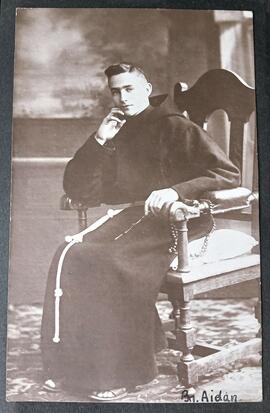
IE CA DB/BOM · Person · 30 August 1934-14 September 2020

Eamonn O’Mahony was born in Middleton, County Cork, on 30 August 1934, the son of James and Máire O’Mahony (née Tobin). He received his secondary education at the Seraphic College in Rochestown and entered the Capuchin novitiate on 3 October 1952. He took Brendan as his religious name upon joining the Order. He undertook his early academic studies in University College Cork, where he obtained a BA (1956), followed by an MA in 1957, both with first class honours. He then went to Ard Mhuire Friary near Creeslough in County Donegal for his theological studies and was ordained to the priesthood on 24 September 1960. From there he proceeded to the Pontifical Gregorian University in Rome where he was awarded a Licentiate in Sacred Theology (STL) two years later. From there he went to the University of Louvain in Belgium, where he obtained a PhD ‘Summa cum Laude’ in 1964. On his return to Ireland, he was appointed to the Chair of Philosophy in University College Cork, a professorship, his uncle, Fr. James O’Mahony OFM Cap., had occupied before him. There followed thirty-four years of busy academic work, during which scores of students destined for the priesthood in numerous congregations and orders received their grounding in philosophical studies. After several years as a member of the Provincial Definitory (Council), he was elected Irish Capuchin Provincial Minister in 1976, and was re-elected in 1979. In the latter year, under his guidance, the Western American Capuchin Province came into being in California and Oregon. In Ireland, he oversaw the opening of the Capuchin friary in Carlow in 1977. In 1982, the friars also took charge of Gurranabraher parish in the Diocese of Cork and Ross. He continued in his role as philosophy professor in University College Cork until his retirement in 1999. He died in Holy Trinity Capuchin Friary on Father Mathew Quay in Cork on 14 September 2020. He was buried in the cemetery adjacent to Rochestown Friary in County Cork.

Baptismal name: Eamonn O’Mahony
Religious name: Fr. Brendan O’Mahony OFM Cap.
Date of birth: 30 Aug. 1934
Place of birth: Midelton, County Cork (Diocese of Cloyne)
Name of father: James O'Mahony (Séamus Ó Mathúna)
Name of mother: Máire O’Mahony (née Tobin)
Date of reception into the Capuchin Order: 3 Oct. 1952
Date of first profession: 4 Oct. 1953
Date of final profession: 4 Oct. 1956
Date of ordination (as priest): 24 Sept. 1960
Educational attainments: BA, 1st class hons., UCC (1956); MA, 1st class hons, UCC (1957); Licentiate in Sacred Theology, Pontifical Gregorian University, Rome (1962); PhD, Catholic University of Louvain (1964)
Leadership positions: Provincial Definitor (Councillor), 1967-70, 1970-3; Provincial Minister, 1976-82
Date of death: 14 Sept. 2020
Place of death: Holy Trinity Capuchin Friary, Cork
Place of burial: Cemetery, Rochestown Capuchin Friary, County Cork

IE CA DB/AM · Person · 21 January 1912-25 December 1988

Baptismal name: John O’Mahony
Religious name: Fr. Alfred O’Mahony OFM Cap.
Date of birth: 21 Jan. 1912
Place of birth: Farrankeal, Rathmore, County Cork (Diocese of Kerry)
Name of father: Michael O’Mahony
Name of mother: Nora O’Mahony (née Cahill)
Date of reception into the Capuchin Order: 3 Oct. 1932
Date of first profession: 4 Oct. 1933
Date of final profession: 4 Oct. 1936
Date of ordination (as priest): 23 June 1940
Educational attainments: BA (1936)
Missionary activities: Travelled to Northern Rhodesia (now Zambia) on 8 Apr. 1942. Regular Superior of the Livingstone Mission from 1950 to 1967. He returned to Ireland on 5 Oct. 1973.
Date of death: 25 Dec. 1988
Place of burial: Cemetery, Capuchin Friary, Rochestown, County Cork
IE CA DB/171 · Person · 5 September 1910-19 December 1991

Early Life and Religious Formation
Valerian O’Leary was born Niall O’Leary on 5 September 1910 in Cork city. He received his preliminary education under the direction of the Christian Brothers in Cork. Following graduation, he entered the Capuchin Franciscan Order on 3 October 1927. He pronounced his solemn profession on 4 October 1931 and completed his theological curriculum over the ensuing years. He was ordained to the priesthood on 23 June 1935, at St. Eunan’s Cathedral in Letterkenny, County Donegal.

Initial Ministry and Missionary Transfer
Following ordination, Father O’Leary served his initial clerical assignment as Assistant Master of Novices in Ireland from July 1935 to October 1936. In late 1936, he was transferred to the American missions, commencing his long service on the West Coast as Assistant Pastor at St. Joseph Parish in Roseburg, Oregon.

Apostolates and Governance
Father O’Leary held the unique distinction of working within every primary apostolate of the Western American Mission, encompassing parochial work, education, healthcare chaplaincy, formation, and administration:

• Educational Leadership: Appointed as the inaugural Principal of St. Francis High School in La Cañada Flintridge, California, directing the institution through its foundational years from 1946 until 1952.
• Provincial Governance: Elected as a member of the Custos-Provincial Council, serving a three-year administrative term from 1949 to 1952.
• Healthcare Chaplaincy: Served as Chaplain to the State Hospital in Ukiah, California, from 1957 to 1961, and later as Hospital Chaplain in Fresno, California, from 1968 to 1975.
• Local Superiorship: Appointed Guardian of San Lorenzo Seminary in Santa Ynez, California, serving from 1975 to 1982.

Archival Labors and Concluding Years
Upon completing his term as Guardian in 1982, Father O’Leary remained in residence at San Lorenzo Seminary. During this period, he dedicated his efforts to a long-term historical project initiated in 1972: updating, compiling, and publishing the Provincial Catalogue, a highly utilized reference registry for the jurisdiction. In his advanced years, Father O’Leary suffered from failing health. He died on 19 December 1991. He was buried in the Capuchin Provincial Cemetery, San Lorenzo Seminary, Santa Ynez, California.

IE CA DB/AOL · Person · c.1729-8 January 1802

Arthur O’Leary was born in the townland of Acres near Dunmanway, County Cork, in c.1729. He was educated locally. In about 1747 he travelled to France and entered the Capuchin friary at Saint-Malo. He later served as a French army chaplain, and during the Seven Years War (1756-63) was assigned to visit prisons and hospitals where prisoners of war were confined. O’Leary returned to Ireland in 1771 and became a member of the Capuchin community in Cork city. He officiated at a small chapel in Blackamoor Lane (sometimes spelt Blackmoor Lane) which opened shortly after his arrival in the city. Through his many writings O’Leary actively campaigned to secure the relief of Irish Catholics from the Penal Laws. Discouragement at the ascendancy of forces opposed to religious reform in Ireland may have inspired O’Leary's decision to move in 1789 from Cork to London, where he served as a chaplain to the Spanish embassy. He soon quarrelled with his superior in that post, Fr. Thomas Hussey (1746-1803), a future bishop of Waterford and Lismore and the first president of Maynooth College. He transferred to St Patrick’s Chapel, Sutton St., Soho Square, where he ministered to a congregation that included many Irish members. In his new situation O’Leary was active in efforts to secure relief for English Catholics and exerted himself on behalf of distressed French émigrés. O’Leary died in London on 8 January 1802. He was buried in St. Pancras churchyard but in 1891 his remains were reinterred in the Catholic cemetery at Kensal Green.

IE CA DB/69 · Person · 25 March 1890-13 May 1976

Herbert O’Hanlon was born in Dublin on 25 March 1890. He joined the Capuchin Franciscans in October 1908 and took Reginald as his religious name. He was ordained to the priesthood on 1 July 1917. Soon after his ordination, he was assigned to the American mission custody and spent several years ministering on the West Coast. In 1924 the Irish Capuchins took over the administration of the Old Mission Santa Inés near Solvang in California. Fr. Regniald was appointed assistant pastor to Fr. Albert Bibby OFM Cap. He briefly took charge of the Mission in 1929. Seemingly he was a popular friar with parishioners and a local newspaper in Santa Barbara referred to him as a ‘true son of the Seraphic Francis’. Fr. Reginald returned to Ireland in 1934. He was initially assigned to Holy Trinity Friary in Cork but was later transferred to the Church Street community in Dublin. Aside from preaching, one of his principal ministries was the writing of short devotional booklets published by the Catholic Truth Society of Ireland (CTSI). He died in Dublin on 13 May 1976 and was buried in Glasnevin Cemetery.

Baptismal name: Herbert O’Hanlon
Religious name: Fr. Reginald O’Hanlon OFM Cap.
Date of birth: 25 Mar. 1890
Place of birth: Compton House, Dolphin’s Barn, Dublin
Name of father: Michael O’Hanlon
Name of mother: Catherine O’Hanlon (née Kelly)
Date of reception into the Capuchin Order: 18 Oct. 1908
Date of first profession: 26 May 1910
Date of final profession: 21 Dec. 1913
Date of ordination (as priest): 1 July 1917
Missionary activities: Travelled to the Western United States mission in 1924. He returned to Ireland in 1934.
Date of death: 13 May 1976
Place of death: Church Street, Dublin
Place of burial: Glasnevin Cemetery, Dublin

IE CA DB/129 · Person · 14 May 1902-11 August 1957

Baptismal name: Patrick O’Hanlon
Religious name: Fr. Oliver O’Hanlon OFM Cap.
Date of birth: 14 May 1902
Place of birth: 27 Michael Street, Waterford City (Diocese of Waterford & Lismore)
Name of father: David O’Hanlon (Grocer)
Name of mother: Sarah O’Hanlon (née Murphy)
Date of reception into the Capuchin Order: 17 Sept. 1920
Date of first profession: 18 Sept. 1901
Date of final profession: 29 Dec. 1925
Date of ordination (as priest): 19 June 1928
Educational attainments: BA (1924)
Missionary activities: Travelled to South Africa in April 1930; Elected a discreet for the African Mission on 21 June 1935. He was reappointed a discreet on 14 Oct. 1938
Date of death: 11 Aug. 1957
Place of death: Parow, Cape Town, South Africa
Place of burial: Maitland Cemetery, Cape Town, South Africa