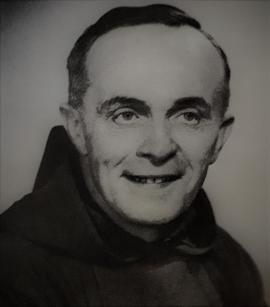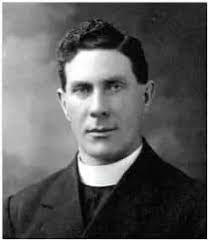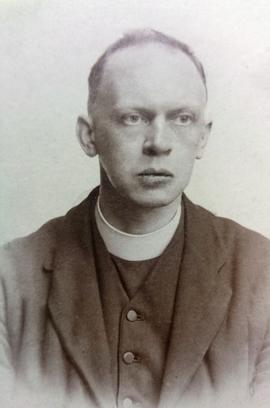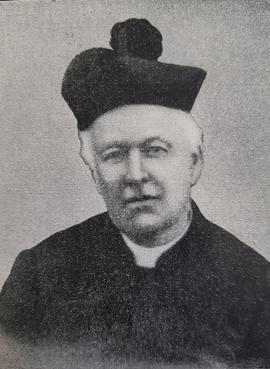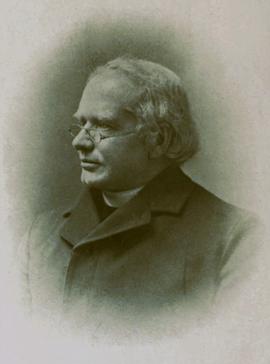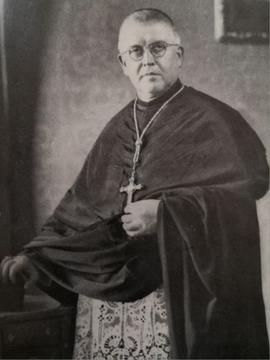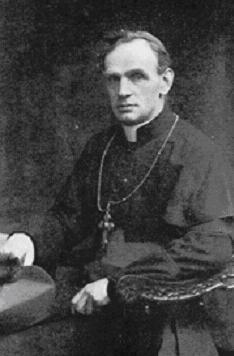
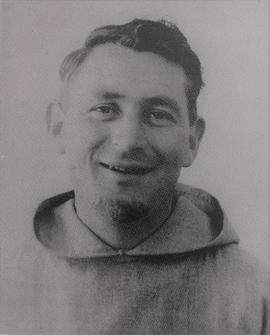
Peadar Ó Laoghaire (Peter O’Leary) was born in Lios Carragáin near Macroom in County Cork on 30 April 1839. Born into a bilingual family, he was educated at St. Colman’s College in Fermoy before entering the seminary at St. Patrick’s College, Maynooth, County Kildare. He was ordained to the priesthood in 1867. He went on to serve in several parishes in the diocese of Cloyne, spending his final thirty years (from 1891) as parish priest of Castlelyons (Caisleán Ó Liatháin) in County Cork. From 1906 he was officially titled Canon Peter O’Leary, but he was more commonly addressed as ‘an tAthair Peadar’ (or ‘Father Peter’). Although he did not begin writing in earnest until he was in his fifties, the foundation of Conradh na Gaeilge (1893) spurred him on to take up a career as a writer. He was particularly eager to compile accessible Irish language reading material, especially for a younger generation. O’Leary completed nearly five hundred pieces of work including essays, stories, and translations of The Bible and ‘Don Quixote’, in addition to modernisations of early and medieval Irish texts. His best-known works are ‘Séadna’ (1904) and ‘Mo scéal féin’ (1915). ‘Séadna’, a folk tale, is considered a seminal work in the Gaelic revival, epitomizing O’Leary’s championing of ‘caint na ndaoine’ or the language of the people. His pioneering autobiographical work, ‘Mo Sgéal Féin’, was published by the Irish Book Company, founded by Norma Borthwick and Mairéad Ní Raghallaigh, with whom he was closely associated. O’Leary’s contribution to Irish language literature saw him honoured as a freeman of both Dublin and Cork, with Cork Corporation referring to him as ‘the greatest Irish writer of his age’ when granting him the freedom of the city in 1912. O’Leary died in Castlelyons, County Cork, on 21 March 1920 and was buried in the local cemetery.
Josef Martin Kälin was born in Einsiedeln, Switzerland, on 22 March 1887. His parents were Josef Martin & Anna Verena (née Schön) Kälin. His father was a timber merchant and the family sought to educate all their children. From 1899 to 1907 he attended the high school located at Einsiedeln Abbey. He then entered the monastic life at Muri-Gries Abbey in northern Italy in 1908 and made his religious profession on 5 October 1909 being given the name "Bernard." He continued his education in the fields of Philosophy and Theology at the University of Freiburg and was ordained a Roman Catholic priest on 18 October 1912. He continued his studies at the same university receiving a doctorate in philosophy in 1918 with a dissertation on the Epistemology of Saint Augustine entitled "Die Erkenntnislehre des hl. Augustinus." Between the years 1913-1945 Kälin taught at Kantonsschule Obwalden overseen by the Benedictines, serving as teacher and rector of the school. During this time, he wrote a number of philosophy textbooks that became popular.
On 10 August 1945 Kälin was elected as the Abbot of Muri-Gries Abbey and received his blessing on 13 August 1945. He served in the role for only two years until he was elected as the third Abbot Primate of the Benedictine Confederation and Order of St. Benedict on 16 September 1947. As Abbot Primate he resided in Rome, Italy, while also overseeing Sant'Anselmo all'Aventino. He traveled quite extensively in his role as Abbot Primate, but was also instrumental in his work at the Pontificio Ateneo Sant'Anselmo where he founded a monastic institute, taught philosophy, and redesigned the Church of Sant'Anselmo. He served in this role until 1959 when he was not reelected as Abbot Primate, at which point he returned to Muri-Gries Abbey where he died on 20 October 1962.
Thomas Keogh was a Roman Catholic priest who became Bishop of Kildare and Leighlin. He was born in Gurteen, Skeoghvosteen, Graiguenamanagh, County Kilkenny in 1884. In 1898, he enrolled in St. Josephs's Academy in Bagenalstown, operated by the De La Salle Brothers. He studied for the priesthood in St. Patrick's College, Maynooth, and was ordained in 1909.
Bishop Keogh served on the staff of St. Patrick's, Carlow College (1911-1932) and as Vice-President (1921-1932), before being appointed parish priest of Portarlington, County Laois.
He was appointed Bishop of Kildare and Leighlin succeeding Dr. Matthew Cullen on 8 August, and consecrated 18 October 1936. He retired 25 September 1967, and died on 22 May 1969.
Baptismal name: Patrick King
Religious name: Fr. Philip King OFM Cap.
Date of birth: 16 Mar. 1885
Place of birth: Glin, County Limerick
Name of father: Thomas King
Name of mother: Johanna King (née Ahern)
Date of reception into the Capuchin Order: 17 Mar. 1903
Date of first profession: 17 Sept. 1904
Date of final profession: 31 July 1908
Date of ordination (as priest): 24 Sept. 1921
Educational attainments: BA (RUI)
Date of death: 22 Aug. 1952
Place of burial: Cemetery, Capuchin Friary, Rochestown, County Cork
Patrick Morrisroe the son of Mary Brennan and John Morrisroe (the baker) was born in Charlestown, County Mayo 19th February 1867. His sponsors were Luke Brennan and Frances Kelly. He joined several siblings. As seemed to follow family suit, he was educated at the local N.S. Seminary, then on to Ballaghadereen and Maynooth College. Following his ordination at the Cathedral at Ballaghadereen he served in the diocese of Achonry. In 1896 Patrick returned to Maynooth to become Junior Dean in the College.
CathedralPatrick was consecrated a Bishop at the age of 44 in the Cathedral, Ballaghadereen along with his cousin Most Rev. Bishop Michael J. O'Doherty, later to become Bishop of Zamboagna, in the Philippines. Most Rev. Dr. Healy, Archbishop of Tuam was the concecrating prelate, and was assisted by Rev. Dr. Clancy, the Bishop of Elphin. The congregation which filled the Cathedral included Messrs. John Dillon M.P., J. McVeagh M.P., and John O'Dowd M.P. The sermon was preached by Rev. Dr. Beechler, Maynooth College.
A man of deep learning Patrick was an authority on theological and liturgical matters. His Lenten Pastoral of 1941, one of great controversy was censored by the government. There are two versions of the Pastoral, one before censorship and one after. In it he directs his final comments to a world in crisis. "As we pen these pages, beloved Brethren, we are face to face with a spectacle probably more appaling than any recorded in the annals of history. Long ago it was predicted that nation would rise agains nation and Kingdom against Kingdom."
At the age of 79 Patrick died at the Palace, Edmondstown House, Ballaghadereen. Priests and people from all parts of the Diocese of Achonry and from around the world attended the removal of the remains to St. Nathy's Cathedral. The Archbishop of Tuam, Most Rev. Dr. Walsh officiated at the house. The funeral procession was headed by the members of the Diocesan Chapter and a large number of surpliced clergy of the diocese who chanted the Miserere. Members of the St. Vincent de Paul and Gardai acted as pall-bearers and marshals, and gardai, under the direction of Supt. J. Lyons provided a guard of honour. Members off all the Catholic organizations marched in the procession. His crypt is located within the sanctuary.
Taken from - https://freepages.rootsweb.com/~morrisroe/genealogy/notjustacouple.html
See also https://www.catholic-hierarchy.org/bishop/bmorr.html
John Anthony "Jack" Kyne (4 November 1904 - 23 December 1966) was the Roman Catholic Bishop of Meath, Ireland from 1947 to his death in 1966.
Kyne was born in Longwood, County Meath on the 4 November 1904. He won a scholarship to St Finian's College in Mullingar and later became a member of staff there. Kyne studied for the priesthood at the Irish College in Rome and was ordained a priest of the Diocese of Meath on 31 July 1927. From 1930, including during World War II, he served as a vice-rector of the Pontifical Irish College in Rome. In 1939 Pope Pius XII named him a Monsignor and further appointed him as Papal Chamberlain in 1940.
Episcopal ministry
Following his predecessors elevation to Archdiocese of Armagh in 1946, he was appointed Bishop of Meath on 29 June 1947,[1] a position he held until his sudden death in Mullingar on 23 December 1966.
James J. Ryan (1851 – May 9, 1939) was an Irish Catholic priest in the diocese of Cashel, who served as president of St. Patrick's College, Thurles (1903–1914). Ryan also funded the establishment of Glenstal Abbey, inviting the Pallotine order to establish a presence in Thurles, and funded the re-establishment of the Irish College in Louvain. Born in Thurles, Co. Tipperary in 1851, he went to Louvain to train for the priesthood from 1873, ordained in 1876 he was awarded the degree of J.C.B. (Lovan.) before continuing his studies in Rome.
Returning to Ireland in 1879, Ryan took up a position as a professor of church history, in St. Patrick's College, Thurles, the Cashel Diocesan Seminary, before becoming vice-president and in 1903 president of the college, a position he held until 1914. In 1909 with the support of Archbishop of Cashel, Rev. Dr. Fennelly, he invited the pallottine order to set up in Thurles with their students studying in St. Patrick's College when he died in 1939 he left his residence to the order.
Glenstal Abbey
Reportedly a wealthy man, Ryan purchased Glenstal Castle for £2000, in 1927, from Sir Charles Barrington, where he resided for some time, promising it to the Benedictine order if they set up a monastery there, which they eventually availed of. Initially, there was some discussions between the order and Ryan who wanted to maintain room and hunting a fishing rights on the property, as well as the order considering other locations such as Kylemore.
Re-establishment of the Irish College, Louvain
Ryan was involved in the re-establishment of the Franciscan Irish College, in Louvain, St Anthony's College, Leuven, which had no longer been in the Irish, or orders possession, since the French Revolution. With his friend from their University days in Louvain, Cardinal Désiré-Joseph Mercier, and helped by funding from Irish-born American philanthropist Marquis Martin Maloney. He purchased the property on behalf of the Irish Franciscans, in 1923 (for legal reasons it was nominally under the ownership of the Catholic University of Louvain), worked to have the property repaired after damage from the Great war, and restored the memorial stones of the Irish buried there.
Ryan died at his residence The Hermitage, Cabra, Thurles, on May 9, 1939.
- Wikipedia
Thomas Joyce was born near Urlingford in County Kilkenny on 15 June 1906. He joined the Capuchin Franciscans in October 1926 and took Gerard his religious name. He enjoyed a brilliant academic career in Rome (gaining a Licentiate in Canon Law) and in Ireland (a Higher Diploma in Education from University College Cork). He was ordained to the priesthood at Ard Mhuire Capuchin Friary in County Donegal in June 1933. In 1937 he travelled to the Prefecture of Victoria Falls in Northern Rhodesia (later Zambia) and ministered in the region around Sihole for seven years. He died of blackwater fever at the mission outpost of Kalabo on 12 July 1944 at the age of just thirty-five. Fr. Capistran Singleton OFM Cap., a fellow missionary friar, ministered to him in his final hours while Br. Alexius Paolucci OFM Cap. made his coffin with some wooden planks intended for the new church.
Baptismal name: Thomas Joyce
Religious name: Fr. Gerard Joyce OFM Cap.
Place of birth: The Islands, Urlingford, County Kilkenny (Diocese of Ossory)
Date of birth: 15 June 1906
Name of father: Patrick Joyce (Farmer)
Name of mother: Mary Joyce (née Hennessy)
Date of reception into Capuchin Order: 4 Oct. 1926
Date of first profession: 5 Oct. 1927
Date of final profession: 5 Oct. 1930
Date of ordination (as priest): 29 June 1933
Educational attainments: BA (1930); LIC (Rome, 1933-6); returned from Rome in 1936 to prepare for missionary work in Africa
Missionary activities: Travelled to the Prefecture of Victoria Falls, Northern Rhodesia (later Zambia), in 1937
Date of death: 12 July 1944
Place of death: Kalabo, Northern Rhodesia (died of Blackwater Fever). Fr. Capistran Singleton OFM Cap. was with him.
John Brendan Herlihy was born in the village of Knocknagree in County Cork on 11 March 1911. He joined the Capuchin Franciscan Order in October 1928 and took Agathangelus as his religious name. He studied in Rome and was later ordained to the priesthood in Letterkenny, County Donegal, in June 1935. In the following year he volunteered for missionary work in Africa. He initially worked in the missionary territory in the Prefecture of Victoria Falls in Northern Rhodesia (later Zambia). In the 1940s he was appointed guardian (local superior) and parish priest of St. Mary of the Angels Friary in Athlone just outside Cape Town in South Africa. On 9 September 1958 he arrived in New Zealand and was appointed the first guardian of the community at 186 Glenmore Street in Northland, a suburb of Wellington. He was also the first Capuchin priest in St. Vincent de Paul Parish (now Otari Parish) in Northland-Kelburn in Wellington. He was diagnosed with cancer and died in Wellington on 5 June 1968. He was buried in Karori Cemetery, Wellington
Baptismal name: John Brendan Herlihy
Religious name: Fr. Agathangelus Herlihy OFM Cap.
Date of birth: 11 Mar. 1911
Place of birth: Knocknagree, Couny Cork (Diocese of Kerry)
Name of father: John Herlihy
Name of mother: Catherine Herlihy (née Sullivan)
Date of reception in the Capuchin Order: 5 Oct. 1928
Date of first profession: 6 Oct. 1929
Date of final profession: 6 Oct. 1932
Date of ordination (as priest): 23 June 1935 (St. Eunan’s Cathedral, Letterkenny)
Educational attainments: 1st class hons., BA, 1931
Missionary activity: Travelled to the Prefecture of Victoria Falls, Northern Rhodesia (later Zambia), on 31 Oct. 1936; Travelled to Wellington, New Zealand, on 21 June 1958
Leadership positions: Appointed first discreet of the Victoria Falls Mission, Northern Rhodesia, on 28 March 1946; Appointed second discreet of the Livingstone Mission, Northern Rhodesia, on 24 Nov. 1950 (re-appointed on 6 June 1954).
Date of death: 5 June 1968
Place of death: Calvary Hospital, Wellington, New Zealand
Place of burial: Karori Cemetery, Wellington, New Zealand