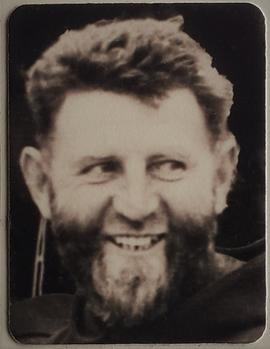
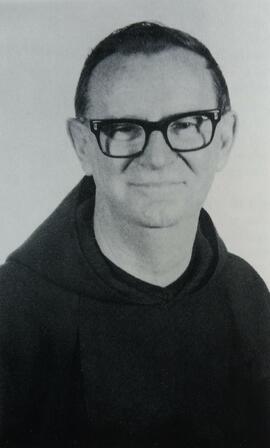
Baptismal name: William O’Donovan
Religious name: Br. Finbarr O’Donovan OFM Cap.
Date of birth: 3 Jan. 1912
Place of birth: 4 Kinsale Cottages, Cork
Name of father: Daniel O’Donovan (Labourer)
Name of mother: Catherine O’Donovan (née Casey)
Date of reception into the Capuchin Order: 21 Oct. 1951
Date of first profession: 22 Oct. 1952
Date of final profession: 22 Oct. 1955
Date of death: 13 Jan. 1988
Place of death: St. Bonaventure’s Friary, Cork
Place of burial: Cemetery, Rochestown Capuchin Friary, Cork
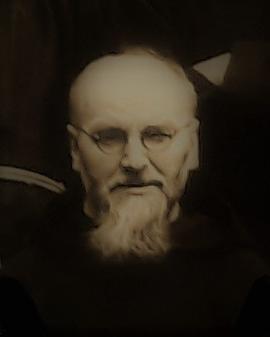
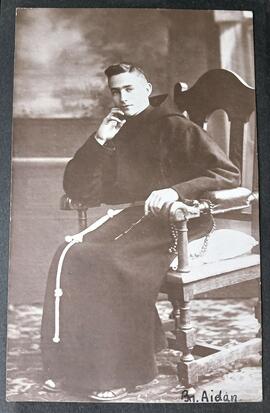
William Byrne was born in Enniscorthy, County Wexford, on 6 July 1887. He joined the Capuchin Franciscans on 23 May 1908 and took Aidan as his religious name. He made his solemn profession on 12 October 1912. For many years he was associated with the House of Studies at St. Bonaventure’s in Cork. He was later appointed a Brother Questor and collected alms to support the friars for over twenty years. He died in Dublin on 1 June 1963 and was buried in the Capuchin plot in Glasnevin Cemetery.
Baptismal name: William Byrne
Religious name: Br. Aidan Byrne OFM Cap.
Date of birth: 6 July 1887
Place of birth: Duffy’s Gate, Enniscorthy, County Wexford (Diocese of Ferns)
Name of father: Edward Byrne (Painter)
Name of mother: Mary Byrne (née Atkins)
Date of reception into the Capuchin Order: 23 May 1908
Date of first profession: 8 Sept. 1909
Date of final profession: 12 Oct. 1912
Date of death: 1 June 1963
Place of death: Bons Secours Hospital, Glasnevin, Dublin
Place of burial: Glasnevin Cemetery, Dublin
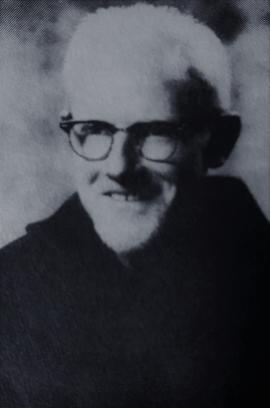
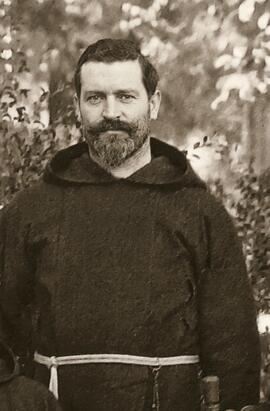
James Honohan was born in Donoughmore in County Cork on 16 September 1905. He joined the Capuchin Franciscans in April 1932 and took Patrick as his religious name. Shortly after his solemn (final) profession in April 1936, he was transferred to the United States mission custody. His initial assignment was in St. Patrick’s Friary in Wilmington, Delaware. In 1943 he was transferred to St. Joseph’s Church in Roseburg, Oregon, where he spent three years. In 1946 he came to St. Francis High School in La Cañada Flintridge, California, where he spent thirteen years, serving as cook and sacristan. Following another year in Willington, Br. Patrick returned to St. Francis High School. In 1966 he assigned to Mission Santa Inés, Solvang, California. He again served as cook and sacristan and maintained the mission’s grounds. He died in Santa Inés on 6 September 1979 and was buried in the cemetery adjoining San Lorenzo Friary.
Baptismal name: James Honohan
Religious name: Br. Patrick Honohan OFM Cap.
Date of birth: 16 Sept. 1905
Place of birth: Ballycunningham, Donoughmore, County Cork (Diocese of Cloyne)
Name of father: Andrew Honohan (Farmer)
Name of mother: Hannah Honohan (née Twomey)
Date of reception into the Capuchin Order: 24 Apr. 1932
Date of first profession: 25 Apr. 1933
Date of final profession: 25 Apr. 1936
Missionary activities: Travelled to the United States mission on 4 Oct. 1936
Date of death: 6 Sept. 1979
Place of death: Santa Inés, California
Place of burial: San Lorenzo Friary, Santa Inés, California
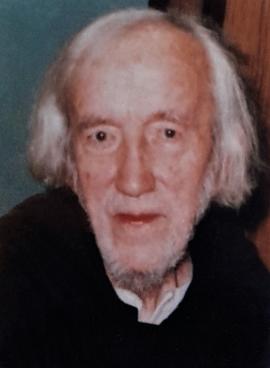
James Grealy was born in Dunnamaggin, County Kilkenny, on 6 October 1927. He was received into the Capuchin Order in October 1927 at St. Bonaventure’s in Cork. He took Hubert as his religious name upon joining the Order. He was ordained to the priesthood on 23 June 1935. He served as Director of Students at St. Bonaventure’s in Cork for twenty-one years (1944-67). Prior to this assignment, Fr. Hubert served as Vice-Master of Novices. In 1970 he was appointed Master of Novices, a position he would hold for five years (to September 1975). Throughout his life, he maintained a keen interest in Mariology and published several works on the subject. Later, his special interest in the Knock apparition led him to write several pamphlets, including ‘Towards an understanding of the Apparition at Knock’ (1959) and ‘The Meaning of St. Joseph’s Presence at the Apparition at Knock’ (1960). In 1975 the Franciscan Herald Press published his work on the souls in purgatory titled ‘The Mystery of Purgatory’. He was also involved in giving retreats (particularly to religious sisters). He spent the final years of his life in the Capuchin Friary in Raheny in Dublin. He died in a nursing home in Dalkey, County Dublin, and was buried in Glasnevin Cemetery.
Baptismal name: James Harold Grealy
Religious name: Fr. Hubert Grealy OFM Cap.
Date of birth: 6 Oct. 1907
Place of birth: Caherlesk, Dunnamaggin, County Kilkenny (Diocese of Ossory)
Name of father: Michael Grealy
Name of mother: Catherine Grealy (née Timon)
Date of reception into the Capuchin Order: 3 Oct. 1927 (Kilkenny Friary)
Date of first profession: 4 Oct. 1928
Date of final profession: 4 Oct. 1931 (St. Bonaventure’s Friary, Cork)
Date of ordination (as priest): 23 June 1935 (St. Eunan’s Cathedral, Letterkenny, County Donegal)
Leadership positions: Spiritual Director of Philosophy Students, St. Bonaventure’s Friary, Cork, 1944-67; Master of Novices, Kilkenny Friary, 1970-5
Date of death: 29 Mar. 1993
Place of death: Our Lady’s Manor Nursing Home, Dalkey, County Dublin
Place of burial: Glasnevin Cemetery, Dublin
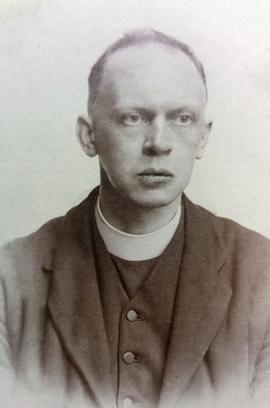
Henry Edward George Rope was a writer, poet, editor, and priest widely known in the Catholic Church for his traditionalist views. He was the elder brother of Margaret Agnes Rope, a stained-glass artist, a nephew of Ellen Mary Rope, a sculptor, and George Thomas Rope, a painter, and naturalist, as well as a cousin of M.E. Aldrich Rope, another stained-glass artist. He was ordained at St. John Lateran in Rome on 27 February 1915. He served in the Shrewsbury Diocese up until 1937, in which year, on 30 October, he took up the position of archivist in the Venerable English College in Rome. His positions as a priest included Chester St Werburgh 1915-17, Crewe 1917-18, Plowden, Shropshire 1918-24, Market Drayton 1924-25, and chaplain at Mawley Hall (near Cleobury Mortimer) 1925-37. His tenure in Rome was interrupted by the Second World War, during which he served as a chaplain at the Convent of the Sacred Heart in Albrighton Hall, Shrewsbury (1940-44). He re-joined the Venerable English College and on his return to Rome after the war in 1946, again served as archivist, until December 1957. Returning to England, he settled at the Carmelite Monastery, Quidenham, Norfolk, where his sister Margaret Agnes Rope, the stained-glass artist, had died some four years previously. Due to his writings and his work as archivist at the Venerable English College in Rome, he was well known in his lifetime, particularly within church circles. He nurtured friendships with many prominent lay Catholics and clergy which in turn generated a wealth of correspondence. Aside from Benedict Williamson (1868-1948), a church architect and later Catholic priest, on whom he wrote a two-part monograph, Rope is associated with G.K. Chesterton, Hilaire Belloc, John Hawes, and many others. Henry Rope died in London on 1 March 1978 and was buried in the graveyard attached to the Church of St. Michael and the Holy Family in Kesgrave, Suffolk.
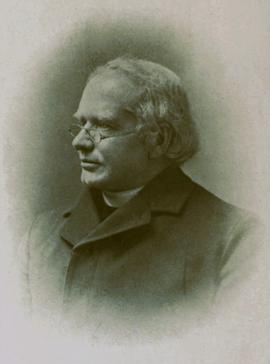
Peadar Ó Laoghaire (Peter O’Leary) was born in Lios Carragáin near Macroom in County Cork on 30 April 1839. Born into a bilingual family, he was educated at St. Colman’s College in Fermoy before entering the seminary at St. Patrick’s College, Maynooth, County Kildare. He was ordained to the priesthood in 1867. He went on to serve in several parishes in the diocese of Cloyne, spending his final thirty years (from 1891) as parish priest of Castlelyons (Caisleán Ó Liatháin) in County Cork. From 1906 he was officially titled Canon Peter O’Leary, but he was more commonly addressed as ‘an tAthair Peadar’ (or ‘Father Peter’). Although he did not begin writing in earnest until he was in his fifties, the foundation of Conradh na Gaeilge (1893) spurred him on to take up a career as a writer. He was particularly eager to compile accessible Irish language reading material, especially for a younger generation. O’Leary completed nearly five hundred pieces of work including essays, stories, and translations of The Bible and ‘Don Quixote’, in addition to modernisations of early and medieval Irish texts. His best-known works are ‘Séadna’ (1904) and ‘Mo scéal féin’ (1915). ‘Séadna’, a folk tale, is considered a seminal work in the Gaelic revival, epitomizing O’Leary’s championing of ‘caint na ndaoine’ or the language of the people. His pioneering autobiographical work, ‘Mo Sgéal Féin’, was published by the Irish Book Company, founded by Norma Borthwick and Mairéad Ní Raghallaigh, with whom he was closely associated. O’Leary’s contribution to Irish language literature saw him honoured as a freeman of both Dublin and Cork, with Cork Corporation referring to him as ‘the greatest Irish writer of his age’ when granting him the freedom of the city in 1912. O’Leary died in Castlelyons, County Cork, on 21 March 1920 and was buried in the local cemetery.
Early Life and Early Ministry
Leo Sheehan was born Denis Sheehan on 10 December 1889 in Macroom in County Cork. He entered the Capuchin Franciscan Order and, following his ordination to the priesthood, was transferred to the United States to serve the American missions. By 1922, Father Sheehan was assigned to St. Mary’s Parish in Ukiah, California, ministering alongside the Father Urban Riordan. In early 1924, he was stationed at St. Anthony’s in Mendocino, California, while concurrently providing pastoral assistance to the coastal parish in Greenwood.
Educational Leadership at Mendocino City
In 1924, following the Capuchin friars’ acquisition of a large estate built in 1902 in Mendocino City, Father Sheehan proposed converting the property into a preparatory seminary for aspirants to the Order.
• Authorization: Approved by the Provincial Definitory in Ireland on October 7, 1924.
• Rectorship: Following remodelling, the facility accommodated 40 students, with Father Sheehan appointed as the first and only Rector of St. Anthony’s School.
• Decline and Destruction: Student enrolment declined sharply in 1929 at the onset of the Great Depression. In 1930, an electrical wiring short caused a catastrophic fire that destroyed the building; the school was never rebuilt.
Subsequent Pastoral Assignments
Following the closure of the school, Father Sheehan returned to full-time parochial ministry across the United States:
• 1932: Stationed at Our Lady of Good Counsel Parish in Fort Bragg, California, alongside the Reverend Finbarr O’Callaghan.
• Pre-1935: Assigned to St. Francis Parish in Bend, Oregon.
• 1935: Transferred to St. Joseph’s Parish in Roseburg, Oregon, following a formal canonical visitation of the American houses conducted by the Reverend James O’Mahoney on behalf of the Irish Provincial Definitory.
• Later Years: Transferred to St. Patrick’s Friary in Wilmington, Delaware, where he spent the remainder of his active ministry.
Father Leo Sheehan passed away on 2 October 1959. He is buried in Wilmington, Delaware.
Early Life and Academic Formation
Emilian Meade was born John Joseph Meade on 8 May 1919, in Knocknagree, County Cork, to John and Helena Meade. He received his secondary education at the Capuchin Franciscan College in Rochestown, County Cork. In 1938, he entered the Capuchin Franciscan Order, making his simple profession in 1939 and his solemn profession in 1942. His higher education comprised philosophical studies at University College Cork, followed by theological studies in Ard Mhuire Friary in County Donegal. He was ordained to the priesthood there in 1946.
Educational Apostolates in California
In 1947, Father Meade was transferred to the West Coast of the United States to join the faculty of the newly opened St. Francis High School in La Cañada Flintridge, California. He dedicated many years to the institution as both an instructor and administrator, serving two distinct tenures as school principal:
• First Term as Principal: 1952-1956
• Second Term as Principal: 1963-1965
Additionally, he served a brief tenure as a member of the teaching faculty at Mater Dei High School in Santa Ana, California.
Provincial Governance and the Founding of San Lorenzo Seminary
Father Meade entered executive leadership upon his election as Custos Provincial of the Western American Custody, serving from 1956 to 1962. Upon taking office, he heavily emphasized spiritual renewal, urging the friars to ‘pray for vocations’, and continued the foundational administrative work initiated by his predecessor, Father Stephen Murtagh OFM Cap.
His six-year provincial administration was defined by a major expansion milestone:
• Land Acquisition: Accepted an offer of land donated by the Hourihan family in the Santa Ynez Valley.
• Seminary Construction: Oversee the establishment and construction of San Lorenzo Seminary, which formally opened on 4 September 1962.
• Institutional Relocation: Successfully transitioned the novitiate from Wilmington, Delaware, to the West Coast, achieving a long-standing provincial objective to train novices locally in the West. Father Cyril Kelleher OFM Cap. was appointed the seminary’s first Guardian, and Father Sebastian Ward OFM Cap. was named Novice-Master.
Following his provincial term, Father Meade returned to San Lorenzo Seminary from 1965 to 1969, serving as Guardian and overseeing structural developments and landscaping improvements to the friary grounds.
Parochial Ministry, Healthcare Chaplaincy, and Final Years
Following his administrative tenures, Father Meade shifted into local pastoral work and healthcare chaplaincy:
• Burlingame, California: Served a brief assignment as Associate Pastor at Our Lady of Angels Parish.
• Fresno, California: Transferred in 1975 to serve as Guardian of the Fresno Friars and Chaplain to the Fresno Community Hospital.
While stationed in Fresno, Father Meade developed a chronic heart condition that significantly altered his active routine. In 1991, he returned to Our Lady of Angels Rectory in Burlingame, spending the final ten years of his life in retirement. Father Emilian Meade died on 4 August 2001. He was buried in the cemetery attached to San Lorenzo Seminary, Santa Inés, California.

Early Life and Religious Formation
Daniel O’Reilly was born on 11 September 1894, on Walkin (now Friary) Street, Kilkenny, Ireland, to Patrick O’Reilly and Kate O’Reilly (née Cross). He entered the Capuchin Franciscan Order, receiving the religious name Aidan upon his investiture on 17 September 1911. He pronounced his simple vows on 17 September 1912, and made his solemn, perpetual profession on 8 July 1916. Parallel to his religious formation, he pursued higher education and graduated with a Bachelor of Arts degree in 1915. He was ordained to the priesthood on 3 May 1918.
Missionary Assignment and Ministry in the United States
Following his ordination, Father O’Reilly spent his initial years in Ireland before emigrating to the United States in 1921 to join the American mission field. His subsequent ministry was centred across several notable Pacific Coast foundations:
• Los Angeles, California: Dedicated most of his provincial career to parochial ministry at St. Francis of Assisi Parish near Sunset Boulevard.
• Solvang, California: Appointed Pastor of Old Mission Santa Inés in 1936, directing the historic parish for a multi-year tenure.
• Burlingame, California: Assigned in 1959 to assist the community of friars at Our Lady of Angels Parish during his final year of life.
Throughout most of his life, Father O’Reilly suffered from a succession of chronic illnesses. On 7 December 1959 (the eve of the Feast of the Immaculate Conception) he was noted by his community to be in excellent spirits. He retired early to his room in preparation to celebrate the 8:00 a.m. scheduled public Mass the following morning. Sometime during the early morning hours of 8 December 1959, he passed away quietly in his sleep at the age of sixty-five. He was buried in Burlingame near San Francisco in California.
Religious name: Fr. Aidan O’Reilly OFM Cap.
Baptismal name: Daniel O’Reilly
Date of birth: 11 Sept. 1894
Place of birth: Walkin (now Friary) Street, Kilkenny
Name of father: Patrick O’Reilly
Name of mother: Kate O’Reilly (née Cross)
Date of reception into the Capuchin Order: 17 Sept. 1911
Date of first profession: 17 Sept. 1912
Date of final (solemn) profession: 8 July 1916
Date of ordination (as priest): 3 May 1918
Educational attainments: BA (1915)
Missionary activities: Travelled to the United States in 1921
Date of death: 8 Dec. 1959
Place of burial: Burlingame, California
Early Life and Education
Daniel Duffy was born in Brooklyn, New York, on 10 February 1908. At his baptism, he was given the Christian name Thomas. He holds the distinction of being the first locally born vocation for the future Western American Capuchin Province. He was sent to Ireland to pursue his religious formation, where he entered the novitiate and completed his philosophical and theological studies.
Ordination and Ministry
Daniel Duffy was ordained to the priesthood at St. Eunan’s Cathedral in Letterkenny, County Donegal, on 17 June 1934. He returned to the United States in 1935. Known among his fellow friars as ‘Dan’, his early ministry was characterized by diligent work as an associate pastor, during which he frequently conducted missions and novenas.
Pastoral Assignments
• Ukiah, California (1940s–1950s): Spent a significant portion of his ministry serving at St. Mary’s Parish.
• Hermiston, Oregon: Served as an associate pastor across three distinct intervals: briefly in 1952, from 1957 to 1961, and from 1964 to 1965.
• Roseburg, Oregon: Transferred to St. Joseph Parish for what would be his final active pastoral assignment.
Late Life and Death
While serving in Roseburg, Father Duffy suffered a stroke, leading to a rapid decline in his health. He was subsequently transferred to a care facility in Beaverton, Oregon. Despite being confined to a wheelchair, he continued to offer Mass whenever his strength permitted and received regular visits from his fellow Friars. After receiving the Sacrament of the Sick, Father Duffy died peacefully on 14 December 1967. He is buried in Roseburg, Oregon.